Friday, August 21, 2009

Post # 72, Just how would you go about making a product for multiple systems?

There's an awful lot of panty twisting going on out there over the Mentzer/Kask/Ward game company announcement. Guys who's opinions I respect seem to have come down on opposing sides and I'm not really sure why. The whole thing appears too vague at this point for me to have any feeling one way or the other. There is simply not enough information available yet for me to draw any conclusions.

I have to assume that this is another example of the internet super-highway retarding communications rather than enhancing them. I see that a lot.

I've observed gamers, whom I know think very nearly alike, blunder into keyboard confrontations at their first meeting in forums and comment threads over some tiny, ill chosen verbage.
Ladies and gentlemen, words on screen, in stark black and white, automaticlly appear hostile when they espouse a view point that is counter to your own. Human communication is mostly non-verbal. Inflection, facial expressions, body language make up the major part of how we convey thoughts. The internet eliminates all of this. With out these things to moderate the meanings of our words, every sentence that dos'nt support our own point of view is translated by our lizard brains as, "Everything you love, sucks!"

So, I'm not going to choose up sides and start flinging crap.

Personally, I would very much like to see the M/K/W project succeed. Not because the OSR needs a "big dog" to lead, but because those guys have done great work in the past, and I expect to see them do so again in the future.

Now to the question. Frank posted about how they were thinking of publishing adventures in a thread on Dragonsfoot. The idea was to make systemless modules that included a statistic booklet that would provide the information for many different systems, so that the module could be run with what ever game system you happen to prefer.

I like this idea, since my own personal OSR is a very broad domain, stretching all the way from the grim mountains of OD&D, to the black valley of AD&D, all the way to the frothy sea of 2e. And it also encompasses all the retro-clone outlands.

In order to make this work though, you'd have to be able to compress a lot of system information into a form that is very tight in presentation. Otherwise, you end up printing a lot of text that isn't of use to your buyer, and this is text and paper they still have to pay for even if it isn't usefull to them.

My first shot at this was the Multi-Edition Stat Column. I cross referenced the orc monster entry from OD&D, Basic D&D, AD&D, 2e, LL, S&W, BFRPG, and Hackmaster4e and sorted out a stat column that included all stats from all editions. I divided it into a top block for combat stats, and a bottom block for non-combat stats. I put the abreviations for each game across from the stats they appear in so that the DM could see at a glance, which stats applied to his game.

I had a helluva time making it look right on the blog until Max Davenport helped me with the html. I hate that crap. I was going to use it for all the monsters here on the blog, but the html is sort of a pain and I've reverted to standard AD&D stats since.

I think one thing I'd do differantly now would be to assign a symbol to each of the editions instead of using their abreviations. Or maybe not. I'll have to try it and see how it looks.

So, other than monster stats, what could be done to compress the presentation of the crunchy bits of the various editions into a form that would be understandable, and not require too much paper and deciphering?
Now that I really start to think about it, what else is there in an adventure module that requires statistics other than the monster entries?

Below is the original version of the Multi-Edition Stat column for the Giant Ground Stirge.

Whats the rest of the OSR braintrust have to say? Got any ideas?


>
All editions. Armor Class : 5
All editions. Hit Dice :4+4
All editions. Movement :8" (max when fleeing)
All editions. Number of Attacks :1
All editions. Damage/Attack :1-6
S&W, AD&D, 2E, HM4E. Special Attacks :blood drain
AD&D, 2E, HM4E. Special Defenses :natural camouflage, as elven cloak.
AD&D, 2E, HM4E. Magic Resistance :nil
S&W, LL, BFRGP. Save (as) : 4 hit die monster, or 4th level fighter
AD&D, 2E, HM4E. Frequency :rare
OD&D, LL, BFRPG, AD&D, 2E, HM4E. Number Appearing :1-3
OD&D, AD&D. % in lair :30%
AD&D, 2E, HM4E. Intelligence :animal
LL, BFRPG, 2E, HM4E. Morale :low
LL, AD&D, 2E, HM4E. Alignment :neutral
AD&D, 2E, HM4E. Size :M, six feet long
OD&D, LL, BFRPG, AD&D, 2E. Treasure Type :nil
S&W, BFRPG, AD&D, 2E, HM4E. Level/XP Value :4th/150+3 per hp
AD&D, HM4E. Psionic Ability :nil
2E, HM4E. Climate/Terrain :woods and scrub lands
2E, HM4E. Organization :solitary
2E, HM4E. Activity Cycle :nocturnal
2E, HM4E. Diet :living blood
2E. THACO :17
HM4E. AKA :Throat stabber

Monday, August 17, 2009

The Welwa, or, I frikken told you not to pick the Shalm cursed flowers!

"She did not fly through the air, but neither did she walk upon the earth. She had a mane like a horse, horns like a deer, a face like a bear, eyes like a polecat; while her body had something of each. And that was the Welwa."

quote from, The Violet Fairy Book, Andrew Lang, 1901. Illustration by H.J.Ford.

The Welwa

Frequency: Singular
No. appearing: 1
Armor class: Variable
Move: Variable
Hit dice: Variable
% in lair: Special, the Welwa only exists during encounters.
Treasure type: nil
No. of attacks: 3 per round
Damage/attack: Variable
Special attacks: Variable
Special defenses: Variable
Magic resistance: 50%
Intelligence: Very
Alignment: Neutral
Size: L
Psionic ability: nil

It is thought that the Welwa is possibly a form of, "Genius Loci", a spirit of place, which generates a physical form to defend is location. The Welwa may manifest in ancient locations of great natural beauty. Old forests, rivers, mountains, etc... Should the area be in some way threatened, the Welwa may appear to protect it.

The Welwa takes the form of a composite creature. Animals native to the area are merged into a single being which features the most powerful attributes of each. The Welwa is different every time it is manifest.

The Dungeon Master must generate it's statistics at each encounter. This is done by rolling on a random wilderness encounter table that is applicable to the environment of the area in question.
Six creatures must be chosen at random, disallowing those which are unnatural, or of greater than animal intelligence.

The Welwa will have hit dice equal to the total combined hit dice of all the creatures which were incorporated into it.

Each entry in the statistic column above which is listed as, "Variable", is chosen from the most advantageous choice possible considering the stats of the random creatures aggregated into each unique incarnation of the Welwa.

As an example, an incarnation comprised of, elk, bear, wolf, skunk, weasel, and hawk, would have an armor class of 6, a move of 33', do damage/attack of 1-6/1-6/2-8, have special attacks of, Gore, Hug, Musk, and double damage on a dive, and would have 12+8 hit dice.

In an encounter, adventurers must defeat the Welwa, or flee from it. It cannot be charmed, held, or otherwise commanded or influenced as it is a force of nature. The Welwa will attack without pause, and it has no need to check morale. It will pursue to the natural boundry of it's generating area.

If the party will be passing through an area capable of manifesting the Welwa, and it seems likely that they may act in a way which will provoke the place's spirit, it is best to pregenerate the Welwa so as not to slow the game.

********************************************************

I took the idea for the Welwa from The Violet Fairy Book, which I found online at The Children's Nursery and it's Traditions. It's A nice site with many old, and out of copyright books of fairy tales digitized and scanned for the web. I love those gruesome old children's tales from before the helicopter parent appeared to insulate their precious snowflakes from any suggestion that the world did not love them.

http://www.childrensnursery.org.uk/

Saturday, August 15, 2009

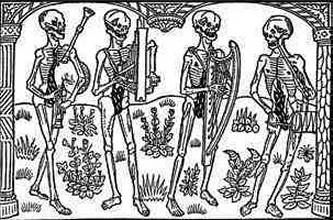
The Bone Minstrels, or, "Look out! That skeleton's got a...flute?!

The Bone Minstrels.

Frequency: Very rare
No. appearing: 4-8
Armor class: 7
Move: 12"
Hit dice: 1
% in lair: 100%
Treasure type: special
No. of attacks: 1
Damage/attack: 1d6
Special attacks: transfixing reel, (see below)
Special defenses: defended by their "audience"
Magic resistance: standard
Intelligence: non
Alignment: neutral
Size: M
Psionic ability: nil

Bone Minstrels are a special type of undead, the blame for which, is widely laid at the tapping feet of Wyrdlbrr the Composarch, necromant and music aficionado. Bone minstrels appear to be the same as any skeleton-type undead, save that, instead of swords or spears, they bear a variety of musical instruments.

In the same manner that standard skeletons are employed as warders, Bone Minstrels are tasked to guard a room, or other specified area, and act when intruded upon.
As soon as trespassers transgress against the warded space, the bone minstrels will at once, rise from their stools and begin to play their instruments. The tune which they play is the dread transfixing reel. All who hear the music must save vs charm, or immediately begin to dance with reckless abandon to the eerie, wailing song.

So long as the bone minstrels play, the charmed will continue to dance. As the undead never tire, the victims will dance to their deaths, if they are not stopped.
The bone minstrels must all be destroyed in order to halt the dance. Each time a minstrel is destroyed, the charmed are allowed to attempt to save vs the transfixing reel.

A minstrel will not defend itself unless it's instrument is broken. Instead, the minstrels are protected by their skeletal audience. The audience is composed of the remains of past victims of the bone minstrels. There will be 1d10 audience skeletons, armed with various weapons. These will rise from the floor as soon as the bone minstrels begin to play. They will either dance along with the charmed victims of the minstrel's reel, or defend the minstrels from any who attack them.

The Bone Minstrels otherwise are treated as standard skeletons. They take only half damage from edged weapons, are immune to Sleep, Charm, Hold, or cold-based magics, and take full damage from fire. Holy water causes 2-8 points of damage for each vial which strikes a bone minstrel.
There is a 20% chance that any encountered group of Bone Minstrels will include a, "Vocalist".
If a vocalist is present, then the chance to save vs charm and avoid the transfixing reel incurs a -2 penalty.

Monday, August 10, 2009

I'm considering a new rule for combat, the Feint.

I'm referring to it as, the feint. It's abstract, of course, since this is Old Guard AD&D, and I'm often kind of vague myself. Maybe it's just the venom.

Anyway, in combat, the feint would be any sudden and unexpected action or move which throws the opponent off his stride. A feint may be a stop thrust, a hurled object, a kick in the crotch, even a sudden shout.
A feint is used to disengage from and escape an opponent the PC has decided is out of his league, or to buy time for others of his party to complete actions of their own.

To preform a feint, the PC must declare his intention to do so when his turn to act comes. The player must roll to hit normally, and if a hit is indicated, the feint has succeeded.
The opponent is surprised by the unforeseen move, and looses his action for that round.
The feinter may use the round to run away without fear of an attack as he retreats. He may use the round to attack again. Or he may use the round to preform any other action which he can accomplish in a single round.

The feint may only be used by fighters and thieves, and associated sub-classes.

The point of this would be to escape from a combat the PC cannot win, or to buy time for another PC to get off a spell, or slam a door, or stuff the halfling down the latrine, or whatever.

Do any of youse guys use a similar rule? How has it worked out for you? I don't have any newer edition stuff, so I don't know if they have a similar rule or not.


Saturday, August 8, 2009

Well, I had a craptacular day.


If you're not in north America, this little bastard is a Yellowjacket wasp. They nest underground and can be very aggressive about defending that nest. I've got them here and there on the property, but I usually don't run into any problems with them.
Not this morning though. Dad was mowing the lower yard, out by the road, and I thought I'd go prune up the little walnut trees down there.
I let the squirrels plant the walnuts for me a few years ago, and they're around 10 to 15 feet tall now. Walnuts can grow spindly and develop weak joints if you don't trim them back on occasion, and it's best to shape them young.
So, there I am, snipping back the low hanging branches, and I walk right on top of a yellowjacket nest I didn't know of. The vicious little bastards came boiling up out of the ground and stung me sixteen times before I realized they were even on me.
The tenacious little feckers hung with me all the way back to the house, a good hundred yards. I still had four on me when I stripped off in the kitchen.
I got it mostly around the ankles, with some on the arm and back, one on my pen holding finger, and two stings on my upper lip.
My grandmother was allergic to wasp stings and had to keep an epinephrine pen on hand, so my wife was pretty freaked out. Apparently though, I'm not carrying that particular gene.
My lip did swell up so much I looked like I'd been talking smack about Gary over at Knights&Knaves. I sounded like Elmer Fudd all day.
My face is just about back to normal now, but with all the venom, and the benedryls I took to counter it, I just laid around in a daze all day.
I did manage to put down some ideas for my Alchaemist class, so it wasn't a total loss of a day.
This does mean war, though. No more mister nice guy with stinging insects. I'm going to poison that nest and laugh. And every other wasp and hornet I can find. If it stings, and doesn't make honey, it's gonna die.

Wednesday, August 5, 2009

The Dretching Bucket, or, Pholtus burn it! What is that stink?!


The Dretching Bucket appears to be a filth-encrusted wooden bucket filled with vile, scummy water. Careful inspection may reveal the sigals and symbols, crafted of strips of human bone, inset within and without the bucket. The layers of grime obscure them from any cursory inspection.

Should the bucket be overturned, and it's contents sloshed out upon the ground, the stinking liquid will form an 8'x8' pool. This puddle is actually a gate to distant infernal regions, and 1d6 Dretch will immediately clamber up and out of the pool and attack any and all persons present. The bucket spiller included.

The wretched little demons will fight with great gusto, only fleeing if two thirds of their numbers have been slain. Any that escape will shadow the party, looking for a chance to murder and devour them when they are at some disadvantage.

The Dretching Bucket was created by the slave-mage Arhmvexoos. Tasked to improve and repair the sewers of the Lesser Capitol of the Ancient Empire, Arhmvexoos caused all of the many miles of cess-tunnels to drain into a planar gate which he created and connected to the Abyss. As he was constrained, and forced to work his magic against his will, the bitter wizard expended no great effort to ensure that the drain-gate functioned in one direction only.

This, of course, resulted in the infamous Night of Ordure and Brimstone, about which it is forbidden to speak. No more here shall be written on that fell and odorous happening.

Soldiery of the Empire, sent to arrest Arhmvexoos at his prison-keep, were the first to encounter the Dretching Bucket as they searched the catacombs beneath the extrospectium. The bucket had been left balanced atop a door left ajar. It would have seemed the sort of joke which some yokel country jester might play, had the spilling of the bucket not resulted in the death of the famous Sword-Leader Yrflrr and a dozen of his Ironcoats. Those who knew the truth behind the mask of stalwart heroism which hid the true character of Yrflrr still found much humor in the last filthy joke of Arhmvexoos.

1d6 Dretch: Move: 9", Armor class: 2, Hit dice: 4, No. of attacks: 3, Damage/attack: 1-4,1-4,2-5, Magic resistance: 30%, Intelligence: low, Size: S,(3' tall) Spell like powers: once per round, Darkness 5' radius, Scare, Stinking cloud, once per day, Telekinese 500 gp weight, Teleport, once per day, and a 5% chance to gate in a type I demon.

Sunday, August 2, 2009

So, I just reach in the jar, pull out a tile, and I win a prize? Well, ok.

The Lottery Jug of Zagig!

Also known as Zagig's jar, The Lottery Urn, and "that mad bastard's cookie jar", The Lottery Jug is a simple stoneware jar with a conical lid topped by a ball shaped knob.
The Jug appears to be of about two gallon size, and is glazed in an unremarkable off-white.
Within the Jug are a variable number of lozenge shaped tiles of ivory, ebony, and lapis lazuli. To use the Lottery Urn, it must be shaken, with the lid on, and then, he who wishes to play the lottery, must reach inside and draw forth a tile. In most cases, the fortune inscribed on the tile comes to pass as soon as it is read.
Though it is possible to lift the lid and look within the jug, it is not possible to deliberately choose a tile. As soon as a player's hand enters the jug, darkness will obscure the tiles. If the jug is overturned and the tiles dumped out, they will be blank and non-magical until replaced in the urn.
The fortunes inscribed on the tiles may be benign,(ivory tile), malevolent,(ebony tile), or strange and wondrous,(lapis lazuli tiles).

Each time a tile is drawn, there is a 10% cumulative chance that the Lottery Urn will vanish.

1. All coinage on the tile drawer's person vanishes.

2. All coinage on the tile drawer's person doubles in value.

3. All coinage on the tile drawer's person becomes harmless iridescent beetles which escape their containment and scuttle about randomly. Any that are killed, or escape before ten rounds have passed, do not revert to coins.

4. The lottery player trips and breaks his nose. 2 pts damage.

5. The player gains 1 pt of dexterity.

6. The next attack against the tile drawer will miss, but only because the drawer stumbles and falls in avoiding it. 1d4 points damage upon the occasion.

7. The tile drawer instantly contracts the Mumps.

8. Any physical deficiency the drawer suffers from, near-sightedness, acne, a hump, etc.., is instantly corrected.

9. From this point on, the tile drawers farts smell like wild flowers.

10. One magic item in the drawer's possession becomes cursed. ( The DM should list all the character's magic items and roll to determine which item is now tainted. The DM must then decide in what way the item has been changed.)

11. One magic item in the drawer's possession is enhanced. The DM must treat as in # 10.

12. One item in the drawer's gear which was not previously magical, spontaneously becomes so.
This will be an item which is not normally treated with magic, such as, a flask of oil, a single tent stake, a packet of iron rations. The DM will determine in what way the item has become magical.

13. A leather sack containing 5000 gold pieces falls out of the sky and lands directly on the tile drawer. 3d10 points of damage.

14. A beautiful djinn appears to grant the tile drawer one wish, and a kiss. The kiss is required to receive the wish, also, though attractive, the djinn has horrific garlic breath.

15. The tile drawer's hair permanently becomes fine, pure gold, and continues to grow normally.

16. Instantly struck by lightening! 3d6 damage.

17. One stat raised by 2 points. Player's choice.

18. Character gains 1d20 inches in height.

19. A small, vicious dog appears and bites the tile drawer. 1d4 points of damage.

20. The tile drawer is suddenly capable of playing any musical instrument.

21. Once per turn for the next three days of game time, a small random object will fly out of no where and hit the tile drawer in the head. No damage. roll 1d6 each turn. 1-a stone, 2-a 20 gp gem, 3-a chicken bone, 4-an eyeball, 5-a silver coin, 6-a nut.

22. Tile drawer loses one aspect of his class. A thief loses one thieving skill totally, a fighter loses ability to wield, or proficiency with, a single weapon type. A magic-user looses the ability to ever again cast a random spell. A cleric may never again turn undead of greater than 4 hit dice.

23. Tile drawer gains an aspect of another class. A cleric gains the ability to find/remove traps. A thief may lay on hands as would a paladin. A magic-user to employ a single melee weapon as a fighter of equal level. A fighter gains the ability to Read Magic.

24. For the duration of the drawer's next adventure, the eyes of his patron god will be upon him. The character's actions will bring judgement, for good, or for ill. If the character professes no faith, then a random deity will choose to bring him into the fold. Willing or not.
***************************************

The above are examples of lottery fortunes. The DM is free to add to them to whatever extent he wishes. To maintain the balance of whimsy, malignance, and weal, however, you must always add to the fortunes in groups of three tiles. One for a fortune largely good, one largely evil, and one strange and wondrous.
In order to fully feel the sense of excitement of playing the lottery, it is best to have the players draw numbered chits from a jar, or a hat, rather than roll dice to determine the outcome.

The Lottery Jug of Zagig is meant to bring that feeling of tempting fate to the game, without the potentially campaign ending results of the infamous Deck of Many Things. You can make it as deadly, or goofy as you like. In any event, Zagig will be pleased.