Showing posts with label Character classes. Show all posts

Saturday, April 3, 2010

The God-Haunted Paladins of Wyrd Greyhawk. The pious sword is sharp.


The word Paladin derives from the Latin palatinus, meaning, “attached to the palace”, and refers to the twelve Peers of Charlemagne. These men were seen as the best of the best, equal to the King in nobility, valor, and skill at arms. The term eventually came to be a descriptive title applied to those knights, of any country, which exemplified the virtues of the chivalric code, especially knightly prowess in battle.

The paladin character class of Wyrd Greyhawk has as its foundation the AD&D paladin listed in the Player’s Handbook. The changes I’m making to the class are as much a matter of enhancing the flavor and atmosphere of the setting as they are adjustments to the mechanics of the class. The minimum stat requirements remain the same, Str 12, Int 9, Wis 13, Con 9, except that I’m eliminating the Charisma minimum. The paladins of Wyrd Greyhawk are not necessarily leaders of men. Many of them could be seen as Hermit Knights, or armored street preachers, or martial mystics as much as the standard expectation of a devout and selfless fighting man who lives to protect the weak from evil.

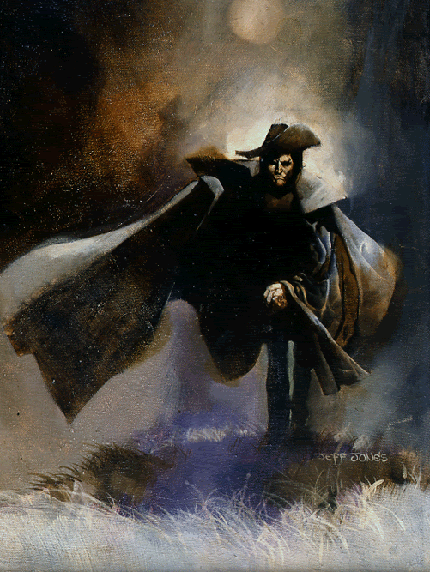
My setting is heavily medievalesque, but not exclusively so. The medieval/chivalric themes and attitudes must be altered to fit a world of lusty pulp adventure where life is red in tooth and claw, and the things of the Outer Dark hunger after blood and souls. The paladin class is populated by characters who are Chivalric idealists, but Wyrd Greyhawk is a grim and earthy world and the paladin goes about his work knowing that the greater share of humanity is self interested and uncaring, and that living by his ideals will almost certainly cost him his life. He does so anyway, because Right must be served. Solomon Kane is probably the best fictional character model for what I’m shooting for with the Wyrd paladin.

The paladins of Wyrd Greyhawk are driven men. They are as they are because they can be nothing else. A paladin has been chosen by a God to promote his cause as an emissary and exemplar of the deity’s ethos. Always are the God’s eyes upon the paladin, always he feels the God’s guiding hand upon his shoulder. NPC paladins are very rare. A kingdom may have only a handful. Even Nyrond or Furyondy hold no more than a dozen paladins each. A PC paladin will be close to unique in the campaign, and unlikely to meet others of the class.

A paladin can only be of Lawful Good alignment. Only Gods of this alignment will have paladins in their service. In Wyrd Greyhawk this includes Pelor, Pholtus, Heironious, Cuthbert, the Great God, and The One God. A paladin may be devoted to one of these gods, or more than one, save in the case of the One God, whose worshippers acknowledge no other. Which ever of these Gods the paladin reveres will affect the priorities of his personal Code of Chivalry.

This code of knightly conduct which a paladin observes varies from place to place, with some aspects emphasized while others are downplayed depending upon the ethos of the divinity with which the paladin is associated. Honor, Duty and self sacrifice are at the core of all variants of the chivalric code. A knight should display such virtues as courage, a willingness to give his own life for another’s, mercy, valor in war, skill at arms, justice and protection for the poor or weak, fairness, obedience and faithfulness to his God, generosity, graciousness to women, etc…


The exact virtues and expectations of the code, as well as which aspects carry the most weight in determining the correct course of action a paladin should take in any given situation depend upon the virtues particular to each paladin’s version of the code. When a PC paladin is created, the exact nature of his code of chivalry must be defined in writing. Once the PC paladin’s code of chivalry has been determined, the DM must enforce it ruthlessly. Adherence to the code, or failure to do so, supersedes alignment as the determining factor in deciding whether or not a paladin has access to his paladin’s abilities.

The code of a paladin of Pholtus includes the following tenets, observed in this order of precedence.
1. Obedience to Law
2. Never shirk a just task
3. Defense of any charge unto death
4. Order is the path to Rightness
5. Noble service dutifully rendered
6. The light must be shown to those who know it not
7. Respect for peers and equals
8. Obedience and respect from those beneath your station
9. Protection and justice for the weak
10. Prowess in battle is the test of righteousness

The chivalrous code of a paladin of Heironeous or of Pelor will be different, containing elements that are the same, or which overlap, but likely in a different order of importance, and certainly including different ideals. This means that though all paladins are Lawful Good in alignment, they will by no means think and act alike. Conflict between paladins upholding different codes and others of Lawful Good alignment over the proper course of action in a given situation is not unlikely.

I’m using a version of the Hackmaster 4E Honor system to determine when a paladin may or may not draw on his class abilities. The paladin’s scores in the class’s prime requisites, Str, Int, Wis, Con, are averaged to yield a base Knightly Virtue Score. Violations of the paladin’s code of chivalry or alignment cause penalties to accrue. Exemplary conduct receives bonuses. If penalties push the paladin’s Knightly Virtue Score below its base value, his class abilities are diminished, or unavailable, and remain so until suitable penance has been made. Likewise, bonuses may increase the power or duration of a paladin’s abilities. Bonuses, however, are more difficult to earn, and do not carry over from day to day.

A paladin who violates the code of chivalry looses his paladin’s abilities, becoming an ordinary knight, but may regain them with effort. A paladin who violates his alignment, Falls, and is forever more, a mere fighter.


A paladin, who keeps the code and acts in accordance with his alignment, may;

1. Detect evil up to 600 feet away, as often as desired, providing that the paladin is concentrating on detecting the presence of evil and seeking it in the correct general direction.
2. A paladin makes all saving throws at +2.
3. A paladin may “lay on hands” once per day. This heals 2 hit points worth of damage per level of experience of the paladin. A paladin may only heal others in this manner, he may not heal himself.
4. A paladin is immune to all forms of disease.
5. Once per week, a paladin may cure disease of any sort, magical or natural in origin.
6. A paladin may create a 10 foot radius Circle of Protection from Evil so long as he concentrates on maintaining the protection and performs no other actions. He may move at ½ normal movement rate, but may not attack and maintain the protection at the same time.
7. At the 3rd level of experience, a paladin gains the ability to Rebuke the undead, demons, devils, or other similar malignant extra planar creatures in a manner similar to the cleric’s ability to Turn undead. Monsters in this category with hit dice equal to or fewer than the paladin’s experience level must Save or be driven from his immediate presence by the power of his holy words. Those who Save may still not approach the paladin unless attacked first.
8. If a paladin manages to gain possession of a “Holy Sword”, he may dispel magic in a 10 foot radius at the level of magic use equal to his level of experience. To do this, he must raise the sword, unsheathed, above his head and concentrate on no other task. Dispelling magic in this manner employs the power of the paladin’s divinity directly, and will invite the attention, and probable judgment of the deity.
9. A paladin, in straits most dire, may, 1% chance cumulative per level, receive divine aid in the form of an unexpected ally whose powers and abilities are just enough to level the field of battle and give the paladin a fighting chance of prevailing. The Cry for Succor is not to be given lightly, the paladin’s divine patron will consider it no small thing, and there will likely be strings attached. The paladin’s Knightly Virtue Score will add to or subtract from the chance of the divine patron sending aid. It is possible that the ally will become a henchman or boon companion at the DM’s discretion.
10. A paladin who receives divine healing from a cleric who reveres the same God as the paladin will always gain the maximum benefit possible from the spell.
11. Any normal creature the paladin employs as a mount will always give its utmost efforts.
12. A paladin gains +1 to initiative.

The standard AD&D restrictions on equipment remain in force.

1. A paladin may not own more than 10 total magic items, including 1 suit of armor, 1 shield, 4 weapons, and 4 magic items of other types.
2. A paladin may not retain wealth, keeping only enough coin to pay for his immediate needs until he reaches 10th level, after which point, he may keep monies sufficient to pay for the construction and staffing of a small castle.
3. A paladin will have only associates of congenial ethos if at all possible. It is very often not. Whether or not a paladin may interact with other PCs or NPCs of conflicting alignments, and for how long, or for what purpose, depends upon the paladin’s code of chivalry. The DM will pass hints to the player in the form of omens, feelings, or events to make the wishes of the paladin’s divine patron clear. Failure by the paladin to keep to his code will of course result in penalties being applied to his Knightly Virtue Score.

The paladin class is probably the least pulpy and Sword & Sorcery friendly class of any of the AD&D classes. Even the cleric is an easier fit, at least in my eyes, with its Van Helsing like origin as the nemesis of the infamous Sir Fang. The paladin come from a separate literary tradition, chivalrous romance, and approaches the themes of sword fantasy from the direction of a different set of assumptions about right, wrong, and the purpose of adventure.

This doesn’t make the paladin incompatible with the fighter, magic-user, thief, or cleric, or the world they inhabit, I don’t think. AD&D is an amalgamation of the many sorts of fantastic escapism popular at the time of it’s writing, as today’s editions are as well. The Wyrd-paladin is just my attempt to smooth the seams and joints between the paladin and the other classes, and also the version of Greyhawk I run.

I’m really just doing this for my own enjoyment; I don’t have any players who would consider running a paladin of any stripe. I think the class probably also suffers from all the contemporary social baggage it has to lug around as much as all the restrictions it carries in play. It seems to be largely assumed that a paladin is by definition a self righteous, holier than thou, jackass closet Nazi. I suppose it’s the sophisticated modern attitude that no person of religious devotion or feeling can also be a genuinely good and well meaning person.

The paladin is a necessary part of Wyrd Greyhawk though, even if no players chose to run one, they’re present in the game world. Meeting an NPC paladin is like dealing with a force of nature. They are not dissuaded or persuaded, and a God stands behind them. A powerful NPC paladin is something like a dragon of good, in so far as how the party must carefully consider what actions to take in dealing with him. A paladin is intractable, resolute, and a force to be reckoned with.
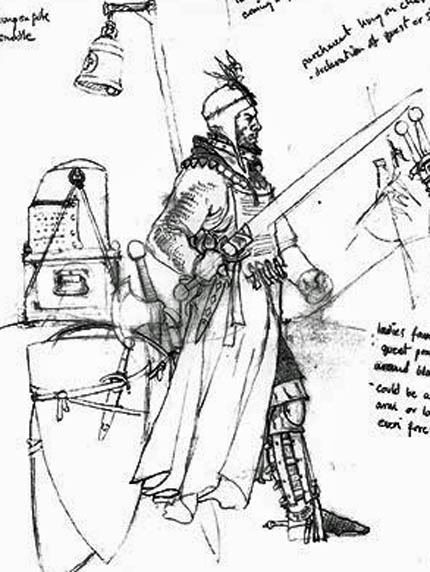


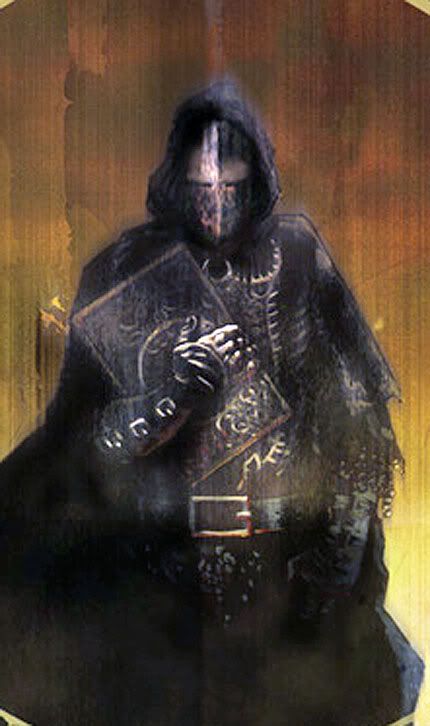
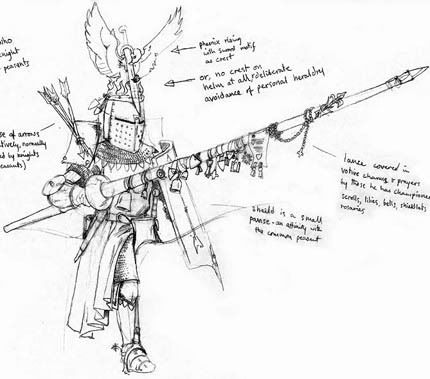
The black and white sketches are bits I've clipped from concept art for knights of Brettonia from Warhammer. I don't know who did the color piece, though I'm sure I've seen it used in some gaming product before. I just found it on the net labled,"monk". I like it though.

Tuesday, February 9, 2010

Considering Class Design Theories.


I had a short, but thought provoking exchange with Zak S of Playing D&D with Porn Stars a few days ago in the comments of one of his recent posts. It started me considering just what it was I was doing when I think about a potential new class for The Game.
Everyone has basic assumptions about The Game that they absorbed when they first started to play. Depending on which edition you were first exposed to, you internalize views about D&D, how it’s played, what it’s about, how the rules are to be applied, etc… This really applies to everything, music, cars, whatever, first impressions set the standard and are difficult to overcome.

My first edition was the Holmes basic box, and then on to AD&D, where I’ve been happy to stay ever since, occasionally venturing out to plunder other systems and drag their choice bits back to my lair to see if they may be assimilated.

Resistance is futile.

Anyway, I think that when you are designing a character class for The Game, the degree of definition of the class will depend on what your vision of the game world entails, as much as which edition of the rules you are playing by, and what view you have about how those rules are to be applied. In my mind the notion of classes of people in the game world reflects the archetypes of the sorts of figures and characters in the fiction and literature that the game world is made of.
I think there is a sliding scale here that describes the degree of resolution you’re comfortable with in your version of The Game. The scale moves from very broad character types in OD&D, (a fighter class character can be anything from a pikeman to a cavalier to a gladiator to a goat herder with a rock), to the extremely and tightly defined classes of the newest edition, which run like Swiss watches, but are rigid and inflexible.

In the medieval world, society was seen as divided into three parts. Those who pray, those who fight, and those who work. These are broad, archetypal classes, similar to OD&D classes. You could add to this, those who use magic, and those who steal, and delete the workers and you’d have the standard line up of Cleric, Fighter, Magic-user, and Thief. Subclasses and refinements of these basic classes cover just about all the types of characters that make sense, to me, in the game. From this point, further character types, and increased definition of the abilities of those characters are more a matter of increasing the flavor and depth of the game world than they are of increasing player choice. Of course I’m not against that; I do it all the time. I see it as a matter of detailing and embellishing the game though, rather than fixing something that is, “broken.”

I think for a class to be fitting in the game, it should in fact simulate a group of people who appear in significant numbers in the game world. To actually rate a character class, there should be an actual occupational or social class of people to support the archetype. That’s where I’m coming from when I consider character classes; I’m trying to simulate in game terms a given archetype from what ever media, generally fantasy or science fiction, that has caught my eye, and that I think can be made to fit my game world.

This means that though I give the class advantages and disadvantages, whether or not it’s balanced against the other classes in the game isn’t really my top priority. The idea that all classes must be equal in effectiveness in all situations strikes me as bit creepily Marxist. I suppose it’s the spirit of the age infecting The Game. Though a PC is also a playing piece, I suppose the gamist point of view is not my primary one. It’s one of my assumptions that you play the game to simulate being a certain type of character and experience fantastic situations, more than to dominate or attempt to “win the game”. This may or may not be one assumption you share, but I expect good sportsmanship in my players and a co-operative spirit amongst them, as players if not as characters.

Any character class that leaves details open to interpretation, leaves them open to player abuse. That’s an acceptable risk to me as that’s something I can deal with. Openness in the rules is what makes them flexible enough to accommodate any eventuality. Bad faith players will face the iron gauntlet of retributive DM fiat. Like I’ve said, I was a ruthless min/maxer as a kid, but now I want a sense of immersion in the character and the world.

I don’t do voices though, and no singing.

In building a PC, I see two routes to creating an interesting character. You can go with the bare bones OD&D archetypal classes, fighter, Magic-user, cleric, and then create secondary rules to further flesh them out, or rely on negotiation between the player and the DM to determine what the PC can do, other than what is explicitly spelled out in the rules. This is the least restrictive and most free form method, at least as far as D&D goes.

I’m a Holmes/AD&D baby though, so I’m not adverse to skill systems like that introduced with the Thief class. I still think that role-playing by the players and description of the actions they want to perform and how, plus negotiation are the “best” way to run The Game, but, there will be times when it’s necessary to have a written skill system to fall back on. If the players encounter a problem they can’t solve that’s killing the game’s momentum and stalling play, if they are a shy or retiring group and don’t want to speak up, or the problem is trivial and holding up progress, I just default to rolling for it.

Just where it is on the character class creation scale that your preferences lie depends on your personal gaming philosophy and which edition of the rules formed the foundation of your assumptions about The Game. Of course, the edition you started with may not be the one you are philosophically predisposed to prefer. I think the rapid success and expansion of the OSR indicates that quite a few younger gamers are finding the earlier editions more to their taste than the newer ones. You don’t have to be old to be Old Guard.

Friday, February 5, 2010

The Spy character class; "The name is Bond, Fantastic-medieval Bond".


The Spy Character Class.

The Spy is a character class specializing in information gathering, the theft or recovery of objects, and assassination. A spy may be an agent of a government body or a given Lord, a religious Leader or church, or a powerful mage or organization of magic-users. A spy may also be a free agent, offering his skills and services to those willing to pay for them. A spy may also work purely for his own immediate gain, without the direction of a patron if he so chooses.

A spy will never admit to his profession. Instead, a spy will employ a Cover Class, acting as though he were in fact, a fighter, thief, magic-user or cleric. Thief, fighter, or else merchant, tradesman, or courtier are the cover classes preferred by spies. Pretending to be a magic-user or cleric may put the spy in the position of being expected to perform magic of which he is not capable. Even the spy’s close companions and adventuring partners are unlikely to be privy to his true class status.

A spy always starts his career in the service of a given power. The training in espionage a spy requires can be taught by very few mentors and is even more hidden and esoteric than that of most schools of magic use. A first level spy will likely still be in the influence of the spy master who mentored him, if not in direct service to him. As a parting, or graduation gift, a spy master will often bestow upon his apprentice a list of contacts and bolt holes. These contacts will be people of various levels of social status who are allies of the spy master, or at least owe him a debt. They will aid the spy at need, to a degree.

In addition to the abilities he learns that directly involve spy craft, a spy learns a wide range of skills which are used to blend into the populations through which he must move unnoticed in the practice of his art. A spy may learn art appraisal, mercantile sense, horse breeding, iron working, or any other field of knowledge needed to support the guises he may work under. These skills and whether or not a dice mechanism is to be attached to them are left to the preferences of the Dungeon Master.


A spy is a competent combatant, attacking on the fighter matrix, but primarily operates by misdirection, stealth, and subterfuge. A spy will avoid melee unless reasonably certain of victory.

A spy can be of any alignment. Spies who are both Lawful and Good are, however, few and far between.

The spy class is open to all races.

A spy rolls D8 for hit points.

A spy may use any melee weapon without penalty. A spy may acquire weapon proficiencies in the same manner as would a fighter.

A spy who attacks with Surprise may assassinate his target as would an assassin class character of equal level.

A spy is always on the look-out for concealed or secret doors or hiding places and has been trained to find them. A spy has a 2 out of 6 chance of noticing such things upon entering a room. This increases to a 3 out of 6 chance if exclusively and actively searching.

Intelligence is the primary attribute of the spy. A spy must have an intelligence score no lower than 10. An intelligence score greater than 15 will give the spy a 10% bonus to experience points earned. A spy with a 15 or better intelligence will, at 9th level, have a 50% chance to learn an alignment language that is within two steps removed from his own.

A spy may wear armor which is consistent with that available to his Cover Class. Generally, a spy will prefer light, non-metallic armor, or depend upon magical protections rather than be encumbered by the heavy metal armor of the fighting man. A spy will be unable to employ either his thieving abilities, or perform an assassination if wearing armor other than leather, or studded leather.

A spy may Open Locks, Find/Remove Traps, Move Silently, Hide in Shadows, Listen at Doors, and Ascend/Descend Vertical Surfaces as would a thief of equal level. As with thieves, the spy’s chance to succeed in these endeavors is considered to be over and above that of a non-spy or unclassed character.

A spy may also Read Person. By observation of a given person, and/or directly engaging that person in conversation, a spy may be able to discern something of that person’s character or motivation. A spy has a base chance of 10% to Read Person at first level. This chance increases by 10% per level of experience, and a 1% bonus per point of intelligence over 10 is also accrued. It is wholly up to the Dungeon Master’s discretion what insights into the read person’s character or motivations the spy may gain by success.

A spy may also Disguise himself and/or Pose as another person in the pursuit of his goals. Disguise refers to physical changes in the spy’s appearance achieved by the use of wigs, clothing, prosthesis, or cosmetics. Pose refers to the spy’s ability to impersonate a given personage successfully. Ordinary NPCs that have no reason to suspect the spy is other than he presents himself will automatically be taken in by the disguise or pose. NPCs with class abilities who are wary, or have reason to be suspicious have a base 2% chance, cumulative per day of interaction with the spy, of realizing that the spy is not who he purports to be. Guardsmen, Shire-riffs, moneychangers, Lords and military officers are of the sorts of NPCs which would be wary of spies.


A spy’s class advancement follows the same numerical progression as the Thief’s.

A spy may contract hirelings, but will not attract henchmen. Rather, a spy will cultivate contacts. These persons are often of dubious nature, but may largely be counted on to help the spy in a pinch, providing information, victuals, a hiding place, or equipment.

At 10th level a spy becomes a spy master and if he wishes, may found a safe-hold and gather his own circle of spies. A spy master will create safe-holds in multiple locations. A safe-hold will always be hidden from common knowledge behind a front, such as a tavern, a school, or a bath house. Apprentice spies, properly vetted, may be sent to the safe-hold for training by contacts or former clients of the spy master. A high level Spy Master will not rule a demesne directly, as might a Fighter-Lord, but through his network of contacts, spies, and associates, is likely to have far greater influence on the course of events.


The spy is a reprioritization of the assassin, blended with the thief, plus some additions of my own to more closely simulate the sort of character you see in modern espionage fiction, but reshaped to fit a fantastic medieval game world. I think the class would fit in well in a setting or campaign that indulged in intrigue or the "Game of Houses" scenario.
The spy class abilities I've left fairly open ended as far as the mechanics go. I of course think that role playing out the read person, disguise, and pose abilities is the best way to go. You will have situations where the player, or DM may not feel up to it, or don't want to spend the game time on it though, so the mechanics are there as a back stop.
I also think it would be fun in a standard adventuring type of campaign. That PC that wears leather armor and claims to be a fighter, whom the party assumes to be a theif, might actually be a spy wearing a double cover class. Maybe he's a freelancer, maybe he reports to the Local Lord, maybe it goes higher than that.
Throw some rival NPC adventurers, the Tax-Monger, The Slave Merchants Guild, and the Unlicensed Purveyors of black lotus juice into the mix, and an honest, hard plundering party of adventurers may have a more difficult time in fencing their haul than they did in acquiring it.

Huzzah!

I'll be interested to hear any feedback, additions or changes that occur to you. This is my first draft of the idea, and I expect to make some changes.

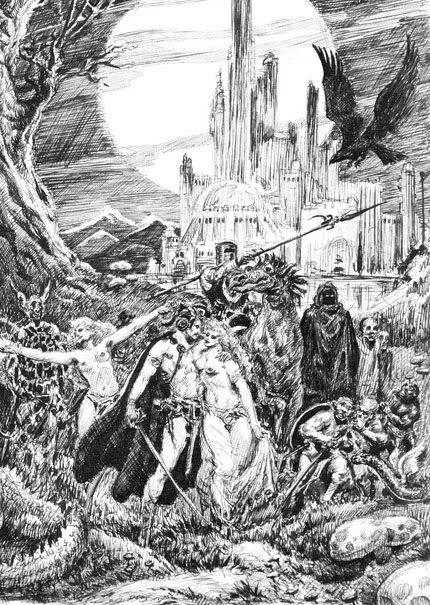
Art wise, we've got some Mead Scheaffer(sp?), a Jeff Jones piece for Red Shadows, and a wood cut illustration I found somewhere.


Saturday, January 9, 2010

Wyrd Greyhawk. Armored wizard, no. Well, maybe a little.

When I make decisions about how I'm going to house rule The Game, it primarily setting specific. And it's not usually about balance in the rule set itself, it's about simulating in as realistic a manner as I can, the conditions of life in the game world.
I'm still not clear on the accepted definitions of simulationist, gamist, narativist, etc... It seems that everyone operates from their own definitions here, and the whole things seems to vague for me to argue about.
I really need firm footing for me to bother with discussion, and until somebody publishes a Websters for Gaming, all I feel confident in doing is expressing opinion, and explaining why I hold it as best I can.
Most of the arguments I read online boil down to differences in definition, as often as they do differences in philosophies.

So, Armored Wizard.

Not for Wyrd Greyhawk, with few exceptions.
Of course, there is the game balance consideration that you don't want a character class with access to powerful magic dominating the game and over shadowing all the other classes. Armoring a wizard turns him into a magic tank and if you want your players to work together, it's best not to let any one of them have too much power.

My view of magic use, at least in Wyrd Greyhawk, is that it's a skill and an art that is developed slowly over time and requires enormous devotion and concentration to master.
Magic use is not easy, and very few can learn to do it at all. A magic-user, of whatever stripe, can not afford to spend the time to learn many other skills if he ever wants to advance in magic use.

In addition to the fact that large amounts of iron in close proximity affect the ease of magic use, essentially acting as a grounding connection for the arcane currents the magic user must draw into himself during casting, wearing and moving in heavy metal armor is as much of a skill as wielding a sword, and this is a skill a magic-user has no time to master.
Metal armor drags on the limbs, it requires a great deal of physical energy to move in for any length of time. It requires time and effort to get into and out of, and to maintain. It costs a great deal of coin to purchase and repair.
These are all costs the magic-user can't afford to bear if he intends to increase his skill at magic use.
A wizard in Wyrd Greyhawk isn't going to wear chainmail any more than a surgeon would in the operating room, or a lawyer would in court. It's not a tool of his trade, and would really only get in the way.
You could wear a suit of armor while mowing the lawn, or fixing a computer, but it would make your job a lot more difficult and if it's your job to fix computers, you don't need to wear a lot of steel to turn sword blows. If a magic-user finds himself in a position where wearing armor is the only way he can survive, he's a crappy magic-user and is advertising his lack of magical talent.

That being said, I have some exceptions.

Specialist magic-users, like the Alchaemist and the Viviomancer, I allow to wear soft leather, (AC 9,AC 8 with studs), leather equal to a motorcycle jacket in protective quality. I let specialists do this on the assumption that their tight focus on a small area of magic doesn't require of them the all consuming concentration more encompassing spell work does.

The second exception is for NPC magic-users of Imperial Suel blood lines. The aristocracy of the ancient Suel Empire was steeped in sorcery for thousands of years. They deliberately engaged in an incestuous program of arcane eugenics for centuries in order to increase the power of their wizardry. They trained in martial arts alongside the eldritch. The result of this is that humans of Imperial Suel blood function as fighter/magic-users without any penalty.
This branch of the Suel race isn't open to PCs though. I use them solely as antagonists and NPCs. They are extremely few in number now, and most of them are quite mad, as well as evil beyond redemption.

I do let magic-users carry and use swords, but there is a catch here too.
Again, swordsmanship is a skill the magic-user will not have time or energy to spare to learn, so, a magic-user can only employ a sword in most basic manner.
As far as the rules go, this means that no matter the magic-user's level, he always attacks with the sword as a first level magic-user. No advancement in skill is possible.
This doesn't apply to traditional magic-user weapons like the dagger or staff. The magic-user's chance to hit with them improves with level advancement as normal.
I'm operating from the assumption that the traditionally allowed weapons of the magic-user class are actually used as aids in learning magic when the magic-user is a young apprentice.
There's nothing written in the books that says so, but I find it a convenient rationalization.

And that's good enough for me. Heh...

Now this only applies to my version of Greyhawk, mind you. In other settings I could easily change my rationalizations to make the facts of magic use fit the game world.

I would have no problems with armored wizards in a more magic-rich environment. Wyrd Greyhawk is low magic, earthy and desperate. On Carcosa, or even maybe the Forgotten Realms, I'd be more free-wheeling, maybe.
If the classes available to players were restricted to just magic-user,and fighter, or if the world didn't have distinct classes and each PC was built from the ground up, I'd be more open to the armored magic-user.
But then again, that's moving far afield of AD&D, and I wouldn't stay there too long.
I try other systems, but I always come back to my foundation, I am Old Guard after all.

Saturday, December 26, 2009

The Viviomancer Magic-User Subclass. Life and death are not manipulated without consequence.

The Viviomancer: an AD&D Magic-User Sub-Class.
The Viviomancers are a sub-class of magic-users which are wholly devoted to Life Magic. This being spells and magic items which affect living things only in a manner which is positive, or neutral.
Viviomancers, also sometimes called vivomancers, deal only in magic which heals, cures, enhances, and strengthens. Or with magic which modifies living things in a manner that is beneficial, or at the least non-malignant. The school of Viviomancy is grounded in the theory that the energy of life, which is called Vivir, can be increased, manipulated and directed by magic.
Viviomancers can cast any spells common to general magic-users which fall within these boundaries. They also have a body of spells which are endemic to the class and unavailable to non-viviomancers. The majority of viviomantic magic draws its power from the positive plane.
A viviomancer may only cast direct damage dealing spells in self defense or in situations where the use of force to defend others is justified.

Viviomancers must always be of good alignment.

Vivomancers have D6 for hit points.

Viviomancers may not wear armor heavier than leather.

Viviomancers are limited to the standard allowable weapons common to all magic-users.

Humans, elves, half-elves, and gnomes may become viviomancers.

The practice of viviomancy is the study of the connection between life, magic, and all living things. Whether the philosophy is instilled in them by the teachers of a viviomantic order, or they arrive at the belief due to the preponderance of the evidence revealed to them by the working of viviomantic magic itself, viviomancers understand and feel deeply the interconnectedness of all living things.

This means that the first rule of the viviomancer is to do no harm in the practice of viviomancy.
This does not mean that the viviomancer is a pacifist or unwilling to defend himself. It means that killing is a last resort, and that spells that are viviomantic in nature must never be used to cause harm.

The great power of magic of the viviomantic school must be managed with care and forethought. Self-knowledge and humility are necessary in one who controls the magic of life and death. A viviomancer of uncertain character or conviction may eventually be overcome by hubris, becoming arrogant and self-worshiping.
Such a viviomancer is in danger of, “falling”, in a sense similar to the way a paladin might fail his faith. A viviomancer who falls may become a generalist magic-user, or even a necromancer.

Though viviomancers have access to many magics of a healing nature, their spells are not divinely given as are those of a cleric or priest, but are born of the study of magic as are the spells of any other magic-user. Viviomancers are likely to venerate a god or gods of healing, magic, or nature, but receive no special compensation by it.

Normal animals are likely to react as positively to the presence of a viviomancer as they would to a druid. The exposure to life magics gives them an aura of calm benevolence. This also results in a bonus to viviomancers reaction adjustment score of +5% per level.

Viviomancers go adventuring in order to acquire new spells, fulfill the conditions of their apprenticeship, gain needed spell components, raise the money needed to build viviomanticums, or any of the myriad other reasons which cause people to risk their lives facing the unknown.

Viviomancers are by nature opposed to necromancy and necromancers. A viviomancer is likely to be quite tolerant of the foibles of others, looking away from thefts which serve the greater good and victimless crimes. They will, however, never willingly ally with those who employ death magic.

Viviomancer spells.
The spells of the viviomancers include many of the standard spells of magic-users, along with their own versions of many cleric spells, and a large roster of spells which only they can employ.
Though they can use spells which directly cause damage, they do so with a penalty, and only as a last resort. Spells which cause damage dice per level to a foe, such as fireball, lightening bolt, etc, do 50% less damage when cast by a viviomancer. Conversely, magic items which heal wounds or cure disease will increase in effectiveness by 25% when wielded by a viviomancer.

Below is a list of spells from the lists of magic-users, clerics, and druids which viviomancers have versions of for levels 1-3.

1st level.
Cure light wounds, Purify Food & Drink, Resist Cold, Charm Person, Enlarge(living things only), Find Familiar, Jump, Animal Friendship, Invisibility to Animals, Message, Sleep.

2nd level.
Detect Invisibility, ESP, Forget, Invisibility, Ray of enfeeblement, Scare, Strength, Hold Person, Know Alignment, Resist Fire, Slow Poison, Speak with Animals, Barkskin, Create Water, Feign Death.

3rd level.
Blink, Clairaudience, Clairvoyance, Fly, Haste, Infravision, Slow, Suggestion, Water Breathing, Cure Blindness, Cure Disease, Remove Curse, Hold Animal, Neutralize Poison, Plant Growth, Summon Insects.

Spells of the viviomantic school of magic include such dweomers as;

The Marvelous Diagnosticator; of Gregorious Dwelling which reveals to the viviomancer the cause and cure of any ailment, poison or disease.

Strengthen the Senses: One of the recipient’s senses is heightened to super human levels for one turn per level of the caster. The recipient gains the vision of an eagle, the scenting ability of a hound, bat-like hearing, etc

The Hand of Life: By touch, undead must save or be instantly reduced to ash. Those who save take 1d4 dmg per level of the caster.

Increased potential: One of the recipient’s ability scores is raised to its maximum possible for their race for 3 rounds per level of the caster.

Maximized Potential: All of the recipients stats are raised to the max possible for a period of 3 rounds per level of the caster. Both recipient and caster lose 1 hit die of hit points at the end of the spell duration.

Defer Sleep: Recipient may go without sleep for a number of days equal to his constitution score.

Defer Food & Water: Recipient may go without eating or drinking for a number of days equal to his constitution score.

Bolster Vitality: Adds 1 hit die roll to recipient per level of the caster for a period of 4 turns.

This is as far as I’ve gotten with the viviomancer so far. The idea is a magic-user subclass which absorbs the healer class and also has a broader portfolio to work with. I myself have no problems with the cleric, I like a little righteous smiting, but I’ve seen many gamers want a healer without the godly baggage.

The viviomancer is my attempt to create a class that covers that base, but has some logical reason for being, rather than just existing to play the field medic.

I haven’t worked out a full spell list, or decided how to modifiy each of the standard spells usable by the class yet, but I thought I’d put this out there and see what you fine fellows and ladies think.

I didn’t have the time to fine tune this like I did the Alchaemist or the Friar, but I think it’s a good start and I enjoyed working it up.
The holidays are exhausting, what with family and travel and whatnot, and I’m glad to get the chance to fiddle with The Game again.

Merry Christmas!

Tuesday, October 20, 2009

The Alchaemist. A magic-user subclass for AD&D/OSRIC.

The Alchaemist, a magic-user subclass for AD&D.

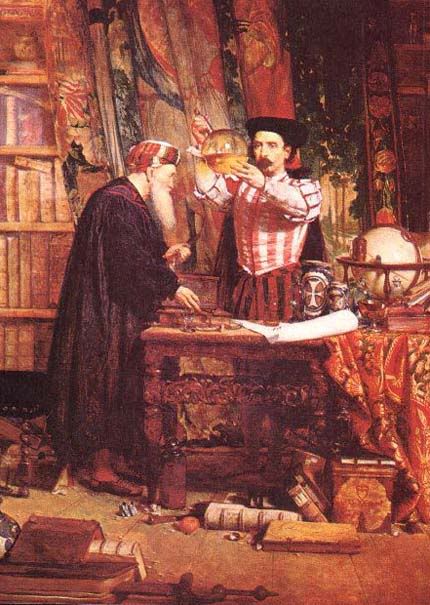
The Alchaemists are those magic-users who specialize in the practice of Alchaemancy, that branch of magic which is concerned with discovering, understanding, and activating the magical potential which is inherent in all natural materials and living things. In fact, in some lands, the term Alchaemancer is used in place of the more commonly given name, Alchaemist.

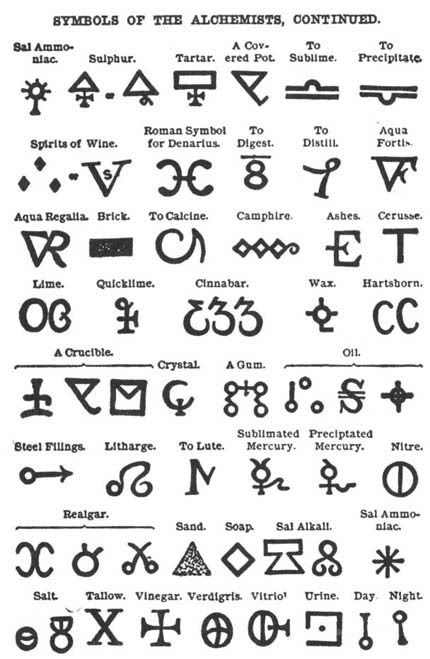
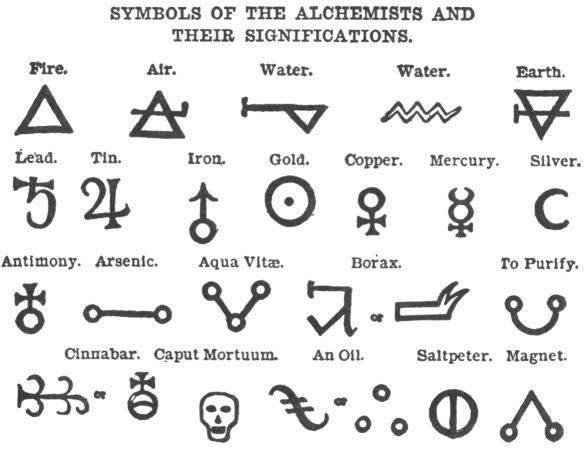
Rather than engaging in spellcraft directly, Alchaemists create Alchaemical Formulae. These formulae are complex instructions, often presented in allegorical, or pictographic forms, for the compounding, mixing, distillation, brewing, or otherwise preparing of potions, powders, oils, balms, salves, and other ingestable and applicable mediums which serve to store and convey magic.

The alchaemist’s painstaking and careful approach to magic, emphasizing reproducible procedure and orderly methodology, often sets ill with the more individualistic will-workers and arcanists. Wizardly and Sorcerous magic-users often look down on Alchaemists as mere artisans to their artists. For their part, alchaemists view standard magic-users as sloppy and perhaps, somewhat primative.

Alchaemical formulas are just as well-guarded, rare, and sought after as are the spells of wizards and other magic-users. Alchaemists must create, or search for these ancient and forgotten instructions which make their particular discipline of magic possible. Likewise, an alchaemist must search for, buy, beg, borrow, or steal, the precious ingredients and reagents that make up the material components of their potions and powders.

An Alchaemist lucky enough to find one of these formulas must inscribe it into his Alchaemical manual. The manual is a book much like a magic-users spell book. Alchaemical formulae are spell-like in that they will slip from the mind and be lost if not written down. The alchaemical manual is a necessary reference for the alchaemist in his potion making. Alchaemical formulae are divided into levels of power in the same manner as spells.

An alchaemist may learn and cast cantrips and first level spells as any magic-user might, but may not learn spells of any higher level. An alchaemist who also learns a standard magic-user spell gives up the ability to create a potion of equal level. The spell takes up the same amount of concentration which the execution of an alchaemical formula would. Standard spells will require the alchaemist to keep a spell book in addition to his alchaemical manual.

An alchaemist may not wear armor.

An alchaemist may carry a small shield.

Weapons available to the alchaemist include all those open to the magic-user, plus the short sword.

An alchaemist rolls 1d4 per level for hit points.

An alchaemist fights on the magic-user matrix. Note that though an alchaemist may carry a short sword and small shield, he will generally use them only in defense when all else has failed. The constant mixing, grinding and pounding required of a practicing alchaemist gives him greater physical competence than a standard magic-user, but, as he still fights as a magic-user, and rolls d4 hit points per level, hand to hand combat is not his forte.

The Alchaemist advances in level on the Magic-user's advancement table.

An alchaemist may use any magic item usable by standard magic-users except for magical staffs.

The number of alchaemical formulas which an alchaemist can execute in a day is equal to the number of spells a magic-user of the same level may memorize in a day.
Refer to the, Spells usable by Class and Level chart for magic-users.

An alchaemist may identify any potion with a single drop on the tongue. This is identification of the potion only, not understanding of it’s formulation.

Alchaemical potion making is not the same as that practiced by standard magic-users and alchemists. In order to create a specific potion, the alchaemist must possess the necessary alchaemical formula and follow it to the letter. Once the material components have been mixed and processed to readiness, the alchaemist must cast the spell, alchaemancy, on the mixture. This activates it’s magical power.
Alchaemancy is unavailable to non-alchaemist magic-users. Alchaemical knowledge is conveyed by a deeply esoteric and symbolic language, the meaning of which, no alchaemist will willingly share with a non-initiate of the craft.

A potion created by an alchaemist will retain it’s potency for one week per level of experience of the alchaemist if kept in a non-magical container. The same potion will retain it’s power permanently if contained within an Alchaemical Flask.

An Alchaemical Flask is defined as any container for liquids or solids, which has been specially constructed and enchanted to hold alchaemical magics. Such a flask must be made of the finest materials and will cost at least 500 gold pieces to make. An alchaemical flask may be reused so long as it is carefully washed with pure water before being refilled in order to prevent potion mixing. If this is not done, the potion miscibility tables must be consulted.

An alchaemist may create potions of up to the third level of formulation with the small equipment he is able to carry,"in the field". Alchaemical formulation of greater than third level will require the alchaemist to have access to a fully equipped laboratory and an assistant, or assistants. The workspace and equipment needed to perform the Greater Formulations will cost, at the least, 10,000 gold pieces.

The begining alchaemist is assumed to possess an alchaemical manual containing the alchaemancy spell as a parting gift from his teacher. He may also possess three other alchaemical formula of the first level, and a single potion in a non-magical container.

There are many schools of alchaemical philosophy. Each strives for certain goals. These schools are not exclusive, alchaemists may belong to more than one school, or to none, as their interests overlap.

Of the known schools, those who search for the Elixir of Life are most numerous. The Elixir is said to grant everlasting life, perfect health, and eternal youth to him who rediscovers it’s formula.
So powerful is the Elixir of Life, that it is said even to be able to lift the curse of unlife and bring a lich back from it’s deathless state to again become a living and breathing creature.
No existent alchaemist is known to have rediscovered the formula for the Elixir.

The second most numerous school of alchaemancers are those who search for the Philosopher’s Stone. This material is said to be able to transform base metals into precious ones. Though some seek it solely for the hope of worldly gain, this is not the only reason. The Philosopher’s stone can be used to separate and refine impurities from any material, and replace any material components required for wizardly spell casting. There are those who say that the substance of the Philosopher’s Stone is in fact, the stuff of elemental existence. That which was before the Gods called the universe into being.
It is also argued that in order to create the Elixir of Life, it is first necessary to discover the secret of the Philosopher’s Stone.
The truth of this is unknown to the alchaemists of today, and it is a great question which many diligently research.

Other associations of alchaemists search for answers to the questions which especially interest them. They bend their studies and expeditions towards the strengthening of metals, the improvement of crops, the making of glass, or any of hundreds of other small preoccupations.
These schools are in no way organized or sanctioning. They are simply associations of like-minded individuals who gather, often around a single alchaemist of great reputation, to discuss, argue, and share the knowledge they have gained, and rumors of where ancient and lost formulae may be rediscovered.


Here are suggestions for the first two levels of Alchaemical formulae. I’m leaving them fairly rough in outline. When I get a chance, I’ll post a complete set. But for now, this will serve as a place holder, and you mad do-it-yourselfers can just take this and run with it. Put down the scissors first.

Alchaemical Formulae

Alchaemical formulae are the written instructions by which an alchaemist creates his potions. The formulae are rare and sought after in the same manner in which a magic-users spells are.
The Dungeon Master is free to determine exactly how much detail he will require in his own game as to the type, nature, and availability of the material components which must go into the creation of a potion. Whatever level of definition is most congenial to the spirit of the game, from making the player character acquire rare and hard to find materials for each formula, to simply hand-waving the procedure, is for the Referee to decide.

Players who are susceptible to the lure of power gaming may attempt to turn an alchaemist into a power house or alchaemical grenadier. The savvy Dungeon Master may control such mischief makers by strictly tracking time in the game and requiring the player to keep accurate records of available potion components. As an alchaemist’s potions have a limited life-time, it is not possible for the Player to build too large of a back stock of magic. Additionally, The DM should consider creating a table to deal with the possible consequences of imbibing a potion that has past it’s prime.

The magics of alchaemical potions are more often linked to the vitality and level of the drinker than they are to the level of the alchaemist who made them. The personal power of the imbiber is a component of the potions magic, and thus, many of the potions listed here have their duration determined by the level of the drinker, and not by the level of the creating alchaemist.

First level Alchaemical Formulae.

Alchaemy.
Alchaemy is actually a spell, and not an alchaemical forumula. It is not, however, accessible to standard spell casters. Only alchaemists have the proper mind-set to understand and cast it.
The basis of the entire school of Alchaemical magic, Alchaemy is cast upon a potion, powder, oil, etc, after it has been newly mixed. This spell activates the magical potential inherent in the materials of the potion and gives it it’s power.

Discern Formulation
This spell is to alchaemy as Read Magic is to standard magic use. By drinking an entire dose of an unknown potion, and casting Discern Formulation immediately after, the alchaemist can learn the alchemical formulation necessary to recreate the unknown potion. The potion being discerned acts as the material component of the spell and does not take effect normally.
The new formula must be inscribed into the alchaemist’s manual within 4 turns or the knowledge will be lost. This does not give the alchaemist the ability to compound the formula if it is above his level of experience.

Flame belch
A flame belch potion will give the drinker the ability to belch forth a tongue of flame which will cause 2 points of damage per level of the imbiber. The flame belch will reach 4' per level of the drinker, and is likely to set fire to any combustibles it encounters.

Detect magic
This potion functions the same as the magic-user spell Detect Magic, save for it’s longer duration.
The drinker will be able to detect magic for 2 turns per level.

Animal Control
This is the same potion as the standard animal control potion listed in the AD&D DMG.

Charming Draught
As the spell, Charm Person.
The drinker of this potion may direct it’s enchantment at any one sentient creature. So long as the drinker treats the charmed creature as a comrade and goodfellow , the magic will stay in effect.

Climbing
This is the same potion as listed in the AD&D DMG.

Diminuation
This is the same potion as listed in the AD&D DMG.

Enlarging potion
Similar to the spell Enlarge, save that it affects only the drinker. The potion will increase the size of a living creature by 25% per hit die or experience level. This change lasts for 1 turn per hit die, or experience level.

Summon Laboratory Assistant
Similar to the magic-user’s Find Familiar. The formula to summon a laboratory assistant is a dry concoction which is burned in a brazier, emitting a cloud of luminescent smoke. The cloud will dissipate after a time and a humanoid creature, eager to serve the alchaemist will arrive within two days time. The laboratory assistant will act as the alchaemist’s right hand man, running errands, preparing material components, or whatever else the alchaemist needs taken care of.

Prul’s eraser
A thick felt pad which is soaked in the alchaemical solution, the eraser will wipe away any form of writing or cartography from any surface. Even letters carved in stone, or graven on metal will be smoothed away by the magic of the eraser. One dose of the potion is good for a use that will clear a 10'x10' area.

Stone melt
Harmless to flesh, wood, metal, and glass, stone melt liquefies any type of stone it comes in contact with for a period of 6 turns. After that, the stone will revert to a solid in whatever form it has taken. A finger dipped in the stone melt can be used to inscribe words in stone.

Alchaemist’s glue
This thick yellow glue will bond any two substances together for 10 turns before dissipating into an acrid smoke. A Dispel Magic will dissolve the glue, otherwise, nothing short of a wish can separate the bonded items before the end of the potion’s duration. The glue is kept in it’s own pot, with a special brush to apply it. The formula creates enough glue for 4 uses.

Jump
When this potion is drunk, the individual may make one 20 foot leap per level of experience.

Confidant’s cordial
When two persons share a swig from a flask of the confidant’s cordial, Each will be able to speak softly under his breath, and the other will hear what is said, no matter the distance between them. A swig is good for two sentences, spoken and heard by each drinker. The formula creates enough cordial for six swigs.

Sleep
The potion is contained within a clay sphere, and is hurled instead of drunk. When the sphere shatters, the potion vaporizes and rises as a cloud of fumes. All creatures within a 20' x 20' foot space centered on the broken sphere are affected as per the Sleep spell.

Shocking grasp
This potion acts as the magic-user spell, save that any contact with the drinker discharges the potions effects regardless of the drinker’s wishes.

Poison
Drinker must save or die. Poison must be ingested, it cannot be used to envenom a weapon.

Iron bane
This potion turns iron headed and edged weapons away from the drinker for 1 round per level of experience. An attacker with a magic weapon may save vs spell to attempt to hit, and then must roll the attack normally. Non-magical weapons with iron or steel parts may not be forced within melee range of the drinker for the potion’s duration. Iron in the drinker’s possession is not affected.

Silvery ward
A packet of greasy silver dust. Smeared on the forehead in an alchaemical symbol it functions as a Protection from Evil spell. It does not require a magic circle be drawn on the ground. So long as the bearer of a silvery ward does not act in a hostile manner, creatures of evil alignment may not approach within ten feet of them. A silvery ward lasts for 1 turn per level of the bearer. A packet contains three treatments.

Illuminator’s paste
Illuminator’s paste is a thick gray gel kept in a heavy waxed paper tube. Objects coated with the paste radiate Light as per the spell. A tube contains 4 treatments worth of paste.

Potion of Vocal Mimicry
Drinker may perfectly reproduce the voice of anyone he has recently heard speak. This effect lasts for 3 rounds per level of the drinker.

Smoke powder
When a hand full of smoke powder is cast down, it produces a flash and a thick cloud of grey smoke. The smoke obscures an area of 10x10 for 4 rounds. A bag of smoke powder holds 4 handfuls.


Second level alchaemical formulae.

Glamer dust
A powder which when blown into the air, simulates an audible glammer spell in a pre-set manner. The sounds the glamer dust emits may be any sound which the alchaemist has heard for himself. Men talking, a blast of trumpets, the roar of a dragon, and many other sounds have been captured in a straw of glamer dust. The formula produces enough dust for single straw’s full.

Perpetual phosphorescence
A non potable potion, sealed within a globe of clear, thick glass. It emits light as a continual light spell. The formula creates enough liquid for a single globe.

Curtain of Night
Poured on the floor in a ring, this potion will obscure the area inside the ring as a darkness spell would. A curtain of impenetrable blackness will rise from the floor and remain for 10 rounds before dissipating. Enough for a single use is made by the formula.

True Sight
For a duration of 1 turn per level of experience, a potion of true sight will allow the drinker to see invisible, or otherwise magically hidden creatures and objects.

Dew of Forgetfulness
Instead of being ingested, the dew of forgetfulness is used by dipping the fingers in it and flicking droplets in the target’s face. The target creature will then completely forget the events of the past ten minutes.

Thief-catcher’s paste
Spread thinly on objects or surfaces, the paste will act as Sovereign Glue only if touched by someone with larcenous intentions. Dispel Magic will dissolve the Thief-Catcher’s paste. The formula will create three treatments worth of paste.

Potion of Intelligence
Drinking this potion will increase the imbiber’s Intelligence score for 1 turn per level of experience.
Magic-user: 1d8 points
Cleric: 1d6 points
Thief: 1d6 points
Fighter: 1d4 points
Characters drinking the potion of intelligence may receive fresh insight into a problem they are facing. The player will be allowed to ask 1 question directly of the DM, in addition to whatever normal advantage would be conferred by the higher Intelligence score.
The Potion of Intelligence must be used with care. Each use after the first incurs a cumulative 5% chance of developing a mental disorder. If such happens, the DM must roll randomly to determine the malady.

Web
Same as the spell, save that the potion is cast into the air towards the target, and becomes the web upon contact. The formula creates a single use amount of the potion.

Fearsome Gaze
Creatures who meet the eyes of the drinker must save vs spell, or flee in terror for 6 rounds. The magic of the potion is expended in a single use. The formula creates 3 doses of potion.

Coffin Breath
As the magic-user spell, Stinking Cloud, except that the drinker of the potion breathes forth the vile cloud of noxious fumes in the direction of his target. The formula creates enough potion for a single use. May discolor the teeth.

Rap
Similar to the magic-user’s Knock spell. No locked portal, chest, or container of any sort will withstand the drinker of a Rap potion. A soft tapping will cause anything which can be opened, to do so. A single dose of the potion enables the drinker to rap three times. The formula creates one dose.

Jester’s friend
This potion is not drunk, but spread or poured. It will make a 10'x10' area completely frictionless for a duration of 5 turns. No matter the material, stone, dirt, grass, carpet, etc, no creature will be able to stand or walk normally without falling. A creature who falls in the center of an area treated with the jester’s friend will be unable to escape the treated space if unable to reach beyond it’s area of effect.

Powdered Guidance
When cast into the air, and a directional, or locational question is asked, this glittery dust will briefly form an arrow pointing in the correct direction as it drifts to the floor. Questions must be a single, clear sentence. "Which way is least dangerous?" or " Which way lies the way out?" The formula creates enough guidance powder for three questions.


Wednesday, June 10, 2009

The Fighting Friar will beat your Monk senseless!


The Friar.

My own Greyhawk campaign is very much Fantastic-Medieval European in theme and tone. With undercurrents of sword & sorcery, and cosmic horror. I’ve never thought the Monk class, as written, was a good fit for it. The Monk grew out of the kung-fu movie fad of the seventies and it never felt to me to have any connection to the other archetypal characters of the game.

I do like the idea of having an class that at least, leans towards unarmed combat though. The Friar is the class I came up with to replace the Monk in my Greyhawk. It is meant to fill the role of unarmed combatant, without the mysticism and eastern philosophical baggage associated with the kung-fu movie derived Monk.

This class is tailored to my own Greyhawk, which is low-magic, and largely lower level adventuring. Tenth level is about the highest any one ever gets. I have open guidelines for hand-to-hand combat, I rely more on common sense than crunch. The worthy Dungeon Master should still have little trouble modifying the Friar to fit his own game world, and is welcome to do so.

The Friar.

The Friar can be considered a subclass of the Cleric, if you like. The Friar is a holy man of a religious order which protects and ministers to the peasantry. Where the Cleric is concerned with exalting his religion and expanding the power of his church foremost, The Friar sees his purpose fulfilled by doing good by the commoners, especially in situations where the local Lords are lax in their duties, or where there is no Law to shield and guide them.

Only humans may be Friars.
The Friar rolls d8 per level for hit points.
A Friar must have a minimum score of 12 for both strength and dexterity.
A Friar must have a minimum wisdom score of 9.
May wear leather, or studded leather armor only.
A Friar may not use a shield.

A friar may use clerical spells, but is limited to 4th level of magic use. 5th level if having a wisdom of 17, 6th level if having a wisdom of 18.
Otherwise, the Friar acquires and employes his spells in the same manner as the Cleric.

A Friar may not use edged weapons.

The Friar may specialize in the use of two weapons, the fighting gloves, or Caestus, and the Crook-staff, also called simply the Cruk.

Caestus are gloves made of multiple leather straps and studded with knobs of bronze or iron. A Friar wearing fighting gloves adds 2 points of damage to a strike with his hands for every three levels of experience. (+2 dmg at levels 1-3, +4 dmg at levels 4-6, +6 dmg at levels 7 and above.

The Crook-staff is a staff of heavy, close-grained wood, equal to or taller in height than the Friar, which has a bent hook on one end similar to that of a shepherd’s staff. A Cruk may be employed in the manner of a quarter staff, doing the same damage, and it may also be used to hook an opponents leg, arm, or neck. In combat, the Friar must declare an attempt to hook an opponent before rolling to hit. If a successful hit is indicated, the Friar may pull a humanoid opponent off it’s feet, prevent it’s attack next round, or hold it in place for one round per level of experience.

A Friar may use other, blunt weapons, such as those allowed a Cleric, but will always suffer a -2 to hit penalty. The only way this can be avoided is to have the Friar train under a martial Cleric, or a Fighter, and expend 1500 experience points in the training.

A Friar is a specialist in the arts of unarmed combat. The various orders of Friars teach their Brothers, pugilism, wrestling, foot-fighting, and other hand-to-hand fighting methods. Any unarmed attack by a Friar is considered a ,"Strike". This includes kicking, gripping, punching with the closed fist, or the open hand, kneeing, or elbowing, attempts to trip, or knock down an opponent, etc.. All such attacks are rolled normally on the Fighters to hit matrix. All Strikes by a Friar do a base damage of 1-6, plus modifications for strength if applicable.
It is assumed that Friars are taught to deal with armored opponents in training. Directing their Strikes at joints, exposed areas, the face, etc, thus, non-magical armor does not lessen the damage a Friar can inflict.

A Friar’s ability to fight increases with age and experience. At levels 1-3, a Friar’s strike does 1-6 points of damage, at levels 4-6, 1-8 points of damage, at level 7 and above, 1-10 points of damage
Damage dealt by a Friar is automatically considered, "subdual damage", unless the Friar announces that he is striking to kill. An opponent driven to zero hit points by the unarmed attack of a Friar has been beaten unconscious, and while helpless, is not dead.

A Friar becomes more difficult to hit as he gains experience . At levels 1-3, he can subtract 1 from his armor class, at levels 4-6, he can subtract 2 from his armor class, at level 7 and above a Friar subtracts 3 from his armor class.

Once per day, the Friar can, "take a punch", or shrug off damage from an attack. This varies by level. 1-4 points of damage can be shrugged off at levels 1-3, 1-6 points of damage at levels 4-6, and 1-8 points of damage at levels 7 and up.

If a Friar strikes with Surprise, he has a chance of Stunning an opponent. This chance increases with the Friar’s level of experience. 10% chance of Stunning at levels 1-3, 25% chance at levels 4-6, 50% chance at levels 7 and up.

A Friar attacks on the Fighters matrix and not the Cleric’s.

A Friar advances in level on the Clerics Table.

All Friars below tenth level simply use the level title "Brother". At tenth and above, they are called, "Father".

Not all Gods will have Friar’s Orders in their service. Friar’s will always be of Good alignment, predominantly Lawful, with some Neutral, and few Chaotic.

Friar’s Brotherhoods of Greyhawk include, The Drubbers Brotherhood of Cuthbert, The Righteous Smiters of Pholtus, Fharlanghn’s Sons, The Enlighteners of Delleb and others.


Friars will dress according to their order, with plain brown or black robes over their clothes or armor in most cases. The Righteous Smiters of Pholtus wear white or yellow, often with a Sunface embroidered on the shoulder. Cuthbert's Drubbers wear shapeless hats instead of hoods. Fharlanghn's Sons wear no shoes, and the Enlighteners of Delleb consider it their sacred duty to spread literacy and combat ignorance. They will always have writing utensils and materials to share.


Caestus are actually Roman boxing gloves, I knew I had to work them into The Game at some point. Roman boxing was probably more like today's Ultimate Fighting than modern boxing as we know it.


It's harder than you might think to find a good image of a shepherd's crook. This one looked the most, hand-crafted and sturdy to me.


And, we're off to pummel evil!