


Here's the winners in the Fight On! Big Book Of Random Tables contest. I got a couple honorable mentions for two of the 100 item random tables I put up here on the Blog.
I had completely forgotten that I'd entered this, until I got an email from the gracious Ignatius Umlaught the day before yesterday.
All these tables will be compiled into a Fight On! book, and it looks like it will be a very entertaining and useful tool for DMs.
The Honorable Mentions.
Planet Exploration Table, Chris Willrich
Magnificent Lagan, Jeff Wilcox
Exotic Intoxicants, Patrick Wetmore
100 Character Backgrounds, Anthony Westenberg
20 Random Alchemical Accidents, Buzz Tilford
Wandering Harlot Table, Adam Thornton
Defective Scroll Effects and
Sewer Features and Hazards, Bill Staeven
Incidents and Events in Town, Joel Sparks
Random Bag of Holding Contents and
Gladiators, Ricardo Signes
Broodings of the Barbarian, Jason Sholtis
30 Close Combat Concentration Breakers, Matthew Schmeer
Battle Scars and Sequelae, Igor Vinicius Sartorato
How to Make a Random Table, Scott W. Roberts
50 Things That Might Be Found In A ‘Dungeon Town’ Curio Shop and
Vile Poisons and
50 Things Found In A Fantasy Villain’s Lair, Richard Rittenhouse
Who Is That Drunkard? and
What the Prostitute Knows, Jim Richmond
Random Bar Encounters, Lawson Reilly
Random Cause of Death, Mr. Reaper
Exploring the Crags, Marc Pavone
100 Random Starting Items for Beginning Characters and
100 Odd, Level-Inappropriate, and Random Treasure Items, Gene Palmer
30 Sprite Curses, Mike Monaco
20 Unexpected Customs and Laws and
20 Reasons for Stuck Doors, Gary McCammon
Random Pirates & Buccaneers, Dyson Logos
Traumatic Adolescent Background Generator, Samuel Kisko
Elves, Kesher
Random City Generator, Nicholas Kariya
Random Secret Door Clues, Adam Flynn
Monster Motivations, Conrad W. Deitrick
Multiversal Table: We Ended Up Where?, Michael David Jr.
The Crate in the Back of the Hold and
Customize Your Mutant and ,
Alchemist’s Ale, David Coleman
Magic Weapon Table, Courtney Campbell
Curious Curative Corollary, BIU_sKrEEm
Falls Down A Pit, Lee Barber
Slum Encounters and
Weird Things In Rooms, Al
Special Honorable Mentions
Rudingoz, Patrice Crespy
Swashbuckling Adventure Generator, Ralph Mazza
The Dungeon is Trying to Eat You! Best Of, Remix!, James A. Smith
What’s in that Hole?, Matthew Schmeer
Drink Me, Eat Me, Mr. Reaper
Elite Honorable Mentions
Ruins, Joe Wetzel
What’s Happened To Those Dead Bodies You Left In The Dungeon Yesterday?, Roger S. G. Sorolla
Character Generation, Alex Schroeder and Adrian Shieh
Magical Research Results, Gavin Norman
Dwarves, Kesher
Exotic Traps, Mr. Reaper
Third Prize
One Page Monster Manual, Paolo Greco
Second Prize
Quick Hex Contents Generator, Al
Grand Prize
Feast, Samuel Kisko
Just how many OSR inspired D&D fan magazines are there now?
I know of Fight On!, Knockspell, Oubliette, I know there are others. Who am I forgetting?
Wednesday, August 3, 2011

Friday, July 29, 2011
Fun with Leeches and Flies!

The common practice of leeching, whereby the spineless water parasites are affixed to those who are unwell with the intent that they should draw forth the bad blood or excessive humors which cause sickness, is in fact only ignorant superstition, and no help at all to those who have fallen ill.
The origin of this error lies in simple, unruned folk attempting to duplicate without sufficient understanding, the performance of Nahwalar’s Marvelous Thaumnivorous Leeches.
That most puissant Viviomancer and life-shaper, by dint of much effort and practice, achieved a spell whereby he might turn the natural actions of the leech to his own advantage and that of the sick he cared for.
This spell, when cast upon a suitable supply or number of ordinary leeches, alters them in such a way that they may be used to ameliorate some unhealthful conditions.
The degree of effect on the patient, and the conditions which may be treated, varies by the number of Thaumnivorous Leeches set to feeding upon him.
A single leech will suffice to draw forth any poison or venom by which the victim’s life is threatened. A victim of poison must receive the attentions of the leech within 4 rounds of the poisoning or envenomation in order to survive. Use of a single leech will cause the loss of one hit point in blood loss as the magically enhanced leeches draw mightily upon the vital fluids of the patient.
A leech which sucks poison will itself die afterwards.
Two leeches are sufficient to cure disease, either natural, or magically inflicted. This includes the infestation by fungal spoors and molds, but not other large parasites such as rot grubs. A pair of thaumnivorous leeches will inflict 4 points of damage upon the patient while removing all trace of disease from the body.
Three leeches must be used to clear the body of the effects of potions, dusts, or other ingested magics. The person so treated will incur 8 points of damage during the procedure.
A set of four leeches will end the effects of any sort of magical Curse, while also causing 16 points of damage to the leeched.
As with normal leeches, thaumnivorous leeches may be removed prior to satiation by the use of salt or fire.
Due to the Laws of Spontaneous Generation, it is wise to destroy by fire any leeches which have become engorged upon magic by their feeding. There is always a possibility that arcane mutation or alteration could bring about changes in a magic-sated thaumnivorous leech which may be infelicitous.
Also, there exists the possibility that a leech, employed upon multiple patients, may in some form transmit magical effects or disease which it had previously drawn from one patient to another.
The spell used to create the Marvelous Thaumnivorous Leeches is quite rare. It has been found to date only in the form of an enscrolled incantation. It prerequires a crystal vessel or decanter of fine workmanship with which to contain the leeches, sufficient solution of aqueous sortilagic fluid to fill the container, and at least four, and no more than eight leeches in good health, as well as a sprinkling of powdered gold and ivory dust.
The spell may of course be copied into a spell book rather than expended directly. All the standard costs and consequences of so doing apply.
Once created, the thaumnivorous leeches will survive within the crystal vessel handily until they are needed.
*Notes of warning, there have been reports that some scrolls containing the engenerative spell have either mistakes or deliberate malignancies written into them. Thaumnivorous Leeches created through the use of such a warped spell result in parasites which directly draw life energy from the patient in a manner similar to some undead. Victims of such leeches will lose one experience level and one hit die per leech attached to them, per round until death.

The Bloodfly Pin.
A large cloak or hat pin of bronze and ruby in the shape of a biting black fly, the Bloodfly Pin isn’t particularly attractive as a piece of jewelry, but it is effective as a magical deterrent.
Once per day, the wearer of the Bloodfly Pin may summon a cloud of vicious biting flies and direct them to swarm a given target. This target may be a single creature, or a designated space, such as a room.
If the target is a creature, the flies will inflict painful, maddening bites causing 1d4-1 pts of damage per round. If the target is a volume of space, then all living things within it will suffer 1 pt of damage per round they remain within it.
The fly swarm will remain for 1D6 rounds before dissipating.
The flies will fly into ears, nostrils and open mouths and make spell casting impossible. Horses and other touchy or high strung animals will bolt and run if attacked by the fly swarm.
The wearer of the pin will draw flies of the normal non biting sort at all times. Usually a half dozen or so will be found buzzing about the general area the pin wearer occupies.
The wearer will also develop a taste for overripe fruit.
If the wearer of the Bloodfly Pin should kill an insect for whatever reason, the next time he attempts to summon the fly swarm, the swarm will target him instead for the full duration of the summoning.
Insects will not attack the wearer of the pin unless attacked first. This includes giant types, but not intelligent insectoids. Intelligent insectoids such as Thri-Kreen, Aspis, etc… will generally feel non-hostile towards the wearer of the pin when first encountered. What happens afterwards is up to the pin bearer.
-------------------------------
It's deer fly season here, hot, humid, still, deer fly season. I hate the blasted things.
Google fetched for me the top pic from some wiki type site.
The second came from the Pictoral Arts blog. It's a sketch for a jewelry maker.
Tuesday, July 19, 2011
Greyhawk Wars meets Kelly's Heroes!

I Watched Kelly’s Heroes last week on the Military Channel, I always loved that movie. If you haven’t seen it, this is the Wikipedia entry for it.
In World War II France in early September 1944, units of the 35th Infantry Division are nearing the town of Nancy when one of the division's platoons receives orders to pull out while under attack from the Germans (much to the dismay of the men, who are eager to get into Nancy in order to find a decent place to get some rest).
Kelly, a former lieutenant who'd been demoted to private as a scapegoat for being given orders to attack the wrong hill and wiping out half a Company of GI's, captures Colonel Dankhopf of German Intelligence. When Kelly notices his prisoner has a gold bar in his briefcase, he gets him drunk to try to get information about the gold. Before he is killed by an attacking German Tiger tank, the drunken Dankhopf blurts out that there is a cache of 14,000 gold bars (worth $16 million) stored in a bank vault 30 miles behind enemy lines in the town of Clermont (most likely Clermont-en-Argonne).
Kelly recruits the rest of his platoon, including skeptical Master Sergeant "Big Joe", to sneak off and steal it. Eventually, others have to be recruited (or invite themselves) into the scheme, such as an opportunistic supply sergeant "Crapgame"; a proto-beatnik Sherman tank commander, "Oddball"; and a number of stereotypical G.I.s presented as competent, but war-weary veterans who are as much fed up with their incompetent or self-serving superiors as they are with the Germans.
The expedition successfully breaks through a German held town during a mortar barrage that has been arranged by Kelly. They then meet bad fortune when an American fighter plane mistakes Kelly's group for the enemy, shooting up their vehicles and destroying them with rockets. They continue on foot and one of them dies in a minefield. Two others of their number then die in a battle on the minefield.
Meanwhile Oddball's tanks head along a railway line wiping out a German depot along the way, but their route is blocked when the last large bridge to Clermont is blown up by Allied bombers, prompting Oddball to let a bridge engineering unit in on the deal. When intercepted radio messages of the private raid are brought to the attention of gung-ho American Major General Colt, he misinterprets them as the efforts of aggressive patriots pushing forward on their own initiative and immediately rushes to the front line to exploit the "breakthrough".
Kelly's men race to reach the French town before their own army. There, they find it defended by three formidable Tiger I tanks with infantry support. The Americans are able to dispatch two of the Tigers and most if not all of the supporting German infantry. However, as they prepare to take on the last tank, which is parked right in front of the bank, Oddball's last Sherman breaks down, and it is found that the Sherman cannot be repaired due to a lack of needed replacement parts.
Powerless to defeat the heavily-armored behemoth, Kelly, Oddball and Big Joe square up like western gunfighters and walk purposefully in line towards it, prompting the commander to emerge from the turret. He and his crew are then offered a share of the loot, the tank blows the bank doors off and they divide up the gold ($875,000 per share).
They then go their separate ways, just managing to avoid meeting the still-oblivious Colt, who is delayed when the celebrating town residents are told he is Charles de Gaulle. Oddball and his crew ride out of town in a Tiger tank and SS uniforms, having used part of their share of the gold to buy them from the Germans. Kelly and his misfit heroes head off into the sunset, presumably en route to Switzerland where they can sit out the war and rest on the joys of numbered accounts.
I made a note years ago about writing a D&D scenario that would put an adventuring party in a Kelly’s Heroes type situation during the Greyhawk Wars, but I never went any farther with it.
The thing with setting up a D&D game around the plot of a movie is that it’s very difficult to replicate events without turning the game into a railroad. I really do not care for those. Railroad games just suck all the tension out of play.
So, I like to set up situations that will likely replicate the general feel of the movie and the pace of its events, but don’t require the PCs perform a pre written pantomime of the movie in order to progress.
I was thinking for the Greyhawk’s Heroes scenario, I’d have the PCs be impressed into the armies of Furyondy at the beginning of the war. Wyrd Greyhawk’s PCs aren’t normally Heroic Fantasy material. They tend to be hardscrabble, average Joes getting by on guts and black humor. Getting press ganged into a conflict between great uncaring powers would be par for the course.
The PCs would be in the position of Kelly and his platoon, while I’d have NPCs for the Big Joe, Crapgame, and Oddball analogue characters.
Looking for a good encampment spot, the PCs encounter a spy/courier of Iuz. The spy has a bag of gold coins and information on just where, thirty miles beyond the battle front, a great horde of looted treasure has been hidden for later shipment to Dorraka.
Of course the PCs want it. Risk your life for a fortune, or risk it for ten silvers a month and disciplinary beatings once a week, plus the chance of encampment cholera and being hacked to death by orcs, which would you, choose?
The game would be an overland hexcrawl through war torn territory and no man’s land, towns held by the forces of Iuz, scarred lands, and wild countryside. The PCs would have to avoid combat wherever possible in order to draw the least amount of attention to themselves if they want to have any chance of reaching their goal.
One of the best parts of the movie was that, in order to solve problems as they went along, Kelly’s Heroes had to keep enlisting the help of more and more other people, who in turn drew the attention, and greed, of still more people. Eventually, the allied command gets drawn into it and the movie becomes a race to reach the gold and escape before the whole U.S. army follows them to Clermont.
To mimic this, I’d add the Notoriety rules from the Dorrakka, City of Skulls module TSR put out for the Greyhawk Wars. (I can’t find my copy at the moment, so I don’t have the module number).
The notoriety rules are a system whereby the PCs accumulate points for high profile actions. As these points accumulate, they draw the attention of various other actors in the module, resulting in them taking appropriate actions of their own. Such as investigating, pursuing, etc…
I’d do the same thing, with PCs actions gaining them notoriety points as they progress, and these points gaining them first the attention of low level Furyondian officers, and then higher and higher up the chain of command as the PCs incurred more points.
If the PCs are clever and circumspect, they might make it all the way to the horde without drawing too much attention. If not, the Furyondian army might make it there right alongside them.
Once Kelly’s Heroes made it to Clermont, they had to deal with a squadron of three Tiger tanks guarding the gold. They knocked out two with surprise and maneuver, and then made a deal with the Commander of the remaining Tiger for a share of the gold.
To have a chance of a similar situation playing out in the game, I’d have to have a suitable foe in the destination village that couldn’t be defeated directly at first, but might be amenable to parley if placed in the weaker position.
I haven’t decided what that foe should be. A trio of young dragons under the domination of Iuz? Impressed former Shieldlander knights? Heavy armored elite hobgoblins? Devils? I’ve got to muse on that a bit yet.

Big Joe would be a Serjeant of Furyondal heavy foot the PCs would have to convince to go along with the plan. No rolling for it, I’d make the players role play it out with “Beegjoh” .
Crapgame would be a Provisioner , charged with securing supplies for the Furyondians. He’d also have thieves’ guild connections and many friends in low places. I might just call him,”Crapper”.
Oddball would be Sir Ohe DeBal, a Furyondian knight of petty nobility with a small squadron of chivalric heavy horse. For Wyrd Greyhawk, a fully armed and armored knight is the best analogue for a tank. 1600 lbs of horse, man, and iron isn’t something any spear pusher wants to get in the way of.
I’d play each of these NPCs just as their actors did in the movie, Telly Savalas for Beegjoh, Don Rickles for Crapper, and Donald Sutherland for Sir Ohe De Bal. Imagine Sutherland in wine stained armor as a black lotus smoking beatnik knight of Fortune.
“Ceaseth thou with thyne negative emanations, Sirrah! If thou dost believe the bridge shall be there, then so it shall!”
This is all I’ve written about the idea. If I do ever pull it together and run it, I’ll let you know how it plays out. If you do it, let me know how it goes. Game on!
Wednesday, July 6, 2011
Dungeons & Dragons Super Edition!
So, let me throw this out there.
Instead of the death march to the land of diminishing returns that continuing down the path of perpetual new editions dooms Wizards of the Coast too, how about a multi-edition edition of Dungeons & Dragons?
The Game is built of multiple core components and elements that show up in all editions. Combat, Character Generation, Player Character Stats, Armor Class, Initiative, Surprise, etc… All the topics that we argue over and discuss on blogs and forums without end.
You could take these core elements as they are written in each edition and group them together to compare and contrast how each edition of The Game treats them.
Each edition is a product of the spirit of the times in which it was produced. Each one makes its own assumptions about what the game is meant to do, how to provide that outcome, and what players are looking for in the play experience.
Every edition made rule changes guided by these assumptions, and which edition you started with, and when, colors your view on what’s right and what’s wrong with the others.
Everybody knows I’m an AD&D guy, I don’t think there’s anything I can’t make it do with sufficient tinkering. But, I will readily admit to prying bits and pieces off of other editions, other RPGs, house rules gathered from blogs and forums, pretty much what ever catches my eye, and seeing if I like it in play. I think most of us, (the Old School blogosphere), do this without giving it a second thought.
You wouldn’t have to do every component of The Game, only the major ones which diverge significantly from previous editions. That would keep it from becoming the Encyclopedia of D&D. (though I would buy the Encyclopedia of D&D WOTC, if you're watching.)
You could present it by topic, say, Hit Points, and then the relevant sections from Original, AD&D, 2E, 3E, 3.5E, 4E, concerning what hit points are, how they are generated, how they are viewed in the game, and then a bit of considered commentary about why each edition makes changes, the different ways hit points are used to represent actual damage sustained, personal energy expended, near misses, luck, etc.
The hit points section could be followed by a bit about the various rules concerning when is dead really dead. Since there is always discussion about death at zero, death at -10 hps, deaths door rules, recovery from near death, I don’t want to go on the cart, yadda yadda.
The point of this book would be to create an Ala Carte Dungeons & Dragons which would allow DMs to pick and choose the elements from all editions that best suited their game and gaming sensibilities and build a personal edition. This is what we all really do anyway, at least, we of the Old School.
Of course, not all elements from all editions can be made to play nicely together. I don’t expect they could be made to do so by a Super Edition, still, having examples side by side of all the different ways that Combat, or Skills, or what have you have been treated in The Game would be horizon broadening for those unfamiliar with other ways of looking at things.
It’s my perception that newer generations of gamers are much less likely to have a do it yourself-make it your own attitude towards gaming. I think a book that actively encourages the idea of tinkering would go a long way towards changing this.
The majority of OSR bloggers and related forum posters are in their mid thirties and forties, I think I can safely assume, and they have been a fountainhead of creativity that I am overjoyed to drink from. However, I find it unsettling that the younger gamers seem to be the ones wearing blinkers about The Game and what it does. It’s supposed to be the kids who are wild and creative.
I can’t tell anyone to get off my lawn if they never jump fences. Dagnabit.
Instead of the death march to the land of diminishing returns that continuing down the path of perpetual new editions dooms Wizards of the Coast too, how about a multi-edition edition of Dungeons & Dragons?
The Game is built of multiple core components and elements that show up in all editions. Combat, Character Generation, Player Character Stats, Armor Class, Initiative, Surprise, etc… All the topics that we argue over and discuss on blogs and forums without end.
You could take these core elements as they are written in each edition and group them together to compare and contrast how each edition of The Game treats them.
Each edition is a product of the spirit of the times in which it was produced. Each one makes its own assumptions about what the game is meant to do, how to provide that outcome, and what players are looking for in the play experience.
Every edition made rule changes guided by these assumptions, and which edition you started with, and when, colors your view on what’s right and what’s wrong with the others.
Everybody knows I’m an AD&D guy, I don’t think there’s anything I can’t make it do with sufficient tinkering. But, I will readily admit to prying bits and pieces off of other editions, other RPGs, house rules gathered from blogs and forums, pretty much what ever catches my eye, and seeing if I like it in play. I think most of us, (the Old School blogosphere), do this without giving it a second thought.
You wouldn’t have to do every component of The Game, only the major ones which diverge significantly from previous editions. That would keep it from becoming the Encyclopedia of D&D. (though I would buy the Encyclopedia of D&D WOTC, if you're watching.)
You could present it by topic, say, Hit Points, and then the relevant sections from Original, AD&D, 2E, 3E, 3.5E, 4E, concerning what hit points are, how they are generated, how they are viewed in the game, and then a bit of considered commentary about why each edition makes changes, the different ways hit points are used to represent actual damage sustained, personal energy expended, near misses, luck, etc.
The hit points section could be followed by a bit about the various rules concerning when is dead really dead. Since there is always discussion about death at zero, death at -10 hps, deaths door rules, recovery from near death, I don’t want to go on the cart, yadda yadda.
The point of this book would be to create an Ala Carte Dungeons & Dragons which would allow DMs to pick and choose the elements from all editions that best suited their game and gaming sensibilities and build a personal edition. This is what we all really do anyway, at least, we of the Old School.
Of course, not all elements from all editions can be made to play nicely together. I don’t expect they could be made to do so by a Super Edition, still, having examples side by side of all the different ways that Combat, or Skills, or what have you have been treated in The Game would be horizon broadening for those unfamiliar with other ways of looking at things.
It’s my perception that newer generations of gamers are much less likely to have a do it yourself-make it your own attitude towards gaming. I think a book that actively encourages the idea of tinkering would go a long way towards changing this.
The majority of OSR bloggers and related forum posters are in their mid thirties and forties, I think I can safely assume, and they have been a fountainhead of creativity that I am overjoyed to drink from. However, I find it unsettling that the younger gamers seem to be the ones wearing blinkers about The Game and what it does. It’s supposed to be the kids who are wild and creative.
I can’t tell anyone to get off my lawn if they never jump fences. Dagnabit.
Saturday, June 25, 2011
Not only Shields Shall Be Splintered!
Trollsmyth's Shields Shall Be Splintered rule to give the shield more value in melee is one of my favorite house rule ideas to come out of the OSR blogosphere.
It's easy, simple to employ in The Game, and makes sense to my way of playing. It also gives a bit more juice to combat. Like a saving throw, it allows for an exiting narrow escape from a possible nasty end.
I like to roll it around in my mind. It has a tasty texture and rule symmetry that appeals to me. Thank you Trollsmyth!
This is how I phrased the rule for my own houserule document.
Any player character, who is employing a shield and takes damage in melee combat, can opt to instead have their shield take the damage. The shield will be shattered and must be discarded thereafter, but the character takes no damage from that particular attack.
I like it so much, I want to share the terror and excitement of that near brush with death with PCs of classes which normally don't carry shields.
So, I'm extending the rule to include hastily improvised shields. Things which might be snatched up in a desperate attempt to ward off an otherwise fatal blow.
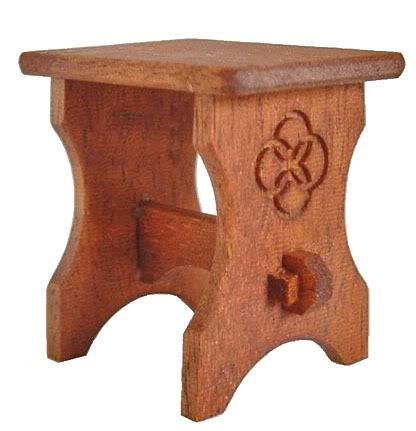
Items such as a stool, a chair, a saddle, a halfling, etc..
This way, magic-users and thieves, who usually need all the protection they can get, have a rule to give them a last chance to escape a cleft skull.
Of course, same as with the shield, whatever object the PC grabs to serve as a shield is destroyed if made to absorb the damage the PC would have otherwise incurred.
*regarding the halfling. Only NPCs may be sacrificed in this manner. PCs may not be employed as hastily improvised shields by other PCs.
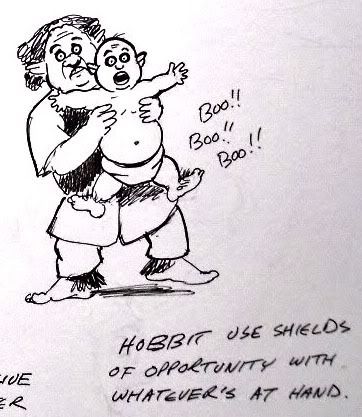
Pics are a nice medievalesque stool I found online, and a clip from a larger sketch by the mighty Jim Holloway, one of my favorite D&D artists.
Sunday, June 19, 2011
The Scorned Blade, An all-humanoid NPC rival adventuring party

The Scorned Blade is the chosen name of an adventuring company composed entirely of renegade and outcast humanoids. Lead by the hobgoblin Zarkutz, the Scorned Blade includes, two orcs, Grum and Cazag, a bugbear, Grug, three goblins, Snool, Bugum, and Pulc, and a gnoll called Hykic.
All are exiles, or outcasts from their tribes for one reason or another. This unsavory group is held together by the iron will and discipline of Zarkutz, that plus mutual need, and the fact that no one else will accept them. They are more than a match for the average party of low level characters because they work as a team and use every dirty trick they can muster.
Ambushing travelers has been their bread and butter, but Zarkutz entertains grim dreams of making a name for himself as human adventurers do, and returning in glory to revenge himself on those who forced him from the tribe.
To this end, he gathers what information he can in regards to lost treasures and magic. He also looks for the chance to capture alive any adventurers that may be able to teach skills that the Scorned Blade lacks. Zarkutz especially wants a thief to teach the goblins, and a magic-user to tutor Kazag.
Zarkutz: hobgoblin war-leader.
AC: 2, HP: 25, Move: 9, Int: above average, Alignment: Lawful Evil.
Zarkutz wears a combination of jazerant and plate armor, and carries a falchion, (dmg: 2-8) and hewing spear, (dmg: 1-6).
Having lost a power play within his tribe, Zarkutz was exiled with dishonor. The hobgoblin lusts for command and forged the Scorned Blade from other outcast humanoids he encountered simply to have something to lead.
He speaks common very well, and will be interested in talking with any player character party that doesn’t attack immediately. At least, any party he can't over come easily.
He will be willing to ally with adventurers if it is advantageous, and will adhere to the letter of any agreement made.
Zarkutz will attempt to impress the members of a weak party into the Scorned Blade if he can dominate them. He will, at the least, quickly begin issuing orders to any indecisive appearing allies.
Grug, bugbear.
AC: 4, HP: 30, Move: 9", Int: low, Alignment: Chaotic Evil.
Grug wears heavy bronze chainmail looted from the cairn of a firbolg giant. He carries also a large shield and great sword,(1d10+1 dmg), which he easily wields one handed.
Grug is very large for a bugbear. He is most enthusiastic, and not overly intelligent. Despite his chaotic nature, he applies himself to the strict lessons of Zarkutz, and as a result, he has become both a skillful and an erratic opponent.
If faced with multiple attackers, Grug's first attack will be to bash the closest target with his shield. Opponents of lesser mass must Save VS Crushing Blow or be knocked down, requiring two rounds to get back up.
Grug will use this time to attack the next closest target.
Grum, orc shaman.
AC: 7, HP: 8, Move: 9", Int: average, Alignment: Lawful Evil.
Spells available: cure light wounds, light.
A fanatic devotee of Baghrutu, Grum was driven out of his tribe by the dominant followers of Grumsh for the crime of heresy.
He wears studded leather, and fights hand to hand with gauntlets of ogre power, (18/00 str, +3 to hit, +6 dmg).
Grum will attempt to convert captured opponents to the worship of Baghrutu. He is passionate, but not eloquent.
His favored method of attack is to blind his opponent with his light spell, and then close to pummel with his iron gauntlets.
He would like to challenge Zarkutz for leadership, but secretly fears the ruthless hobgoblin.
Kazag, half-orc magic-user.
AC: 9, HP: 4, Move: 9", Int: very, Alignment: Neutral
Not brutal enough to live among orcs, yet not sensitive enough to live with humans, Kazag is selfish, unpleasant, weak willed, and greedy. He directs his spells as commanded by Zarkutz, but will never expose himself to direct attack. He is not to be trusted, and Zarkutz makes sure the goblins always accompany him. They serve as both protectors, and minders.
Kazag carries a dagger coated with golden adder venom, Save or suffer agonizing hallucinations for 1d4 days which completely incapacitate the victim.
His spell book holds, Burning Hands, Hold Portal, Identify, and Spider Climb, as well as Read Magic.
The goblins: Snool, Bugum, Poolc.
AC: 6, HP: 7, Move: 6", Int: average, Alignment: Lawful Evil.
Large for goblins, these three are brothers who were cast out for the pleasure murder of prisoners which their chief had intended to ransom.
Scouts and skirmishers, they will close for combat only if ordered by Zarkutz. Each carries four javelins, short swords and shields, and wears studded leather armor.
If the Scorned Blade should manage to capture a thief, Zarkutz intends to force him to teach the goblins his skills.
Hykic, Gnoll
AC: 5, HP: 14, Move: 9", Int: low-average, Alignment: Chaotic Evil.
There is a strong possibility that Hykic is mad. His sharp barking laugh, which seems to come at random moments, is irritating. He was driven from his clan for, "unwarranted cannibalism".
He is ferocious and reckless in combat, and Zarkutz employees him as a shock trooper to terrify and to herd targets into advantageous positions. He is without fear but obeys Zarkutz for reasons of his own.
Hykic wears armor of horn, leather and metal, and carries a long sword and a halberd.
Mally Goodbin, unfortunate halfling
AC: 10, HP: 4, Move: 9", Int: very, Alignment: Lawful Good.
Mally is a slave and cook to the Scorned Blade. Her ability to turn odds and ends into good food is what saved her life when her traveling party was ambushed. The humanoids had never had cooking of such flavor, and Zarkutz knows a fighting force moves on its stomach.
Hykic would like to eat her, and the goblins would enjoy murdering her, but the bugbear Grug considers her his pet, and to Zarkutz she is a tool to keep the group together.
The Scorned Blade is only slightly above the average of humanoid combatants statistically. The thing that makes them dangerous is the fact that they fight as would a well disciplined human adventuring party.
Zarkutz always attacks, and opens negotiations from a position of strength. He will not commit to a combat that he isn’t very sure of winning. There must also be a definite goal, or prize involved. Though, of course, he enjoys fighting as much as any hobgoblin, Zarkutz has priorities, and is not easily dissuaded.
If the Scorned Blade becomes aware of a PC party before the PCs are aware of them, Zarkutz will first determine the strength of possible foes, or new recruits, and then determine a course of action.
If the PCs are obviously too strong for the Scorned Blade, Zarkutz may either avoid them completely, or begin to shadow them, waiting for an opportunity to present itself.
If the PCs are judged to be on close to equal footing with the members of the Blade, Zarkutz will offer a truce, he speaks common quite well. The hobgoblin will use any conference to gather information about the party and its purpose. If the party is competent and willing, and there is gain in it, Zarkutz may offer an alliance of convenience, for a time. Treachery is possible if the information leads him to reevaluate his first assessment of the PCs. He will, however, abide by the letter of any deal or agreement arrived at in negotiation.
If the PCs are judged to be weak or at a disadvantage, then Zarkutz will most likely attack. Any useful survivors will find themselves conscripted into the Scorned Blade.
If the Scorned Blade attacks with Surprise, or otherwise gets to make the first move, they are coordinated and business like.
The goblins will hurl javelins from a distance, choosing unarmored targets such as magic-users first, clerics second. Grum and Kazgag will cast spells to cause confusion and damage from a distance, before Hykic, Grug, and Zarkutz move in to attack any obvious fighters. Grum will close to attack after expending his magic. Snool, Bugum, and Poolc will move in to melee once they have expended their missile weapons. They much prefer to gang up on a single, wounded opponent if possible.
Zarkutz directs the actions of the others and they obey him without question, at least during combat.
If the melee goes poorly, Zarkutz will order a withdrawal. If Zarkutz is himself killed, the others will flee.

This is a version of an NPC party I sent James at Grognardia for his MegaDungeon project a while back. I’m pretty sure that's dead in the water now, so I thought I’d share it with my blog buddies. You can, of course, easily up rate the Scorned Blade for higher level play. I made them with the intention of providing a thorny problem for experienced players running low level characters.
I think that’s about my favorite gaming scenario. Very good players running low to mid level characters who have to make do with what they’ve got. It just seems to have more juice to it, there’s more at stake somehow. High level play feels a bit too super hero-y to me for D&D.
Not that I don’t love super hero rpgs, mind you. I’ll have to tell you about the time we demolished most of downtown Indianapolis in a brawl with A.I.M. I guess I just don’t like peanut butter in my chocolate.
The top pic is cropped and lightened from the TSR Book of Humanoids, done by Sam Rackland I believe. I like it a lot, it illustrates why Old Schoolers know not to mock the single orc guarding a door.
You all know Erol Otus. Dig.
Wednesday, June 15, 2011
Insertable Encounters # 2 The Gallows at the Cross Roads
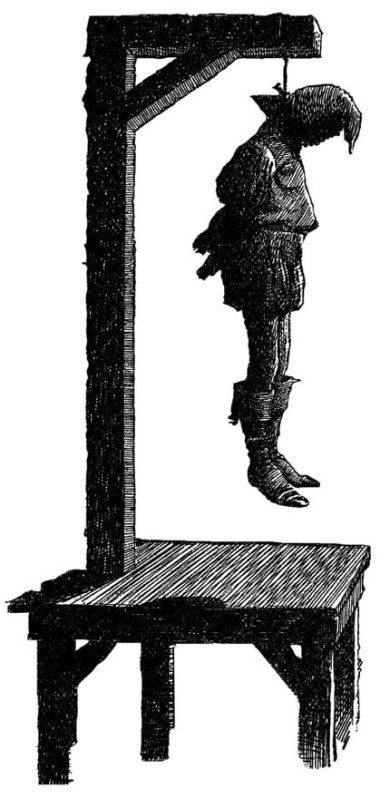
Amongst those who seek to discern the form of the unknowable and define the shape of the ineffable arcane, few are the equal of Gyahzeere the Skryarch. Heretic priest of Boccob-Delleb and eldritch diviner, from his velvet cushioned marble throne-divan beneath the azure dome of his great sanctum psychomanteum; Gyahzeere seeks to know all that is unknown through the art of thaumaturgic extrospection.
Recently, ripples and perturbations in the arcaethosphere have pulled at the edges of his expansive consciousness. Disturbances of a texture and quality unfamiliar to the mystic seer of Urnst have draw his attention to the east and south, to that no-man’s land contested by Nyrond, the Bone March, and the Great Kingdom. The grim Lands of the Unending March.
Gyahzeere does not know what it is that causes the intermittent magical turbulences which intrude upon his prophetic divinations, yet he can discern that if it is not spell work, it is still magic of some sort, and powerful enough to resonate across many leagues.
As his magic has thus far provided him little insight into the matter, Gyahzeere now considers choosing a cat’s paw to send forth to reconnoiter directly. The Skryarch is a most generous employer; coin has little meaning to his ever questing soul. Prospective agents soon learn, however, that acting in the interests of Gyahzeere may bring most unsettling consequences.
Concurrently, as the diviner-mage ruminates on which path to understanding is the most applicable; another already near upon the source of the hidden magic has begun to gather up the loose threads of happenstance.
Hearozaul the Shining Priest, devotee of Pholtus, adherent of the Rightful Way, the curiosity of his brilliant mind piqued, has commenced to acquire and scribe accounts of inexplicable and apparently, “miraculous” events which have taken place within and about a large area which appears to center upon the town of Borlem.
The stories which Hearozaul has thus far gathered seem to have no relationship, one with another, and yet the Enlightener feels there must be one. He prays that Pholtus cast his revealing luminosity upon that which remains shadowed.
Among the accounts the Shining Priest has quilled upon the pages of his journal of inquiry to date;
That of the kind, but quite homely, goose girl who, before the very eyes of the shoemaker’s children, was enveloped in color and suddenly became a ravishing beauty.
The account of the four days rain of wine which fell only upon the estate of Samsar the Vintner, killing all of his grape vines.
The foul death of Wamsucsh the Usurer, the cause of whose demise was later found to be that a very large rat had somehow crawled up his arse, and there, died.
The beautiful music which played from thin air for the space of one hour in the taproom of the Blue Boar Inn.
The scrawny cow of the charitable crone of Duhn which began giving foaming ale rather than thin milk, and apparently still does so.
The tale of how Secoulm the Riff of Lunh met with his bizarre demise, vomiting forth gallons of urine before,” drowning “in the street, his lungs filled with piss.
Hearozaul has expended a great deal of his personal time upon investigating these happenings, but as yet, has reached no conclusions. Something turns aside his priestly magical enquiries. The constant threat of the inhuman raiders across the Harp commands the lion’s share of his attention. The infirmities of the fearful peasantry demand his action.
As his superiors in the order evince no interest in what they declare to be minor devilry or else random arcane circumstance, Hearozaul now muses over the possibility of hiring a spadesman to turn the ground in his stead and perhaps unoerth further clues to the puzzle which tugs at his robe.
Unknown to either the Priest of the Shining One or to the Master Skryer, the source of both the eldritch turbulence and the inexplicable occurrences is in fact, the worn and lonely gallows pole which stands at a dusty cross roads some small distance from Borlem.
In that endless moment before death and judgment, those who die by the noose upon the pole are spoken too by a voice which only they may hear.
The voice asks no bargains and makes no demands. It instead offers a final Wish to the condemned, requiring nothing in return. The only limit attached to the wish is that it may not prevent the death of the recipient.
All of the unexplained events, (save the music in the Blue Boar), are the results of the last wishes of those who have hung from the gallows pole. This is magic of no small power.
The source of the voice is unknown, likewise the reason for its offer. Not all who die upon the gallows at the crossroads are spoken too by the voice. Why some are granted this final “gift” and others are not is also unknown.
The gallows at the crossroad may be inserted into an existing campaign in many forms and serve many purposes. It may be that the PCs are hired as investigators by one or the other of the concerned parties. It may be that a friend, hireling, acquaintance or relative of the PCs dies on the gallows and by way of the wish embroils the PCs in unexpected events. If your group is sufficiently thespian in leanings, in may be that one of the PCs themselves swings from the pole.
The gallows may be used as a hook, or an entry point to adventure, and also as an end point.
The voice may belong to any number of beings, mortal, infernal or divine, or other. Perhaps the speaker gains in some way from the deaths of the hanged. Perhaps it only rewards those who died wrongly. Perhaps it offers the final wish as a test.
It may be that something lies buried beneath the pole, or perhaps nearby. The cross roads itself may be the center of the magic rather than the pole, certainly cross roads have the reputation of drawing the unoerthly. A gate of some sort may be connected to the cross roads.
I like to have things like this in The Game and simply not explain them. The imaginations of the players will often conjure forth more lurid and terrifying suspicions than I could have stated out myself. I love a thick atmosphere of mystery and weird fear to marinate the players in, before their PCs get eaten.
Subscribe to:
Posts (Atom)

