Friday, August 13, 2010

The Swords of the Old Gods.


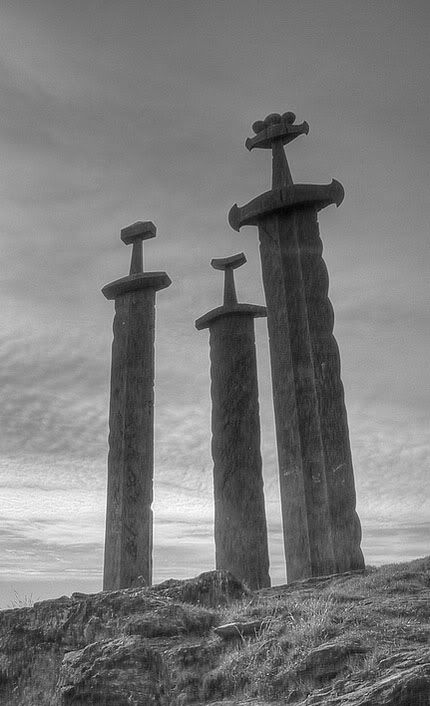
On a sea washed spit of barren stone, on the bleak northern face of the frost glazed Thillonrian Peninsula, Three gigantic swords, ancient and worn, uprightly pierce the shore rock and stand in silent, unknown vigil beside the grey ocean.

Far larger even than the weapons of the greatest giants, the hoary blades, tarnished and pitted by millennia, are known to few, and are less than dim legend to most. Fractured tales and tattered bits of folklore tell of many stories attached to the mighty war brands.

Ullsepas of Seulm, The tale-gatherer and diviner, may Zagyg forgive his prying, related this to the Lord Grenell, Herzog of the North Province, in a secret missive sent by courier eagle.

“As was claimed by the Kettite before he succumbed to the duress of inquiry, a triad of mighty swords, unoerthly in dimension, does indeed stand beside the bitter sea. Their design encompasses many of the elements of the most ancient sword patterns of the pale Suelish barbarians which infest this cold and dismal place, but no creature which walks this world have I seen which could wield blades such as these.

At my first attempt to divine somewhat of the nature of the swords, I was struck down as though I were but an overreaching novice, though all wise precaution had been taken. The Lore imp I had summoned to aid me was burned to ash instanter. I lay senseless upon the black stone for hours, my mind filled to agony with visions I could neither understand, nor retreat from.

I saw endless boreal wilderness. I saw monsters of legend, vast, iron horned, brazen scaled. I saw men at feast, at love, and at war, but not men as we know, greater, without limit. My senses filled with time and smoke and the calling of crows, and the sting of salt water. But over all boomed and rolled the dark laughter. Wild and unending, deep with mirth and madness, beyond the understanding of mortal men.

When at last the vision waned and I again commanded my own form, I stood and found I was no longer alone on that barren shore. Squatting on his long shanks atop a sea spattered boulder was an old man of appearance most dire and strange. Though the cruel wind froze the spray where it fell upon the rocky shore, he wore no clothing other than a rough kilt of seal leather. His fan-like beard and unkempt mane of hair were snowy white, but they did not hide the sky blue eyes, wicked and distant, he turned upon me.

“Are you of the Cruski?” I asked him.

He gestured towards the standing swords with a rune-scribed arm, if the markings were tattoos or scars I could not tell. He spoke in the common tongue, heavy with the accents of the north.

“You seek to know the swords, many-cloaks? There are tales upon tales that speak of the swords. Some of them are so.”

The nails of his long, knotted fingers were heavy and sharp, like the talons of the golden sea eagle.

“I will tell you one, southern bird.” He slid down from the boulder and stood upright, a full head and a half taller than I.

“You know of Kord, of Lerg, of Beltar, Lendor and Syrul, do you not, wizardling? Gods of the cold people, but not the first.”

He gestured past me, to the swords.

“There were others before them, older”. He pointed to the nearest of the towering blades.

“Greater.”

His fingers twisted, they formed a runic symbol I did not recognize.

“The sword of Thoar.” He said, as an invocation. I observed that the runes wrapped around his arm in a continuous spiral from wrist to shoulder.

He pointed to the second sword. “The sword of Vor.”

He looked at me for a moment as his arm slowly arched to the last of the swords. “The sword of Uld.”

“These are forgotten gods? Gods no longer worshiped?” I asked of him.

“What is worship to the Gods? “ He responded. “Gods have no need of worship. It is for men who crave favor of the Gods, as the lowly wolf rolls on his back and bares his belly to the greater.”

He looked at me for five slow breaths with an expression of deep consideration on his face.

“The Three have been gone from here since long before the restless ones sailed south, to empire and decadence. Some say that they were driven out by their children, the young gods. Some say that they have gone to search between the stars for their stolen wives. Or that they have gone avyking against the gods of other worlds. Some say their swords were driven into the stone to mark their defeat and banishment. Some say they stand in remembrance of a great victory. Some say the Three themselves did thrust the swords into the oerth, to mark the way for their return. So that they would not forget from where they had come, or the wergild that was owed them.”

As he spoke, I watched as the blue of his eyes washed outward over the whites, until, save for the pit black pupils, his eyes were blue entire.

“Some of what is said is so. Some is so, but not so. It has been so long that even the truth has been worn by time.”

I will admit to you, Lord, that I felt fear and trepidation in the presence of the man. He smelt of wild and preternatural magic, and no little of it. If there was not madness in his glacial eyes, there was at least contempt of sanity.

Even as he spoke, I had begun a spell to hold him, so that I might more easily put him to the question and thus gain answers more clear in their meaning. He knew what I meant to do, I think, even before I began the binding. My power and skill in the Art is not small, as you well know, but I think he had but toyed with me from the beginning of our encounter.

He stooped suddenly, and with the nails of his bare hand, he slashed into the very rock beneath our feet, a rune of unknown meaning.

“Story time has ended little bird. Fly away now, before the ice takes your wings!”

In that moment before the completion of my own spell, I was suddenly seized by unseen talons and born up and into the sky. I felt mighty wings sweep the air above me, though I could see nothing of the creature which carried me. I believe that somehow the old man had called one of the tremendous eagles of the etheric plane to do his bidding and remove me from his domain.

The eagle carried me for many leagues before I was able to work my hands free of its grip and dispel the magic which had summoned it to this plane. I faced great difficulty in making my way alone through the hostile wilderness. It was some few weeks before I found a city worthy of representing civilization.

I consider now that our compact is dissolved. I will not again dare that uncaring land or face the inexplicable sorcery of the white-haired man. Not unless sufficient recompense and formidable allies be made available to me. If you would have further attempts made in this regard, send to me the Knight of Tatters and his winsome fey vassal, along with Slyr the Sharper and brother Fastandus and also thrice the coin formerly agreed upon.
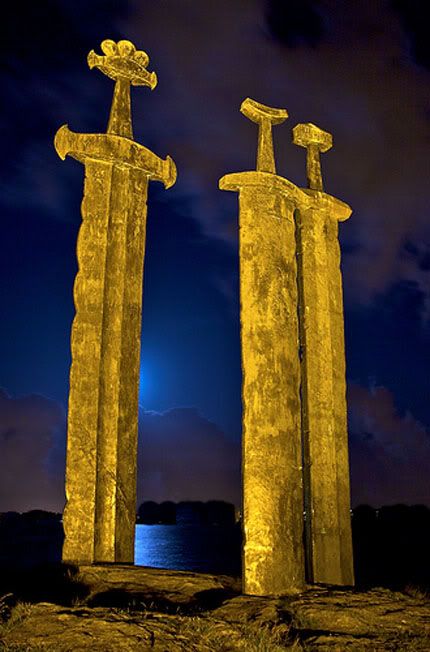


Though the true nature and history of the Three Swords is uncertain and left to the Dungeon Master to determine, and to alter to fit his own campaign, some facts can be established.

The Swords create a powerful Magical Alteration Zone extending for approximately one mile in all directions, including to seaward, and also below ground level, and above into the sky.

The effects of the zone change according to the seasons in a steady pattern throughout the year. The Dungeon Master is free to assign alteration effects and months as he sees fit. (See the link in the Old Guard Guide sidebar to find the original post concerning Magical Alteration Zones.)

In addition, Wyrd Greyhawk’s version, The Swords of the Old Gods, presents the possibility that any characters coming within visual range of the ancient blades may chance Atavistic Possession.

The primal, elemental nature of the power of the Swords may magnify the inner nature of the player characters. As a characters choice of Class reflects who they are as a person, the PC’s class characteristics and stereotypical behaviors will become exaggerated and dangerously unbalanced.

When first sighting the Swords of the Old Gods, Player Characters must Save VS Magic, taking into account their individual Magical Attack Adjustment bonuses or penalties derived from their Wisdom Scores. Those who fail to save have fallen beneath the influence of the Swords.

A fighter may become a Shield-Biter. In this case, he always resorts to violence first to solve any problem. He gains +1 to hit and damage. He acts without regard for his own safety or that of his companions. He may continue to fight to -10 hit points. He also has a 15% chance of going battle mad in any combat which lasts more than six rounds. This is analogous to berserker rage and the shield-biter will attack all present until slain or subdued.

A thief may become a Magpie. Such a thief steals compulsively and without digression from friend and foe alike. A magpie becomes obsessed with anything denied him, a treasure item, a bottle of wine, a girl, etc. All thieves’ skills are boosted by 25%. Practicing the art of thievery becomes the be-all of a thief in the throes of atavistic possession.

A cleric may become a Godsman. In every situation requiring even the simplest and most inconsequential decision, the cleric will require time for theological reflection, to ensure that his actions do not conflict with dogma. A godsman casts spells at two levels higher than his actual experience level. He will also attempt to convert others to the worship of his god or gods at every occasion.

A magic-user may become an Eldritch Seer. He then perceives directly the lines and flows of arcane energy about him at all times. This results in a constant Detect Magic ability which never ceases. The magic-user casts spells as though two levels of experience higher than his actual level. He insists on using magic for even the most mundane tasks. He develops a disregard for all things not related directly to magic, and an obsessive need to possess any magical item he encounters. There is a 15% chance that some form of madness, chosen randomly from the Dungeon Master’s Guide, may strike the magic-user for every day that he remains in this state.

Once a character has fallen beneath the influence of the Swords, the Dungeon Master may wish to pass the player a note explaining the behavior changes he must portray. As with cases of PCs controlled by spell or monsters, the other members of the party who remain unaffected will have to figure out what has occurred and how to deal with it on their own.

Once affected by the power of the Swords, characters will remain so until they move outside of the area of effect of the Swords magical alteration zone. At this point they are allowed to attempt to Save VS Magic a second time. If they fail this second attempt, they will remain subject to the Atavistic Possession until such time as a Remove Curse spell may be bestowed upon them.

It should be noted that the atavistic possession bestows a sense of great freedom from social constraints and a feeling of clarity of purpose which is most gratifying. Those characters which are under its effects are unlikely to be co-operative with anyone seeking to return them to normal.

*The pics are of a Norwegian monument commemorating the battle of Hafrsfjord in 872. I bumbled into them whilst tooling about the internet and found them inspiring. Dig it.

Friday, August 6, 2010

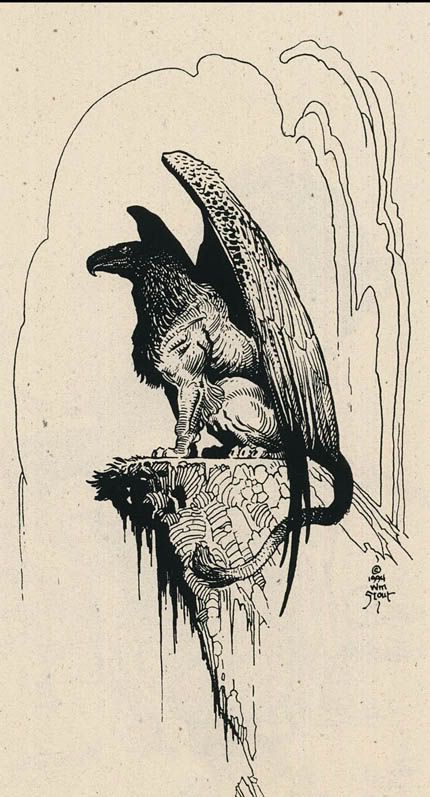
Three Griffons, to kill your players.


The Black Griffon of the Drachensgrabs.

Frequency: Unique
No. Appearing: 1
Armor Class: 1
Move: 12”/330”, (120 feet per round on foot/330 feet per round in the air)
Hit Dice: 14, (112 hit points)
% in lair: 25%
Treasure Type: Special
No. of Attacks: 3
Damage/Attack: 2-16/2-16/2-20
Special Attacks: Scream of Battle, three times per day, the griffon’s scream will force all who hear it to Save VS Breath Weapon or immediately fumble their next action in fear.
Special Defenses: The griffon’s wings make no sound, it’s passage will not be noted if the creature is not seen.
Magic Resistance: 50%
Intelligence: Uncertain, accounts vary.
Alignment: Lawful Neutral
Size: L
Psionic ability: Nil

Said to be more than twice the size of other known griffons, the great Black Griffon of the Drachensgrab Mountains is held by many to be a harbinger of disaster, its appearance an omen of coming events both terrible and important.

One week prior to the battle of Splintered Oaks, the Black Griffon was reported to have dropped without warning from a clear blue sky to slay and devour the favored war horse of Glewning, Duke of Dweryn. The death of Glewning, and the ruin of his House in the aftermath of his loss beneath the Splintered Oaks was later said to have been foreshadowed by the actions of the Black Griffon.

Some hold it was the griffon laid a curse upon Glewning and his kin by its actions, others that the beast was but an omen sent by the Fates, or Istus, like the dreaded Black Dog.

Some hold that it was merely chance, or perhaps an unfathomable jest of Zagig.

Many words have been spent beside late night watch fires in argument over the nature of the Black Griffon. Little of worth has been gained.

Certainly, the beast is a terrible opponent to face in combat. Upon this, all accounts do agree.
Even the most faithful of war horses will refuse to bear their riders within reach of the Black Griffon’s scythe-like talons.

Pladothemed the Infirm conjectures that the beast has a secret purpose. He has charted the sightings and the reported encounters with the Black, and believes that a pattern may be discerned in its movements. The Trembling wizard avows that the griffon wings forth to various places upon the Oerth in accordance to the arrival of certain dates of arcane relevance as noted in the common calendar of the Flaness.
The accuracy of Pladothemed’s theory is contested, however, as he refuses to reveal more.

Aclamng of Dyvers dismisses him as slovenly in his art, and as, “A senile fondler of Halflings!”

Tales concerning the Black Griffon are often contradictory regarding its behavior. Some have painted the creature as a benefactor of lost souls and a guardian of travelers, while others depict it as a remorseless killer with a cruel and malign humor. The truth may only be discovered by those who venture to seek the creature amongst the rocky spires of its home.

This of course, is no mean feat. The Black Griffon is said to nest in the shattered top of an ancient tower in the unknown heart of the Drachensgrab Mountains. Choked with orcs, goblin haunted, and infested with monsters little less formidable than the Black Griffon itself, only fools, the mad, and adventurers willingly dare the horrors of the Drachensgrabs.


Serpentine Griffon

Frequency: Very Rare
No. Appearing: 1-4
Armor Class: 3
Move: 10”/30”, (100 feet per round upon the ground/300 feet per round in the air)
Hit Dice: 8
% in Lair: 35%
Treasure Type:
No. of Attacks: 3
Damage/Attack: 1+1-6/1+1-6/1+1-10
Special Attacks: 50/50 chance for either; Spit venom to 100 feet, Save VS Poison or be paralyzed for 2d8 rounds, or, Constriction for 1d8 points of damage per round. Victim must successfully Bend Bars/Lift Gates to escape the griffon’s coils.
Special Defenses: Nil
Magic Resistance: Standard
Intelligence: Low
Alignment: Neutral, (Evil)
Size: L, (up to 30 feet in length)
Psionic Ability: Nil

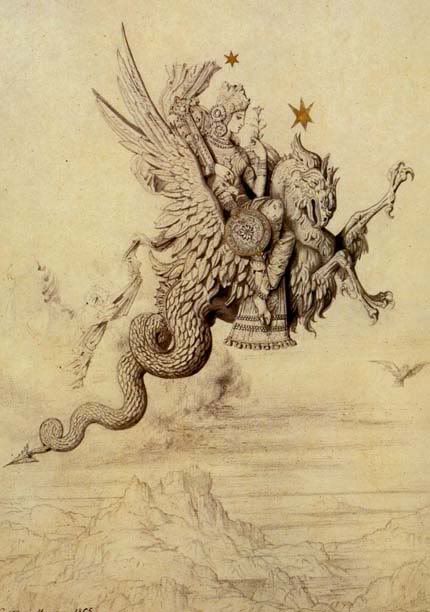
A griffon of this sort possesses the body and tail of a giant serpent, rather than that of a lion, after its eagle’s head, taloned forelegs, and sweeping wings.

Less often encountered than their cousins of the leonine type, they are more likely to be found serving as mounts or guardians than as free wild creatures. A serpentine griffon is at best an untrustworthy servitor, however. It requires constant reminders of its master’s power and will or else it is likely to indulge its own appetites at any opportunity.

Serpentine griffons are more commonly encountered in warm or southern regions. The lair of a serpentine griffon, if it is of their own choosing, will be a location that allows ample sunlight for basking, preferably on rock. They do not seek the heights to nest as do other griffons.

A serpentine griffon left to its own devices is likely to act in a manner similar to that of a dragon. It will find a lair to its liking and then demand food and tribute of passersby and the local inhabitants of the area.


Griffhound

Frequency: Very Rare
No. Appearing: 2-8
Armor Class: 4
Move: 22”, (220 feet per round at a dead run)
Hit Dice: 4
% in Lair: 20%
Treasure Type: Incidental
No. of Attacks: 1
Damage/Attack: 2-8
Special Attacks: Stoop, if a griffhound has sufficient space to reach its top speed in attack, (50 yards required), its first attack will do double damage, and also topple the victim if they fail to roll below their Strength score.
Special Defenses: Never surprised
Magic Resistance: Standard
Intelligence: Animal
Alignment: Neutral
Size: M
Psionic Ability: Nil

Lean and tawny hunters, Griffhounds combine the features of hawks and coursing dogs as griffons do with those of eagles and lions.
Wingless, but with the head and clawed forelegs of a huge golden hawk and the body and haunches of a great sight hound, griffhounds hunt open land in small packs.
Griffhounds may be encountered in areas of savanna, steppe, desert, or other open range or grassland.

The creatures habitually lair atop the highest point of land within their range of vision. This extends for miles due to the keen sight of their hawk eyes.

The tremendous speed and great stamina they possess enables them to run down most any creature they choose as prey. The pack normally hunts by chasing the prey until it begins to tire. Each griffhound then makes a pass at the prey, slashing or biting on their way by. They continue to attack in rotation without stopping until the target falls. Their superior speed leaves very little time for the prey to strike back before the griffhound is out of reach. (-2 to hit penalty to those attempting to defend against griffhounds which have room to employ their running attack)

Griffhounds are roughly equal in size to the largest normal wolves, and while they are unlikely to attack humans or humanoids unless desperate, trapped or very hungry, once combat has begun they are fearless and need never check morale.

Though it would seem likely that griffhounds were at some point creatures created by deliberate magic, they are quite successful in their role as predators of open land and behave as natural animals.

As the only sort of griffonish beast which may be truly trust worthy when taken as a pup and well trained, perhaps due to its canine half, it goes without saying that griffhound eggs will fetch a good price if offered to the correct buyer.

Thursday, July 22, 2010

Magical Alteration Zones of Wyrd Greyhawk, & four new spells from the Weighty Tome.


Singular events of great moment, or the presence of objects of power or importance, magical, divine, infernal, or otherwise, leave impressions on the arcane aethosphere of Wyrd Oerth. Mighty works of magic, godly visitations or devilish intrusions, great conflicts or acts of infamy, leave behind them sumps, eddies, vortices, undertows, or other such disturbances in the normal ebb and flow of eldritch energies about the world.

These disturbances result in zones of magical alteration where normal spell casting is both dangerous and unpredictable. Any particular alteration zone will have a given % chance of causing a spell mishap to occur should an unwary magic-user attempt spell craft within its area of effect. This chance is determined by the Dungeon Master and should reflect the magnitude of the event which caused the aetheric impression originally.

If a spell is cast within an alteration zone, and a mishap is indicated, it may take several forms.

• A simple spell failure is possible. The spell’s energies are drawn into the disturbance with no effect.

• A spell alteration may take place. In some random fashion, the spell’s characteristics are altered. A fireball for example could manifest as a stream of flame that runs along the ground rather than a sphere which flies to its target. Alterations could potentially be helpful or a dangerous hindrance. The fire-stream in the above example could set other objects or persons alight as well as damage its intended target.

• An arcane wildfire could occur. In this case the spell runs out of control. It’s duration, range, area of effect, or power level could triple, quadruple, or the spell could become a permanent manifestation. In this last case, the spell is now drawing energy in a self sustaining manner from the currents about the arcane disturbance itself and has gone beyond the casters ability to end or control.

• A backfire may result. In this case the spell turns back upon the caster, delivering its full effect upon him.

• An unrelated magical manifestation accompanies the spell. A rainbow appears, sprites infest the casters beard, a wagon sized turd falls from the sky, etc. I employ parts of the 2E wild magic rules for this result.

• A spell-ghost occurs. This is not an undead spirit, but a re-manifestation of a spell which was cast previously within the alteration zone. The spell-ghost will take the form of a randomly determined spell which acts at one half of its standard strength. If the spell normally affects a target creature, the Dungeon Master must randomly determine who among the PCs and NPCs present the recipient of the magic is. If the random spell is one that increases in strength by level, the Dungeon Master must also determine the original casting level.

• A revelation strikes the spell caster. Previous or future events connected to the location of the alteration zone are revealed to the caster in an instantaneous vision. The caster is also stunned for 1d4 rounds.

• An arcane reverberation occurs. A wave of magical energy washes out from the locus of the alteration zone. This wave does no damage, but will be felt by all magic-using creatures within 1-100 miles, (2d10), of the disturbance. The reverberation will draw the attention of any such creature or person and may spur them to investigate its source. The reverberation will also be felt on both the astral and ethereal planes, as well as any other such plane which borders directly the prime material.

Famous magical alteration zones in Wyrd Greyhawk include, the Swords of the Old Gods, The Black Spiral of Ket, and the Mirror Water Pools. I intend to detail all of these in future posts.

When designating any particular space as a magical alteration zone, the Dungeon Master may roll 1d8 to choose the nature of potential mishaps, assign percentile chances to each possibility, or simply pre-choose which effect will be manifested in accordance with the circumstances of the zones origin.

If a magic-user is aware of the existence of a given magical alteration zone, he may cast spells normally within its area of effect if, before each attempt at casting, he successfully Saves VS Magic. Otherwise, a spell mishap is certain to occur.
Because of the danger presented by the existence of alteration zones, as well as the generally inconstant nature of magic in Wyrd Greyhawk, most masters include in their apprentices spell books a spell known as,

Discern Arcane Aethography

Level: 1
Range: Visual range of caster
Duration: 1 round
Area of Effect: N/A
Components: V, S
Casting Time: 3 rounds
Saving throw: N/A

If a magic-user has some indication or suspicion that the currents of magic are disturbed or unsettled in a given area due to past magic or other influences, the casting of Discern Arcane Aethography will reveal to him the nature of the disturbance and also what effect it may have upon his own spell casting.

As example, Sugraid the Spindly casts Discern Arcane Aethography upon encountering an ominous arch of living trees deep within the Old Forest. This reveals to him that spell casting here will result in an arcane reverberation unless he first Saves VS Spell successfully before each casting. As Sugraid has no wish to reveal his location or presence, he must refrain from magic-use within the alteration zones area of effect.

Magic-users with an Intelligence score of 16 or above who cast Discern Arcane Aethography prior to casting a second spell in areas outside of magical alteration zones will gather enough of a feel for the shape of magic in their immediate area that the following spell will act as though the magic-user were one level of experience higher than he actually is.


Remlap’s Arcane Inscriptor

Level: 3
Range: Centered directly upon caster
Duration: permanent
Area of Effect: up to a 10’ diameter circle, dependent upon available space.
Components: V, S, M
Casting Time: 6 rounds when pre-cast, 1 segment when activated.
Saving Throw: N/A

When activated, the Arcane Inscriptor instantly burns a magic circle, pentagram, thaumaturgic triangle, or other designated protective inscription into the surface the caster stands upon. Regardless of the nature of the surface, stone, wood, a grassy lawn, a lake, the chosen design will appear complete, unbroken, and legible. This inscription is permanent and may not be broken or erased.

The major portion of this spell is first cast in a secure location, with the magic-user drawing the desired protective inscription on the floor by hand. Then the spell is carried in the casters mind and only activated by the uttering of its final word.

The design created by the Arcane Inscriptor enhances the power of a single spell which is cast after its creation. The inscription created, and the spell enhanced by it must be related. A magic circle will enhance the spell, protection from evil, a pentagram will enhance summoning/binding spells, and a thaumaturgic triangle will enhance divinatory magic.

Specifics are left to the individual Dungeon master to tailor to their own taste.


Call forth the Guryms

Level: 2
Range: 20’
Duration: 1d6 rounds per level
Area of Effect: all within reach of the Guryms
Components: V, S, M
Casting Time: 1 round
Saving Throw: N/A

This spell when cast summons 1d4 of the Guryms per level of the caster. Creatures of the fey underworld, the Guryms are unaffected by other monster summoning spells or magic. Only this specific spell can call them to the prime material plane. The Guryms are completely and utterly uncontrollable. Immune to charm, hold, suggestion, paralysis, binding, or other such magic, they naturally possess an aura of free action and may not be physically bound, restrained, or contained. The caster will have no influence over the actions of the beastly little men. At the end of the given spell duration, the Guryms will fade back to their own dimension.

The Guryms appear as two and a half foot tall, extremely hairy men with disproportionately large heads, blazing blue eyes, and wide mouths filled with sharp teeth. They wear kilts or short pants but no other clothing.
When they appear, their actions are determined randomly. They may, attack all present, revel wildly, steal all things they lay hands on, eat anything ingestable, destroy all objects they can reach, or create art. Roll 1d8 to determine.

Guryms, AC: 4, Hit Dice: 2, Move: 140’ per round, Alignment: Chaotic, Special: unharmed by non-magical weapons, Those face slapped by a gurym will join them in whatever activity they are engaged in until they return to the fey underworld.


Clear the Air.

Level: 3
Range: 60’
Duration: 3 rounds
Area of Effect: Whatever enclosed space the caster occupies, or, 1000 cubic feet of outdoor space, per level
Components: V, S
Casting Time: 6 segments
Saving Throw: None

When this spell is cast, a stiff breeze of pure, cool air blows through the immediate area about the caster and instantly clears the air of smoke, smog, dust, spores, steam, gas or vapor and renders it clean and breathable.

The action of the spell also ends the effects of any magic which causes such atmospheric contamination, such as, stinking cloud, as well as shielding the caster from poison gas attacks such as green dragon breath.

The spell functions in a metaphoric sense as well. Clear the Air will also put an end to Charm and Suggestion or other such mind affecting magic. Recipients of the spell’s benefits may also feel a sense of clarity and inspiration. What may come of this is left to the Dungeon Master to decide.

Monday, July 19, 2010

Does anybody want to trade me for this White Wolf stuff?


I went through a period of voracious collecting of any and all rpg material looking to mine ideas. My trawling netted stuff that didn't really mesh with my own gaming leanings just because I thought I could maybe squeeze something useful out of it.

Now I'm sorting and eliminating things as what I like becomes more clear to me, so I thought I'd see if any of youse guys would like to trade. None of this is rare, but it's in very good shape. If I took the stack to half-price books, they'd give me 1.25 and a kick in the ass,so if anyone has anything they'd like to just trade straight up, send me an e-mail and let me know.

I don't know what shipping cost would be, but if the exchange is roughly even, I'll pay to ship to you if you pay to ship your stuff to me.

If you only want 1 book, that's fine also, you don't have to take them all if you don't need them.

A couple of these have a bit of price tag goo on the cover, but other than that, they're clean and undamaged.

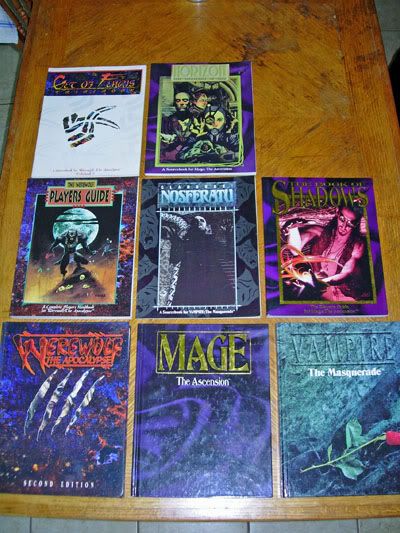
I've got, a Get of Fenris clanbook, the Horizon sourcebook for Mage, the Book of Shadows for Mage, the Nosferatu clanbook for Vampire, the Werewolf Players Guide, a Vampire the Masquerade hardback, a Mage the Ascension hardback, and a second edition Werewolf the Apocalypse hardback.

I'd like to have stuff like, Fading Suns material, Kenzer's Aces&Eights, Alternity stuff, Knights of the Dinner Table comics,( I'll have to check and see which ones I'm missing), and of course, old TSR or new OSR materials. I've probably already got a copy of the TSR stuff, but you never know. Whatever you'd like to trade, let me know.

I'm not interested in making a profit or getting a deal on this stuff, I'm just looking for an exchange of roughly equal value.

Friday, July 16, 2010

Will the real OSR please stand up? Oh look, they all did.


Restoration, See above image.

This is the definition by which I navigate on matters concerning the Old School Renaissance.

In my mind, OSR is a term which describes new materials, games, rules, art, attitudes and philosophies towards role playing games which are derived from, consistent with, amenable too, or congenial with, those same elements of the original editions of the first generation of role playing games.

This is a broad definition, and each facet of it is subject to debate. That’s fine with me. One of my maxims is that, “All statements are generalizations,… generally.” When an apparent contradiction arises, it usually means I’m missing something, that I’m too close to the issue and I need to expand my focus to take in the bigger picture.

I think that the majority of conflicts, in all things, not only RPG discussions, are due to conflicting definitions. So, I try to be as forthright as I can be in sharing the meanings of the terms I use. Most especially here on the web, where 90% of the subtleties of interpersonal communication are stripped away and reduced to stark black and white lettering.

I don't think there is a single OSR. I think there is a multitude of overlapping personal OSR's, each sharing to a greater or lesser degree differing amounts of the various elements that are commonly perceived to make up Old School gaming. I don't think it's possible to sharply define what is and what isn't Old School, and I'm really only interested in general definitions anyway. I think it's porous, the borders are shifting and ill defined, and I like it like that.

At the dawn of role playing gaming, there were no limits. Rules were formulated and tested to see if they would provide the play experience the maker was seeking. There is a primal chaos at the naissance of any and all things which later grow and expand. Anything is possible at the beginning, but for there to be growth, choices have to be made and each choice made both provides structure, and eliminates possibilities. Order is required for growth, but too much order causes stagnation and death.

There have to be rules for The Game to be a game, and not just backyard make-believe, but as each later edition expanded the rules and further defined The Game, it also narrowed the range of possibilities at the same time. This is unavoidable, more rules means fewer real choices in the Game, just as bigger government means less liberty in real life.

The thing here is that there is a sweet spot on this sliding scale of imaginative chaos vs. rules order that I think of as Old Guard, or Old School if you like. Where exactly you see this sweet spot on the scale probably has a lot to do with your personal proclivities and also, at what point in rpg history you were introduced to the idea of role playing. For myself, it was the Holmes edition D&D, and immediately after, AD&D. That’s where I’m coming from.


Renaissance, See above image.

A renaissance is a re-birth, a second beginning, it is not a restoration.

I think a very great deal of the internal conflict, but not all, that I read is due to the confusion between the two terms. The camp that requires original rules purity is actually pursuing an Old School Restoration, rather than a renaissance. There is nothing wrong with this. This is the same attitude towards The Game that a classic car restorer has about returning a model T C-cab to original condition. It’s important for understanding and appreciation the history of the game to preserve attitudes, approaches and ephemera as well as the original rules themselves.
The conflict comes from a failure to recognize the different goals of the renaissance promoters and the restorationists.
This, I think, is the origin of the dogmatic absolutism that concerns some of our good fellow game bloggers. I myself don’t find the uber-grognards particularly troubling. Growing up in rural Indiana, I’ve had to deal with more than my share of obstinate, crusty old bastards and I just see them as part of the local color. I treat them like I do upper management, smile and nod and do what I’m going to do anyway.
I suppose the head-butting between the restoration and the renaissance is something like the disconnection between historical re-enactors and the Society for Creative Anachronism. Of course this is a generalization, don’t carp at me if you don’t like where you come down in this comparison. Heh…

Anyway, My Personal OSR is a renaissance and not a restoration. Full speed ahead! Damn the torpedos! I've got a bad feeling about this! It’s about reexamining the originals to figure out why I like them so damn much. It’s about rebuilding them in my own way. It’s about getting back to that root, that origin point, and examining, considering, and testing all the directions I can think of that The Game didn’t take the first time. And also in just creating materials that I enjoy that do work with the early editions as written. I see no contradiction in these approaches and I do them both concurrently. I appreciate that fully restored classic just as much as I appreciate all the work that goes into a modified hot rod roadster.

I get my kicks by exploring what it is that appeals to me about the old games, and building off of those elements to augment the experience of play. Testing the ideas, rules, approaches that others put forth, or are inspired by the experiments of others, to see what happens, and if I find them congenial to my game, lets me expand my horizons. If I don’t like where the experiment goes, that’s fine. I put the idea back on the shelf and start over. No harm done.

I love the OSR, or at least, I love my OSR. After a dozen or so years of thinking I was the last AD&D supporter on earth the online old game community has made it possible for me to blather on about My D&D to people who actually give a crap and to contribute what I can to the preservation and advancement of Old Guard Gaming. I love it because now I have the chance to contribute to The Game in a way that I couldn't back when it was created. I'd have given my left 20-sider to have been there at TSR at the beginning, but I missed that boat by a decade and it wasn't until I blundered into the online community that I had any chance of actually getting my game writing and ideas out there. It was this blog that brought me the chance to write for Rob Kuntz, which is of course, frikken awesome! My wife dosn't understand the girlish glee that brings me, but she's glad it makes me happy. It was the OSR that got me that chance. As an originator of The Game, Rob himself has no need of the OSR, but for myself, it was what reignited my fire for The Game and got me to actually start writing out all the stuff that clogs my head. The unembarassing stuff at least.

This is what I do. I can’t speak for anybody else and I’m not interested in doing so. I have enough NPCs to manage.


And that's all I've got to say about that.

Saturday, July 3, 2010

The Spontaneous Creation of Magic Items in Play.


I think of my Wyrd Greyhawk as a low magic campaign world, but in fact, it is awash in it. Magic is elemental, a fundamental natural force which permeates and penetrates all space and things in the game world, living and not. Wells and currents of magical energy dot the world, allowing for things and creatures that mundane physics would deny. Raw arcane force has properties and behaviors of it’s own, but these are not completely definable as they vary, shift, and change from time to time and place to place. The only reliable definition of magic is that, it is that which science is not.

The thing that is actually low in Wyrd Greyhawk is the PC’s ability to access and control magic, and employ it to do their bidding. Harnessing magic to create a magic item, or cast a spell is like building a water wheel in order to to use the power of a river to run a mill. Spell work or magic item creation require extensive knowledge, skills, and resources, as well as a proper location and the needed natural energy. Just as a water mill would require knowledge and skill in metallurgy, woodworking, stonemasonry, a basic understanding of physics, the necessary materials, and a strong flowing stream, so too does magic use have a great number of prerequisites.

These things are well beyond the scope of the vast majority of people in Wyrd Greyhawk. Creating a magic item requires knowledge of magic that would be on a level equal with the ability to build a wind turbine to generate electricity, from scratch, without formal schooling. Remember, there are no magic universities or schools in Wyrd Greyhawk, only individual archmages who may choose to take apprentices or not.

This makes the number of magic items and their availability to the PCs in The Game very low and infrequent, which is what the phrase “Low Magic” is commonly seen to mean in gaming terms. This allows me a game world steeped in eldritch glamour without having PC’s suffering Christmas Tree Syndrome and cheapening the weird and unsettling feeling I want magic to have. I actually employ parts of the 2E wild magic system under certain conditions to enhance the atmosphere and ensure that players never take magic for granted. But that’s a post for another day.

This post is about how the natural flow of background magic, combined with circumstance and motivating action on the part of PCs, as well as the good judgment of the DM, occasionally results in the spontaneous creation of magic items.

When a PC shows a particular liking for, and flare in the use of, a particular mundane item, I begin assigning that item Arcane Potential Points, (APPs). Each time that item is employed in a manner which is inventive, showy, changes the course of an encounter or adventure, increases that character’s stature or renown in some way, snatches victory from the jaws of defeat, or is above and beyond the ordinary in some way, I award the item 1 APP. Sometimes 2.

This is a measure of the natural magic of the game world being invested in and/or attracted to the item by the heroic or infamous actions of its wielder. Some events, desperate acts performed under duress or moments of incredible luck, cause ripples and reverberations in the arcane aether, drawing currents of magic towards objects and people. Such actions need not be good in nature, but must be of consequence. I don’t tell players this sort of thing, it’s above their paygrade.

Once an item has accumulated 10 APPs, it has a chance of spontaneously demonstrating magical abilities. This chance is equal to the weilder’s chance of Saving VS Magic. If the item fails the save, it will never become a spontaneous magic channel, end of story. If it succeeds, it has become a magic item.

The DM may proceed in several ways according to the goals of his particular play style from this point.

The magic may be rolled for randomly, using the magic item lists from whatever iteration of The Game you favor and adjusting the result to fit the item. This can be fun, but nonsensical. Which may or may not be a problem for you.

The magic may be dictated by the circumstances of the event which bestowed the final APP. A troll slaying may result in the sword bestowing regenerative abilities on its user. Knocking a thief off a wall with a staff might give the staff the power to cause vertigo or loss of balance on a hit, etc…. I tend to favor this approach myself; I like symmetry and sympathy in magic.

The magic may be related to the characters backstory if you run a story driven campaign. It could be that the character’s actions have activated some destined fate and the spontaneous magic item will in some way make possible a previously unknown or unreachable goal. You could easily retcon any number of plot points into the game in this manner.

The magic may be influenced by powers divine or infernal if such are present in some way at the moment of magical investiture. It may even be possible that the item could become cursed in some way if the final APP derives from an act of evil.

The magic may cause the item to become sentient in addition to whatever magical powers may be gained. In this case, the rules for dealing with intelligent swords come into play, with all that entails regarding power struggles between the PC and the item.

Weapons are the obvious items to become spontaneously magically charged, but any item which a character uses regularly in the requisite manner may possibly become magical. This especially applies to items which are intrinsic to the characters class. Items such as a thief’s favorite crowbar, a friar’s fighting gloves, a paladin’s spurs, or items like a frying pan, a banner, a blanket, etc… May begin to accumulate APPs, if through play they become a regular part of a character’s idiom.

This system allows for magic items to be inserted into a low magic campaign in a way that doesn’t lessen the weirdness of magic, and at a rate that is controllable by the DM. Magic items that come into being this way are very personal to the characters and are treated as having much more value than the generic sword +2 looted from orc hoard #47.

You may or may not wish to inform the players of the new magical power of their item. I find it entertaining to cause unexplained events and drop hints rather than outright announce these things. If the PCs get suspicious and drop some coin on sages and mages, they may find out what has happened, but probably not how, or why. The thing that makes magic, magic is its unpredictability and ultimate uncontrollability. Science is repeatable; magic may or may not be so.

The players don’t get to manipulate this system to create magic items as they wish. As a DM of the Old Guard, I don’t need proof of rules lawyery or bad faith manipulation to get all smitey, only suspicion of same.

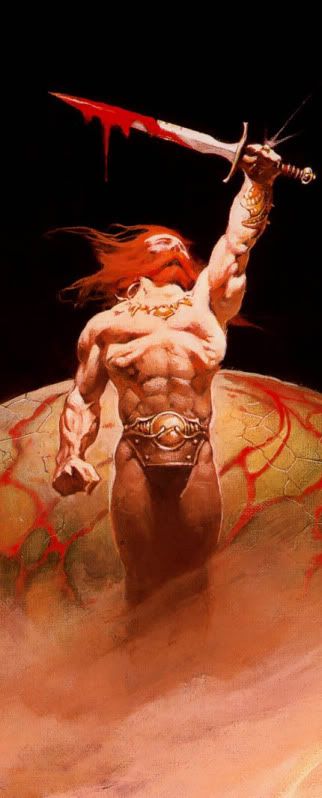
The pic is a clip from the center of a Frazetta painting for Karl Edward Wagner's Kane. I dig it. In my fantasy afterlife, Frazetta sits in on Gary's game in the sky and does the character portraits.

Thursday, June 3, 2010

Wyrd Greyhawk; "And the Goblins WILL get you, if you don't watch out!"


Fear stalks the land in many guises. There are few who know it not.

Great Lords sit their thrones with knotted brows, brooding upon the depredations of dragons, the glory to be won by victory, the ruin brought by defeat. Mighty wizards dwell upon the machinations of their rivals, and mull the limits of their own mastery of magic. Untrustworthy servant that it is, and quick to turn in the hand of he who overreaches. Even those who speak with the Gods themselves carry hidden fears, for with the gift of secret wisdom comes knowledge of the endless Infernal forces which threaten the very existence of all things.

The fears of the great and puissant are not, however, the fears of the common man. Dragons, devils, and malign magic are threats that most know, but vaguely. As fearsome tales told by fireside and distant fables from olden days.

When the plowman pauses in his work to gaze across the furrowed fields and into the shadows of the tulgey woods, it is not the appearance of a great and ravening scaled beast which he fears. When the washerwoman halts in her labor amongst the stones, and warily glances upstream towards the river bend, she does not watch for a warlock to arrive in a flash of reeking vapor. When the cooper wakes in the night and hearkens after sounds in the darkness, it’s not the lustful roar of demons that he listens for.

Such perils are the domain of warriors, wizards, and priests. The peasantry fear that which they know, that which they have suffered by all too often. What the rustics and villagers fear most is the furtive rustle amongst the dim-lit groves, the sudden spiteful black arrow, and the mad, cruel laughter of the Goblins.

The goblins of Wyrd Greyhawk are one race, but of two sorts, the High, and the Low. The Low Goblins retain the standard statistics of AD&D goblins with only a few changes.

Goblins prey upon all other races as the circumstances may allow. They are conscious-less creatures who see all other living things as toys to be tormented for their own amusement, and as food. Cruel mirth is the force which motivates them. Goblins exult in malignant jokes and tricks, usually lethal in nature, visited upon the unsuspecting and helpless. Outright murder is commonly engaged in, but given time to prepare, goblins will always prefer that the death be entertaining for them, and humiliating for the victims.

Low Goblins range between 3 and 5 feet in height, with gray-green warty skin, broad mouths filled with pointed teeth, and lambent yellow eyes. There is much variety amongst them as to general physical conformation. They may be stocky as dwarves, or thin as elves. Some have been told of as sporting horns, others as being as hairy as a ram. There are no reliable reports which can be used to discern the true aspects of their appearance. Those who are learned conjecture that so close is the goblin’s connection to primal chaos that their very forms are subject to change with each generation.

Goblins make very few things for themselves, instead dressing in the clothing of previous victims and employing the weapons of those who have died at their hands. Goblins of the Low sort are most often encountered in groups of 6-24. When more are encountered, they will always be lead by a High Goblin.

All goblins are Chaotic Evil and not Lawful Evil. They are, in fact, so resistant to any sort of order that Low Goblins must check moral every 6th round in any endeavor,(combat, a march, construction, etc..), for which they have no heart. Failure of the moral check does not indicate fear, for though the goblins live to bring terror to others, they themselves feel that emotion but little. Rather, their inner chaos is of such intensity that they are unable to remain dedicated to any task to which they are not driven.

This moral check may be dispensed with if the low goblins are captained, or otherwise commanded by a High Goblin. A High Goblin Lord they will obey with gleeful abandon, even to the point of taking obviously suicidal actions if so commanded.

High Goblins

Frequency: Very Rare
No. Appearing: 1-6
Armor Class: 4, or by armor type.
Move: 12”, (120’ per round)
Hit Dice: 6
% In-Lair: 40%
Treasure Type: Nx4, Q
No. of Attacks: 2
Damage/Attack: 1-6, or by weapon
Special Attacks: Seeming, Curse, see below
Special Defenses: Shadow Step
Magic Resistance: Standard
Intelligence: Highly Intelligent
Alignment: Chaotic Evil, exemplary so
Size: M
Psionic Ability: Nil

The High Goblins are beings of greater intelligence, subtlety, and sophistication than the jeering and cackling Low Goblins. Terribly, this makes their evil humor horrific in its depth and depravity. Those who find themselves within the power of the High Goblins may come to consider their captors witty and insightful. They may feel them to be wildly entertaining and fascinating hosts. This gives their eventual and certain betrayal and death much greater savor and delight from the twisted perspective of the goblins. Sauce for the goose, as it were.

High Goblins are rarely met in large groups. They prefer to live as individuals, Lording over clans of Low Goblins where their will is uncontested. Sometimes families or cabals of High Goblins orbit a particularly powerful, malign, or expansive individual whose force of personality allows him to influence others of his kind. Rarely does a High Goblin appear who can force sufficient numbers of his race to submit to his Lordship and claim the ephemeral title of Goblin King.

The High Goblins are tall and spare of build. They have sharper features than the Low Goblins, skin of a lighter grey, and red-gold eyes shining with sardonic joy from beneath lank, green-black hair. This, the true visage of the High Goblins is rarely seen by others for the “Noble Goblins” posses the inherent magical ability to create a Seeming. The Seeming is both a charm, and a disguise. Those who fail to Save VS Magic will see the High Goblin in whatever form it has chosen, and will perceive it as non-threatening, a friend or possible ally. High Goblins employ the Seeming to gain information, or to lead the trusting astray. They often choose to appear as rangers, elves, or hermits, beguiling travelers or those lost in the wilderness. Once a being has been taken in by the Seeming, it will remain in effect through multiple encounters with the same goblin until it has been lifted by a remove curse, or the goblin himself negates it by attacking the victim. A person may labor for years beneath the delusion of the seeming if it amuses the goblin to continue to string him along, or else it furthers some dark and intricate plot.

The goblins are as closely linked to evil as they are to chaos. Acts of evil, committed by those of non-evil alignment due to instigation by the goblins, temporarily enhance the inborn powers of the goblins.

As an example, goblins may travel by stepping into and out of shadow once per day. This ability allows them to cross distances of up to a mile instantly if shadows exist at both locations. This is the reason that dusk is called, “the Goblin hour”, by villagers and woodsmen. Normally, goblins lack the power to cross boundary lines or circumvent magical wards by stepping through shadow. Even a closed door, or scribed rune prevents entry by the goblins to the most humble cottage by stepping from the shadows.

If, however, through careful machinations the goblins have manipulated the occupants into evil action in some way, they gain sufficient power to enable them to overcome their normal limitations and gain access through the shadows. It must be an actual evil act on the part of the occupants, and not simply a thought or attitude in order for the goblins to gain entry, though even so small a thing as a blasphemous curse uttered in a moment of anger may prove fatal. At the DM’s discretion of course.

Any weapon, magical or not, acts as though Of Wounding in the hands of a High Goblin. Wounds inflicted will not heal naturally and will require magical or divine intervention. Lost hit points will not be regained until the damage has been dealt with by a cleric or magical healing.

A High Goblin may Curse a victim a single time, but if the curse is removed, may never curse that creature again. The curse will be minor, but difficult to deal with. As examples, lameness in one leg, cutting Movement rate in half, deafness, increasing the victim’s chance of being surprised, Confusion, the victim will shortly become lost if not always accompanied, etc… The DM is encouraged to be creative and fitting in inventing goblin curses, and the remedies thereof.

All goblins, both the Low, and the High, receive +1 to hit with the short bow. Their black shafted, spiral fletched arrows are often, (35% chance), smeared with concoctions which cause hallucinations or madness, (50% chance of either). Those struck must Save VS Poison to avoid the effects. Victims who suffer hallucinations will imagine attack by random monsters or catastrophic natural events, (floods, storms, earthquakes), and will act accordingly. Those struck by madness may rave and tear their own cloths, randomly attacking anyone near or hurting themselves. Hallucinations will last for 1d10 rounds, Madness for 2d10 rounds. There is a 10% chance of madness becoming permanent and requiring magical healing to correct.

Each High Goblin encountered has a 25% chance of magic-use with a spell-like form. Goblin magic requires no material components or spell books, though the effects of the wyrd-work are similar in outcome to wizard’s magic. Goblin spells are cast by a short, eerie chant or song which takes 1 round to complete. If a goblin is capable of magic, he may work spells of power roughly commensurate with up to the 4th level of magic use. A goblins ability to work magic is static; it does not increase in levels as does a human magic-user’s. Instead, a goblin may cast 7 spells per day of whatever power level.

As shown above concerning the goblin’s ability to step in and out of shadow, a High Goblin can for a time increase the power of his magic by tricking non-evil aligned creatures into acts of evil. If a High Goblin, through deceit, convinced one party member to unjustly betray another, the power of the next spell he chose to cast would be doubled. This is a complex situation and no set of rules can be written to address all of the possibilities which may arise, so the DM must proceed with all due diligence.

In creating goblin spells, the DM may choose in some random fashion from the magic-user spells of the first to the fourth level. The mechanics of the spells will remain the same, excepting for the single round casting time and the lack of a need for material components, but the visual and/or auditory effects of the spell will be altered to make them strange and unfamiliar to the Player Characters. Magic Missile will function in the game in the standard manner as written; however the glowing darts of magical energy are replaced by a number of large, iridescent hummingbirds which flash through the air emitting a grating whine and impale the target on their needle beaks before vanishing in a spurt of foul ectoplasm.
----------------------------------

The new job, putting in my garden, shop projects, etc, have eaten up most of my time this past month. I only got to work on the goblins in fits and starts. Honestly, I've also been so fascinated in watching the disintegration of civilization in real time that my attention was directed away from D&D. Ridiculous, I know. The march of events in the real world is predictable, unlike the randomness of The Game, but still, it's hard to look away from the train wreck even when you know how it's going to play out.

Heh...

The pic is Blix from Legend, the only Tom Cruise movie which refrained from sucking.