Friday, January 28, 2011

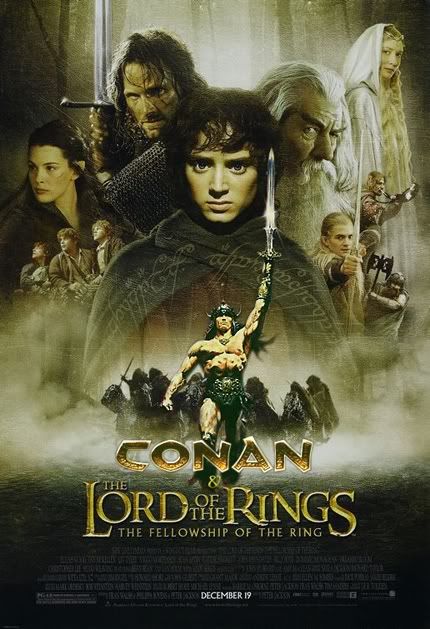
Frodo! What is best in life?


I ran into this somewhere online and of course, I saved it. Cause it makes me grin.

I can imagine Arnold's Conan hewing his way through orcs with lots of Schwarzeneggery vocal effects. "Nnngggraahhh! Awhhooghh! I kill you all! Get to the Choppah!" Maybe not the last one.

Truthfully though, I'd really like a fantasy movie with the scale and heroic theme of the LOTRs movies, and the gritty, joyous hack and slashery of the first Arnold Conan movie. Lets not talk about the second one.

I have a bad feeling about the oncoming Conan movie with Jason Momoa from Stargate Atlantis. I don't doubt Momoa is gonna give it his all, and from the pics of him I've seen in the role, he's looking the part, mostly.

It's just that the hollywood braintrust has done their usual hatchet job on Howard's work. Made up their own characters, pasted on the standard "seeks revenge" plot, and altered Conan to make the non-Howardian elements fit.

I just don't see why all of Howards Conan stories couldn't be treated in the same way they did Arthur Conan Doyle's Sherlock Holmes stories in that Jeremy Brett series. Or the Brother Cadfael stories, or the Hercule Poirot stories.

All most all the Conan work is short stories anyway. Why not a faithful run of one hour episodes?

Wednesday, January 19, 2011

I dig minis.


You don't have to have minis to play The Game, but I think they're an enjoyable extension of the hobby. They also support the tactical combat facet of the game. I don't always use them, but there are definitley situations where having physical markers on a map to judge distance and spacial relationships in melee makes things much easier on the DM and forestalls disputes on the part of the players.
You don't get to argue about wether or not you were in range of that fireball. Look at the minis, man.

You can use dice or what have you, but minis are part of the history of the game. I think they're one of those things which are inherently D&D. A traditional accoutrement if you will. I like accoutrements.

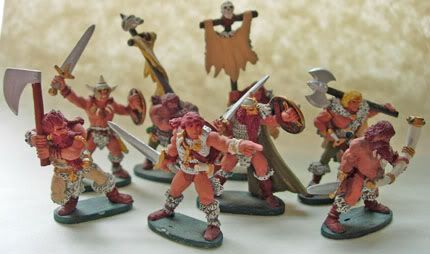
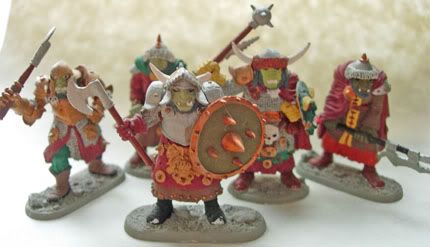
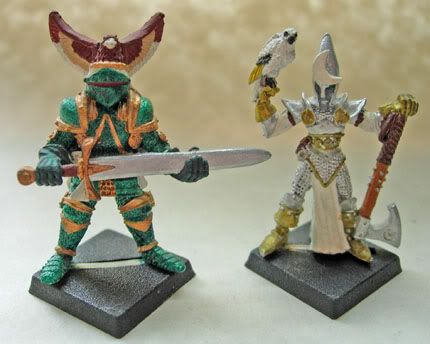
These are pics of a few minis from my horde. I've got a lot of them. This group is mostly Ral Partha, Grenadier, and maybe Reaper or Games Workshop. I judge minis on a case by case basis. I'm not loyal to a particular maker.


These are from before I started using washes or much dry brushing. I'm just going to leave them as they are now though. My mini collection is kind of a record of my skill level at the time I worked on each one. They've all got memories attached to them as well.
Where I lived when I painted them, what was going on in my life, etc. They're like little lead memonics to me.


I like the work itself. The painting and fine work cleaning up the mold lines or splicing weapons is fun. Minis, like this blog, are one of those side pursuits associated with The Game that you can enjoy without actually playing.

They're also low cost. When I was a kid, I built tons of plastic model kits. I had one of those big movie Enterprises with the lights hanging in my bedroom.
The cost of kits is ridiculous now though. A 1/35th scale tamiya tank kit runs $49.99. Fat chance of that.

These two are older and cruder than the barbarians and the ogres above. The knight I just did for the NPC pool. The elf is one of several minis I've used to represent my oldest character. A grey elf fighter-magic-user called Byrandir or Bryn the Axe. He made it all the way to 10th level before I retired him. I know that's not high level by many perspectives, but it's the highest level character I ever had. My Greyhawk has no pity.

I love these little chunks of metal. Just in contemplation of them I'll sometimes have a thought that sets me off on some inspirational tangent of game ideas.

Do you guys have a particular source for minis that you prefer? I've never bought them on line. I prefer to handle things up close before I spend money on them. At this point however, all the FLG stores withing striking distance of me seem to have reduced their in store offerings to a small selection of stuff that doesn't appeal to me.
I'd spend some time kicking game stores but I'll save that for another post, it's late.

Monday, December 13, 2010

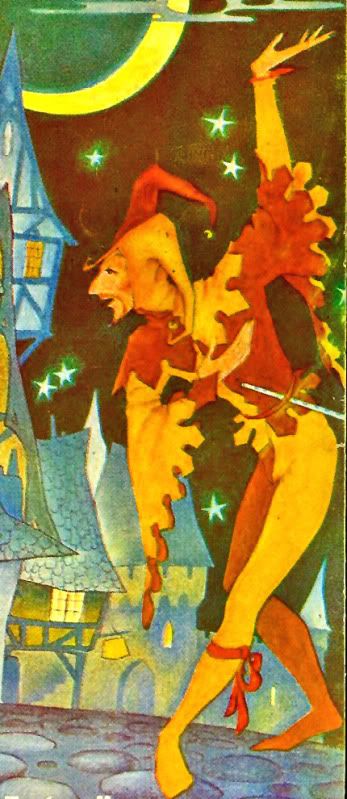
The Many Fold Thieves of Wyrd Greyhawk.


Notes upon the subtle distinctions betwixt, and the hidden hierarchy of, the many fold thieves of Wyrd Greyhawk.

Those who commit theft or fraud may be thieves in action, yet not thieves in class.
The greater part of the NPC inhabitants of Wyrd Greyhawk are not classed characters at all, but merely 1 hit die Men as per the Monster Manual entry.

Persons generally seen as thieves, rogues, scoundrels, tricksters, beggars, knaves, or other such followers of underworld vocations may be practitioners of particular methods of illicit income generation without actually being Thief Class Characters.

In order to distinguish them from PC or NPC Thief Class Characters, they are referred to as Lesser Thieves. Such non-Thief thieves may have some ability in a particular type of thieving ability, such as a greater than normal chance of picking pockets, yet no other ability expected of a genuine Thief Class Character.

As an example; Luhn the Nip, Hit Dice: 1, (hp4), Armor Class: 9, Move: 12”, (120’ per round), Dagger, Special Ability: Pick Pockets as 5th level thief, (50%).
Luhn is a thief of opportunity. A barrel maker’s apprentice, during holidays, fairs, or other gatherings he uses his naturally deft hands, enhanced by a hornblade, a sliver of sharp horn glued to the edge of his thumb nail, to cut purses. Luhn is non-descript, lumpish and dull. Nothing about his appearance will indicate he is anything other than a stolid laborer. On occasion, Luhn allies with amenable barmaids or dancing girls willing to distract a mark in exchange for a share in the ill-gotten gains.

The majority of thieves that PCs might encounter are persons such as Luhn. Not professionals of the Class as are Player Character Class Thieves, but unclassed opportunists of varying degrees of skill and organization.

Such persons may have some skill in any one of the normal thief’s abilities and practice their trade accordingly. A scallywag with the ability to Climb Walls may specialize as a second-story man. A vagabond who can Hide in Shadows, or Move Silently might become an information broker. A scoundrel with the ability to Find/Remove Traps, or Open Locks could rely on breaking and entering.

Some of the more common types of lesser thieves include;

Curbers or Anglers, thieves who steal by reaching hooked staffs or canes through open windows to snatch whatever sellable object presents itself. Curbers may pretend to be blind men or elderly and infirm pedlars, so that their angling sticks may be taken for supports and not recognized for the thieves tools they are.

Divers, a sort of lesser thief-master, who commonly employs small boys, dissipated halflings, or perhaps gnomes of low character, to wriggle through small openings and steal, or open doors from within.

Bludgeoners, who rob only those they may attack from behind and only if they have surprise. They employ clubs, saps or similar weapons. Bludgeoners have a 55% chance of rendering a victim unconscious for 10 rounds if they successfully hit with surprise. If this attack fails, the bludgeoner will immediately retreat. They are not at all interested in a stand up fight.

Bawdy Baskets, itinerant female pedlars and whores of opportunity. With her basket of pins, ribbons, horn cups, caps, wooden spoons and other homely oddments, the bawdy basket seeks entrance into homes, ostensibly to peddle her wares. If the opportunity presents itself, she will be quick to engage in either pilferage or prostitution. A bawdy basket is also likely to act as the eyes of more aggressive thieves, relaying information on things worth stealing and methods of entrance.

Cleymsters are beggars of a most insistent sort who are experts in mimicking the effects of the most fearsome poxes and plagues as well as false sores and lesions. Cleymsters will relentlessly paw at and beg for coin from marks, who most often give them what they want in order to escape as quickly as possible. Occasionally they may work with a cutpurse or foist who takes advantage of the attention they draw in order to pick pockets. PCs who have never encountered a cleymster before will certainly be taken in by their appearance of illness unless they have cause to be suspicious.

Ignoblemen, are masters of confidence and pretense. Arrayed in costly clothing and finery, and attended by servants and footmen, an ignobleman pretends to membership in the aristocracy, usually a travelling noble of some far off land. Ostentatiously sweeping through some sleepy town, burgh, thorp or village, the ignobleman and his entourage will demand lodging, victuals and entertainment. Such is the force of the ignobleman’s manner and charisma that the truth of his assertions of authority and promises of payment are rarely questioned by the towns’ people.

For at time, the ignobleman and his retinue of thieves will live at the villager’s expense while stealing whatever they may, and then when the sham seems soon to be discovered, or the payments for their revelry come due, they will decamp in the night, taking with them whatever they may carry.

Charlatans are similarly confidence men, but usually choose a single, rich victim and spin a web of lies, tales, and false promises in order to lure the mark into willingly giving over his coin in expectation of greater returns on the investment. As does an Ignobleman, a Charlatan expertly pretends to a station or profession which will bestow respectability or expertise upon him in the eyes of the mark. Charlatans are often lesser thieves of high intelligence possessing the Thief’s Skill Read Person. (Read Person allows the thief a % chance to discover a person’s main motive, or greatest desire if able to engage them in conversation for a turn.)

Mobbers are groups of lesser thieves who engage in a sort of en masse pickpocketry. Once they have chosen a wealthy appearing target, the mobbers divide into two groups, blend with the crowd, and maneuver to place the mark between them. Once the target reaches an appropriate location, such as a busy street or market, the two groups suddenly, and loudly, “recognize” each other as deadly enemies and attack. The mark will be caught between them and quickly find himself on the bottom of a pile of flailing fists and thrashing legs. In moments, one group of mobbers will disengage and flee with the second in close pursuit. When the mark manages to pick himself up off the street, he will find that he has been stripped of every item of value which the mobbers might have observed, as well as any pieces of clothing which might have caught the dastards fancy.

The Upright Man. An Upright Man is as much a preyer upon thieves as he is himself a thief. He is acknowledged by the thieves of a given area as a sort of self-appointed Lord and judge. This position he acquires and maintains solely through force of personality, bullying, and manipulation.
An upright man may decide the outcome of conflicts between thieves. He may demand a share in the loot of others. He will rarely participate in the schemes of those he dominates. An upright man often insinuates, and in truth has, ties to the Thieves Guild of the nearest large city. An upright man may be feared by the thieves he encounters, avoided by them when possible, but will be deferred to if not obeyed.

This is only a partial listing of the many infamous specialties in which thieves of the lower sort may practice. The ingenuity and cleverness which they devote towards avoiding the necessity of honest work rivals that of the greatest engineer or artist.

These individuals may operate singly or in informal groups depending upon their preferred methods of thievery. These are not the powerful criminal organizations of the great cities generally referred to as Thieves Guilds, but rather transitory crews of independent thieves and vagabonds. These groups most commonly operate in lesser cities, towns and villages, at events or celebrations such as fairs and tournaments, and in traveler’s taverns, alehouses, brothels, baths and road side Inns.

Small crews are likely to practice a repertoire of grifts and doges depending upon the circumstances. Pretending to represent secular or religious powers in order to levy fraudulent taxes, the selling of false potions and charms, cheating at dice and rigging the outcome of “impromptu” contests with strangers, etc. Any such endeavor which promises the possibility of quick gains without the drudgery of practicing an honest trade.


The Guilds.

Only in the largest and richest cities may be found those shadowed companies known as Thieves Guilds. This term covers a broad assortment of criminal organizations of various sorts. Never will they operate openly as such, even in the most corrupt and decadent city they are hidden behind a veil of propriety and legitimacy.

As with the canting crews of the towns and countryside, no more than a few of the guild members are actually Thief Class Characters. The majority are lesser thieves, porters, teamsters, smugglers, officials of city and court, clerks, forgers, debasers of coin, thugs, enforcers, slayers, spies, fences, or other such 1 hit die Men.
It is likely that actual Thief, Fighter, and Assassin class NPCs of formidable ability hold most of the positions of power within the structure of a guild.

The difference between guild and crew is one of organization and culture as well as method of operation. The crews are often temporary and transient, with direct thievery and fraud of individuals as their goal. They do not survive losses of leaders or members, breaking apart and coming together as circumstances dictate, and moving where ever the pickings seem richest.

The guilds are permanent organizations which hold and control specific territory, usually penetrating government and business, often with complex traditions and subtle rules which are known only to those initiated into the thieves’ mysteries. Whereas the thieves of town and country employ their skills to support themselves as individuals, the members of a great city’s guild act as vassals of the guild master, or guild masters. A kind of criminal feudality in which vassal serves master and master provides for vassal. Though leadership may pass between individuals, this presents no threat to the existence of the guild itself. As they say in Rauxes, “Thieves may die, but the Guild is eternal.”

Simple thievery generates but a small part of the income of a guild. In fact, most of the known guilds do not allow pilfering by their members to get out of hand. The guilds thrive in the shadows and the notoriety brought by overt crime is bad for trade. PC thieves and thieves not affiliated with a guild will be closely watched by guild members if recognized for what they are.

Instead, guilds control and engage in crimes which provide a more steady and reliable stream of revenue.
Smuggling is one of the mainstays of guild business. In any given city there are things which are both desired by the populace, and forbidden to them by the Powers That Be. These things may be weapons, drink, intoxicating substances, etc, the guilds are pleased to supply such items at suitable prices, often passing on to the Forbidding Powers a portion of the proceeds. As illicit items command a greater price when sold under the table than they would if sold legally in an honest market, the portion which goes to the Forbidding Powers is likewise greater than if a simple tax were levied on the sale of said items.

In many cases it may be difficult to discern where the Thieves’ Guild ends and the government begins.

Gambling, in all its many forms, is also a favored guild enterprise. In any large city, the guild nearly always has a hand in any form of established gambling. From cock fighting and owlbear baiting to horse racing and pit fighting, from back room tavern dice games to lotteries and official raffles, the guild will be present in some way to collect its share of the proceeds. In many situations, the guild itself is the sponsor of the event, from behind its mask of legitimate enterprise. If not, certainly those in charge will be persuaded that partnership with the guild is in everyone’s best interests.

Prostitution is likewise most often controlled by the guild in any large city, either directly or indirectly. Successful wayfarers and adventurers, returning to civilization flush with victory and laden with loot, should always remember that the tarts, trollops and courtesans so eager to welcome them and celebrate their great deeds, are also likely the eyes and ears of the Guild. Beside the income generated by their expected skills, information gathering can pay handsomely.

The forgery, of licenses, writs, deeds, letters of passage, or of marquee, grants of authority to collect taxes, or other valuable documents is often also an important guild business.

The nature of the known Thieves Guilds varies greatly depending upon local culture. What may be expected of one may not be so of another.


The Thieves Guild of Rauxes, capital of the Great Kingdom, is baroque in character, subtle in action, immersed deeply in ritual and formal conduct, and evil without the merest glimmer of remorse.
The richest and most powerful, as well as the oldest known Guild, only the Guild of the city of Greyhawk itself rivals the influence of Rauxes.

The Guild of Rauxes is never referred to as such; no acknowledgment of any formal organization will ever be forthcoming from any member in good standing. Instead, the phrase, “Men of Understanding” is used to indicate association with the Guild. The usage arises from the habit of guild thieves to conclude negotiations with the words, “Do we have an understanding?”, or similar words to that effect. Likewise, the phrase, “It is understood that”, may be used to indicate the will of the Guild.

“ Fisilious the glass merchant has become somewhat dawdling in his gratuities. It is understood that this state of affairs cannot continue.”

The Men of Understanding pursue all avenues of illicit endeavor, but are most infamous for subterfuge in pursuit of information, which they broker to those unscrupulous enough to deal with them, assassination, blackmail, slave trading of specialized type, to satisfy rarified tastes, and other, darker, rumored businesses.

So adept at skullduggery are the Guild Thieves of Rauxes, that few King’s Spymasters are willing to risk their pawns in direct conflict with them. Even the insidious and deadly agents of the Scarlet Brotherhood have on more than one occasion, been out maneuvered and forced to withdraw by the ruthless Guild of Rauxes.

The existence of the Thieves Guild of the City of Greyhawk is commonly known, though it is still not talked about openly. Of all such organizations it is the one which most closely follows the form of an actual trade guild. The Guild of Greyhawk is pragmatic, well organized and business minded. Revenge is an indulgence which the Greyhawk thieves largely eschew. Thievery is a trade and a rival one day may become a partner the next day. Vengeance does not buy wine.


The guild of Niole Dra in Keoland is another creature altogether. Rather than forming a unified organization, the thieves of Niole Dra align themselves with a hand full of especially talented individuals to form schools of thievery.
The whole resembles a colony of rival artists, each of whom has a particular style and essential character and his own group of students, emulators and hangers-on.

The thieves of Niole Dra refer to themselves as the Skillful Players and this is a true indicator of the culture of the guild. Many of them are actors, musicians, and artists. Though, of course, they are thieves through and through, to the Skillful Players the act of thievery itself is of equal import as the loot gained thereby. The greater the daring and audacity of the theft, the greater the style and panache with which it is carried out, the more it is admired and its perpetrator acclaimed. Standing within the guild is adjudged by the style with which members carry out their acts of thievery.

Amongst those who have the knowledge and experience to judge, the Skillful Players are held to be both the least evil of thieves, and also the least dependable.

The Guild which operates from Rel Mord in Nyrond has an infamous reputation as a nest of clever schemers and robber lenders who practice complex frauds more often and with greater success than other guilds.
The Coin Counters of Rel Mord, as they are known, are swindlers of rich merchants and unwary aristocracy alike. The forgery of documents and counterfeiting of seals and coinage are also specialties of the changer-thieves. The guildsmen of Rel Mord have no qualms about the use of violence to achieve their goals, but it is never a first resort. Careful legal maneuvering, bribery and blackmail will be employed first, with paid assassins of the highest skill retained only when all else fails.

The Hard Bargainers of Irongate, are tough minded, unbending, cruel humored and loyal, at least towards each other. Smuggling is the major source of their income, and they care not what the cargo may be. The Irongate guild has ties to various pirate groups and is pleased to aid them in disposing of their ill gotten gains.
This is, of course, but a handful of examples of existing thieves guilds.

Assumptions about the nature of, and adjustments too, the Thief Player Character Class for Wyrd Greyhawk.

The purpose of the thief is to steal. This means the thief’s goal is to gain the greatest returns with the least effort and least personal danger. All but the most swashbuckling of thieves will normally avoid melee combat unless the situation is distinctly in their favor.

At the same time, the Player Character thief is no run of the mill knave. Lesser Thieves steal to avoid the effort of work. Guild thieves desire wealth, to be respected or feared, and the power bestowed by membership. The player Character thief is a cut above these unimaginative sorts of thieves. Though a scoundrel and a ne’er-do-well, the PC thief is often a bit of a madcap and a daredevil, with, “at least a diamond chip of the spirit of true adventure”, in the words of the Great Chronicler.

Lesser thieves would never risk life and limb to pluck the jewel eyes from a dark God’s idol when easy marks are to be had playing at tavern dice. Guild thieves would never dare dungeon corridors or ancient tombs when there are shop keeps to be muscled or black lotus of Greyhawk to be smuggled. Only Fortune’s fools, the Adventuring Thieves, risk all to win all.

The Thief Class of Wyrd Greyhawk is the 1E AD&D thief with minor adjustments.

The % chances for success of the thief’s abilities are assumed to be over and above the chance (determined by DM fiat) of a non-thief succeeding in an attempt to accomplish the same act. If an ordinary, non-classed man might have a 10% chance of hiding in shadows in a given situation, then a thief would have a base 10% chance, plus the percentage given due to his level of ability.

All thief PCs receive a +25% bonus to a single thief ability. Which skill receives the bonus may be determined randomly, or the player may be allowed to choose. This bonus is meant to reflect a natural talent for a particular skill. A certain aptitude in one area of thievery, “That lads a born cutpurse!”

No thief’s ability can ever exceed a 95% chance of success regardless of level or bonuses.

Expanded thief’s skills include; Read Person, see the Charlatan entry above, which requires a wisdom score of 12 or more. Also Assess Relative Value, which allows at thief to intuitively choose the most valuable item in a given collection of objects.

In a campaign which includes no demi-human PCs as party members, I also allow thief player characters to utilize the dwarf’s racial ability to Detect Grade or Slope in Passage, and Detect Sliding or Shifting Walls or Rooms as well as the elf’s racial ability to Detect Secret or Concealed Doors.
----------------------

Real world issues, a craptastic internet connection, and winter lassitude have really cut into my blog posting lately. It irks me. I'm not going away anytime soon though, so don't take me off your blog lists. I'll soldier on and eventually the stars will re align for the OGGA.

Koo-koo-katchoo!

Friday, November 19, 2010

Combat Avoidance Bonus to Armor Class.


Combat Avoidance Bonus to Armor Class.

In melee combat, characters expending all their efforts in avoiding incoming attacks, rather than striking back when they have the opportunity, may gain an Armor Class bonus depending upon circumstances.

This bonus is applicable in situations where an unarmed PC is stalling for time to be rescued from attack, or in cases where the PC doesn’t actually wish to harm his attacker, such as when the attacker is a comrade who is being controlled magically or otherwise, by outside forces.

The amount of the bonus, and the way it is administered is left to the DM.

It may take the form of requiring the attacker to roll twice for each attack, and taking the lower number, thus increasing the chance of a miss. Or, the defender’s Dexterity bonus may be doubled, assuming the PC has one. Or, a simple +1, +2, etc, could be awarded to the AC of the combat shirker based upon the level of desperation the DM reads in the Player’s face.

Thieves, for whom the avoidance of combat is second nature, and Friars for whom physical adeptness is a practiced discipline, always have a base +1 Combat Avoidance Bonus in applicable situations, to which bonuses determined by any other method are added.
------------------------

I haven't been here on the bliggety-blog much in the last month. My internet connection became so unstable it was just about impossible to post anything or visit any of the sites I like. As it turns out, apparently the culprit was Trillian. It seems to have gotten jammed halfway through an update. It's straightened out now and seems to work fine as far as I can tell.

I've also spent alot of time clearing the dead trees out of the woods and turning them into firewood. The damn emerald ash borers have killed most of the ash trees and I'm going to have to replace them. I'm very interested in permaculture, so It's going to be mostly fruit and nut trees that will work in a semi open forest setting that I'll be looking into. We'll have to have something to eat when that moron Bernanke collapses the dollar.

Sunday, October 17, 2010

The Scachamma. "It came from the river! Gleorg is devoured! Run fools!"


Scachamma.

Frequency: Extremely rare.
No. Appearing: 1
Armor Class: 3
Move: 75’ per round maximum
Hit Dice: 15
% in Lair: 80%
Treasure Type: Special
No. of Attacks: 2 per round
Damage/Attack: 4D6 bite, 1D6 tentacle lash, 1D8 per round crushing
Special Attacks: Maw Vortex, venomous facial tentacles
Special Defenses: Unharmed by blunt weapons, only takes ½ Damage from fire, immune to electrical attacks.
Magic Resistance: Standard
Intelligence: Low
Alignment: Neutral
Size: L, 80’ long, 30’ wide at the shell
Psionic Ability: Nil

Far from even the dim and guttering flare of enlightenment cast across the Flanaess by the City of Greyhawk, beyond the hidden domain of the Scarlet Brothers, deep within the unmapped expanse of the endless, tangled jungles of unknown Hepmonaland, ancient horrors which would chill the blood of the most hardened slayers glither beneath the steaming emerald canopy.

Those who would venture there do so on the strength of tavern tales and rumors, for little is truly known of such distant places, so far removed from civilized lands.

One such tale fragment comes to us by way of the broken journal of Tilidus the Untoward, procurer of obscurities and late of Rel Astra. During his expedition in search of the nacreous Pearled Falcon, he struck deep into mysterious Hepmonaland.

An entry in that journal, salvaged from the sea, reads in part;

“The sound came upon the evening of the 34th day of the trek into the jungle. We had begun to set up the encampment for the night and gather fuel for the watch fires. From out of the darkness came a long, wailing whistle-like noise followed by four wetly metallic percussions of notable volume, though seemingly of some distance from our campsite.

The effect of this sound upon the savages was salutary. I have never seen such fear in men as was writ across their faces. They stopped in their tracks as though they had instantly become stone. When the sound was repeated a few moments later, they fled into the jungle shrieking, “Scachamma! Scachamma!”

Only the shaman, Guiligag, remained. The gnarled little man stood listening in the direction from which the sounds had come and fingering his bone wheel. After a short time he said to me, “It is across the river and moves north. We will not die tonight. Scachamma goes to pluck the Nahaup from the upland trees. They are sweeter than we.”

Nahaup is the name these people give to the creatures known to scholars as Su-monsters. That some creature might see such terrible beasts as easy prey amazed me. I asked him what manner of monster this Scachamma might be, and he replied thus.

“Scachamma is as a serpent, but also as is a snail. It carries its home with it when it goes to hunt. It is longer than the tallest tree. It is thicker than the river horse. No thing may fight it; all must run when Scachamma comes. The people throw monkeys into the river to keep Scachamma away. Most times it sleeps under the river. “

He leered at me with his sharp, filed teeth, “The men who are not taken by the jungle will return in the morning. We will speak no more of Scachamma. It may hear and come to see who speaks its name.”

I did not press the shaman further, though I wished to know more of this shelled serpent he claimed was the source of that strange and unoerthly call. I admit that I have begun to fear him and his primitive diablerie. I suspect that Guiligag has motives for aiding in my search for the pearled falcon which have nothing to do with those he has given.


What exactly the Scachamma is cannot be determined definitively from the information available. The monster is in general form serpentine and of gigantic size. Its features are somewhat more amphibian than reptilian. Though scaled, it is also covered in a heavy slime coat which protects it from fire. It also possesses an enormous calcareous shell similar in form to that of a sea snail.

Four whip like tentacles which may strike distances of up to 15 feet protrude from its head in pairs. One projects from either side of its glistening snout, and one each sprouts from above its bulbous orange eyes. Anyone struck by one of these tentacles must Save vs Poison or else take 1d6 damage from the viscous venom which drips from them. This venom causes intense pain and unless the victim saves successfully a second time, memory loss. For every point of damage caused by the venom, the victim will lose one day of memory. This can easily result in a magic-user losing all memorized spells, or other important information being lost.

Far more dangerous than its facial tentacles, however, is the monster’s Maw Vortex. Once every four rounds, the Scachamma can create a tremendous suction that functions as a sort of reverse breath weapon.

Creatures of man size or smaller within the area of effect, (equal in form and range to the breath weapon of an adult red dragon), will be literally sucked into the Scachamma’s mouth if they fail to Save vs Breath Weapon. In the following round they will be bitten for 4d6 points of damage, and in the round after that swallowed, dead or alive. Those swallowed alive may attempt to cut themselves free if devoured with weapon in hand. The creature’s powerful digestive acids will cause 1d8 points of damage per round.

The great weight of the creature’s massive body and that of its shell cause 1d8 points of crushing damage per round to any creature it might overrun. Though the Scachamma is slow, it does not tire. It will relentlessly pursue chosen victims so long as it does not lose sight of them.

Magical attacks employing cold will do full damage and also slow the monster’s movement by 50%.

The vast majority of its time; the creature spends asleep at the bottom of slow moving rivers, or in dark and wooded swamps. Only if disturbed or searching for food will it be encountered on the move.

The monster plays various roles unknowingly in the myths, stories, and religions of the inhabitants of Hepmonaland and parts of the Amedio peninsula. This may indicate that more than one such beast exists, or that the Scachamma is capable of crossing the Tilva Straits. As it has never been sighted at sea, it likely travels across the ocean bottom. The reactions of the indigenous peoples to those who inquire about or seek the Scachamma vary widely.

The Scachamma collects no treasure, though objects which are indigestible may remain within its gut. Some tales attribute magical properties to its shell. One of the small spikes or horns which project from it could bring great wealth if offered to the proper buyer.

• I think the Scachamma would easily fit into a Weird Tales or Sword & Planet type game with minimal modification. I generally run Wyrd Greyhawk as medievalesque-black folk tale, but it becomes steadily weirder the farther from the central flanaess adventurers travel. Hepmonaland becomes quite Lovecraftian and horror pulp.

* This monster was inspired by an entry at ShukerNature, the cryptozoology blog of Karl Shuker concerning the Sachamama, a weird beastie reported in Peru. The art is a redrawing of an image from a 16th century piece of Peruvian pottery depicting said beastie.

Here is the original post at Shuker's blog.

http://karlshuker.blogspot.com/2010/10/sachamama-snake-in-shell.html

I'm an aficionado of all things Fortean, and that pursuit naturally provides more fodder for The Game. Dig it.

Thursday, September 30, 2010

Nihilistic Motorcyclists! Who runs Bartertown? Chris Engle runs Bartertown!


One of my earliest posts on this blog concerned Nihlistic Motorcyclists, a game I've had in my collection since the mid 80's. Through the magic of Google, the creator of the game recently came across that very post here on OGGA and sent me an etheric-mail.
I was very pleased to hear from him, and he's given me permission to repost that missive here.
As follows;

I finally googled Nihilistic Motorcyclists and found your blog entry from last year. You are one of maybe twenty people who ever owned this game. Cool!

I the Chris Engle who wrote this dog so I can tell you what became of it and Angel games.

I sent out samples of NM to the distributors in 1986 and got a letter back from Richard Tulhoka (Bureau 13) who said he found a copy of the game at the bottom of a trash can and that the mothers of America would kill me for printing it. That made me think and then pull the game from the market. Only about 25 copies of the thousand I printed ever sold and I pulped all but a handful of the rest. I learned a useful lesson from that about not pandering to the taste of the lowest common denominator. Subsequently Angel Games ceased to exist. I went back to grad school and having been working in Mental Health since then.

My gaming interests didn't end though. In 1988 I invented Engle Matrix Games and started working on spreading that idea. Basically a game that could be run using words rather than numbers where players made up whole scenes and then rolled to see if they happened or not. Now we call that Indie Role Play Gaming but in 88 it was just weird and no one got it. I persisted though and am now happy that my ideas are so old hat. I started Hamster Press in 1995 and have had a booth at Gen Con since a year after it moved to Indianapolis. I do my own production so I can afford to put out all my games but I'm now working on how to move to selling in stores. My story games are about murder mysteries, Cthulhu horror, spy, and dungeon crawls. All very tame and main stream.

When it comes to NM I am amazed at how well the scenario and flow of play hold up. It still works today. I haven't run a game of it in over twenty years (It really is too sick) but I don't see anything now that would say it couldn't still work and creep people out. For all the sick and twisted games that have come out since then I haven't heard of one that made people act as badly as NM does. It is a pure game - it is a behavior mod token system for heinous crime on helpless victims. I learned from this that players do what they are rewarded to do so after that I reward good behavior. With NM I stared into the void and it stared back at me. That was enough for me.

Oh and I learned that you NEED to proof read. I misspelled "police" for god's sake!

Chris Engle

BTW Now I live down outside Bloomington and work at IU. A group of us get together once a month and play Euro Games at the Union. Stop by my booth at Gen Con and say hi.

--
Hamster Press = Engle Matrix Games
http://HamsterPress.net


He's exactly right when he says there aren't any other games out there that so promote heinous actions on the part of the players. It's really astounding, the depths to which players will sink when there is an actual in-game rules reward system for committing atrocities.

The game does play fast and smoothly. It's in the category of rpgs referred to as "beer & pretzels games" today. It's probably more of a "whiskey and human ears" game in play though.

Nihilistic Motorcyclists did have a valuable lesson to teach, in an oblique manner. I like to think that I'm a nice guy, over all. I am introspective and contemplative by nature, and after playing this game a few times, I sort of felt bad about myself.
It's just an RPG, and I'm not of the camp that promotes the idea that RPGs are about self exploration. But I have to admit that Nihilistic Motorcyclists forced me to admit to myself that I'm capable of at least theoretically conceiving acts of no small evil.

No shocker there, today. But, as a teen we're all still learning what it means to be a human being, and when you realize you yourself have as much potential for evil as the next guy, it can be a bit disorienting.

I let chris know that I did gain something from the experience of playing Nihilistic Motorcyclists, expanded insight. This sure isn't a game to play with your kids though. It probably shouldn't be played by anyone actually. At least not by anyone with "issues" it might aggravate.

If you excised the Victory Points system, it would make the core of a nice bare bones post apocalyptic game.

When I asked Chris if I could use his email in a follow up post, he replied thus;

Sure you can. Please stress that after I realized what the game did I pulled if from the market. It just brings out the worst in people but in both our cases is seems to have steared us towards good.

I know its wrong but I can't help but feel a little pride that I wrote a game that remains more out there than anything that has followed. It was a very pure design (commit crimes for victory points - though at the cost of looking crazier and crazier) which is why it was so far out. Kind of "Kill Puppies for Satan" like. I'm glad I started using my powers for good (as the super heroes say).

Chris Engle

PS: If you come to Gen Con look for the booth with all the stuffied animals and dragons at. We pay the bills with plush.


I want to say thanks to Chris for letting me use his replies here on the bliggety-blog, and for creating that horrible,horrible game in the first place.
Nihilistic Motorcyclists has a place in RPG history now. A dark,scary place.

It also strikes me as hilarious that plushies are a part of Chris's business now. Maybe some commemorative Nihilistic Plushies could spice up the booth?
Who wouldn't want a nice fuzzy Toe-Cutter to take home from the con?

Clicking on the Nihilistic Motorcyclists tag in the Old Guard Guide sidebar will bring up the original post on the game from feb-09.

Thursday, September 23, 2010

Can I play with madness? dabbling in skill systems.


* Edit-
The above image was originally 7th son of a 7th son, an interior illustration from Iron Maiden's 1988 album of the same name. I suppose Photobucket took it down in keeping with their vague,arbitrary enforcement of their terms of service. I'm leaving the censored version up as a tribute to their sniveling obeisance to the dictates of the feckless,dying record industry.


The existence of a skill system in a game, and the willingness to use it, or not, is one of those points which is always a bone of contention in those discussions of, “Is this Old School, or not?”

I got on the D&D roadshow at the Holmes edition, which included the Thief class and its thieving skills matrix, so I’ve never been totally opposed to the idea of skill systems. At least in theory, that is. It’s that gap that exists between the theory of what a skill system can contribute to the game, and the facts of what it actually does in play, that prevents me from employing a fully fleshed skill system in my own game.

Skill systems were added to D&D, and made the heart of later RPGs, with the idea that they would expand the possible actions available to PCs. The perception was that actions not quantified by the rules as written were therefore not possible in the game, and the way to correct this was to add to the rules base.

I think this comes from an assumption that anything not expressly permitted, is forbidden. I have an unsubstantiated gut feeling that, in general, the proportion of the populace which thinks in this manner has been increasing for a long time now. I prefer the opposite mode of thought, that everything not expressly forbidden is permitted. And, you’d better have a really good reason for attempting to forbid me anything.

Anyway, what I’ve seen in games with a heavy reliance on skill systems is that rather than expanding the portfolio of actions available to characters, they actually reduce them. The existence of the skill system encourages an attitude towards viewing your character sheet as an armory or magazine of possible action choices. It is so, partially, but the problem arises when it also is seen as a list of the only actions possible. This is the point where players are in danger of falling into the trap of thinking that, “If it’s not on my character sheet, I can’t do it.”

The general attitude of the Old Guard towards this perception is very well summed up in this quote from a thread on RPGNet by Mike “Old Geezer” Mornard.

Probably the most extreme case is a TETSNBN player wondering how to tie somebody up in my OD&D game because there was no “Use Rope” skill. I mean, Crom, “Use Rope”? What’s next, a “Tie Boots” skill? “Eat Food?” “Take Dump?”

That guy kills me.

First generation skill-less RPGs, by not instituting a frame work of defined skills, leave open the greater possibility of character action. Players of the mindset that requires a defined rule structure are uncomfortable with the rules looseness of Old Guard play. They want things spelled out on their character sheet, and they want a rules coded menu of action options.

I think this is fine, in a beginner level RPG experience, but it’s not the sort of Advanced D&D I like.

Don’t take that as an insult if you are in favor of skill systems, I’m not trying to pull your beard. What I’m saying is that skill systems are fine for what they actually do. And that is providing a structure for players and GMs to use in place of their own judgment. What they don’t actually do is increase the possibilities open to players. In cases where the participants are young and inexperienced, in life as well as in RPGs, skill systems provide a structure and framework which fills in for a lack of the knowledge and experience that’s required to feel comfortable with playing and DMing by fiat.

In a situation where a PC wants to attempt something about which you, the DM, knows nothing of in real life, having a skill system handy provides a guide line you can use to navigate that gap. This is a great help to starter gamers, training wheels if you will. The drawback is that if you have no fear of relying upon your own knowledge and judgment, a skill system becomes a hindrance and an encumbrance, eliminating possibilities and making the game less than it could be.

I will, of course, readily admit that I am somewhat grognardly in my attitude towards the precepts of contemporary gaming culture. I don’t agree that more is better, or that a system must be rigidly interlocking or else be seen as “broken”. I like to think that I’m genial in my disregard for modern gaming though. I don’t go out of my way to attack those who see things differently. The vast and inherent superiority of Old School games is self evident and requires no defense. Heh….


See above image for an illustration of what might be defined as, "somewhat grognardly".

I’ve never had any difficulty in making a judgment call, and sticking to it, in cases where a PC attempts something for which he has no rules defined success/failure mechanism. I consider the relevant factors and assign a probability, or a number to beat, and we go on from there. That’s all a skill system does anyway. I’m just more confident that I can take the relevant factors into account and make a decision on the fly that’s more closely applicable to the situation than a hard coded skill system could provide.

Now, it may be that I get away with this because I have players who have known me for a long time, and understand how I think. They know that if I employ Dungeon Master’s Fiat, it’s principled and reasoned and never arbitrary. I make a note of it when I have to fill in the gaps of the rules as written for expediency’s sake, and this becomes like referring to prior case law when similar situations arise later. I don’t allow the rules, or the lack of them to bog a game down. I encourage and expect “outside the dungeon” thinking from players. Some of the most exciting and entertaining gaming results from forcing PCs out of their comfort zones and into situations that require them to attempt actions for which their character class is totally maladapted, in circumstances most dire.

Skill systems tend to retard the willingness of players who are used to them to attempt actions which they do not specialize in, or have some rules established ability to perform. This is why I don’t, as a general rule, use them. I want players to surprise me with deeds of daring do and outlandish solutions to problems. With all the work that goes into DMing I expect a challenge and some entertainment at my end of the table too.

I do like the idea behind skill systems though, the thing that skill systems are meant to do, but don’t. That is, I think, to enhance the depth of the PC by adding layers of potential abilities.

I do this by breaking “skills” into three categories and administering them in an open ended manner.

Natural Talents, this is a list of traits, abilities, aptitudes, quirks, flaws, etc, which the PC was born with. This is always rolled randomly, no exceptions. The class of the character is of no matter and has no bearing on which Natural Talents he may be born with. I leave it to player choice if they want to roll on the Natural Talents list. Some, of course, have definite ideas about the sort of character they want to create and play and don’t want to chance the random results of the list. Others are happy to let chance have a say in character creation and interested in the challenge of running a possible oddball. There are no character building points involved, this is not a system which can be worked to PC advantage. These things are simply meant to add texture and depth to the PC. Some are advantageous, some are drawbacks, and some are normally neutral.

Learned Skills, This includes trade skills, political skills, folk ways, woods lore, etc, skills which the PC learned as a child or was taught prior to becoming a classed adventurer. I assign no rules mechanism to Learned Skills and administer them in an open-ended and common sense fashion. If a player wants his character to have been the son of a fisherman, we’ll have a discussion about just what Learned Skills the PC is entitled too. (What sort of fishing, where, with what equipment, etc,). I’ll write up a brief outline to add to the character sheet regarding the implications for the character’s abilities in-game, and that’s that. If a player wants to perform an action based on his Learned Skill list that I haven’t previously OK’d, he’s going to have to make a convincing argument for it, and quickly.

Minor Class Abilities, This includes all the small things that come along with learning to be a fighter, or a cleric, or a magic-user, or a thief. Each class has its own unique list of Minor Class Abilities. These also may be altered depending upon the character’s background history.

I do allow the possibility of PCs teaching other PCs Learned Skills and some Minor Class Abilities.

In cases where this is just about developing characterization, it’s only a matter of role playing it out. If the knowledge or skill gained may be used to affect the outcome of combat or other situations where the dice normally come into play, then learning the skill will require the PC to expend experience points. I don’t make this cheap, so the player’s got to really want it to make it worthwhile.

I’ll post the text of these categories when I get it transferred from notebooks to Word.

In other news, I barely avoided getting a ticket today for having an expired plate. I had no idea the thing was out of date, the BMV sent me no notice that it was about to expire. This is the second time this has happened to me, but I did have to pay a ticket last time. I really hate it when one branch of government screws up, and another branch punishes me for it. I won’t miss the BMV when the revolution comes.