Friday, April 29, 2011

A monster, and a magic item for the Weird West.

Monsters are very rare in the Weird West, it just happens that PCs run into them more often than most folks. People keep to their towns and settlements for the most part; it’s the brave, the desperate, and the touched who dare the open range, the mountains and the deserts by their lonesome.

Likewise, items of a supernatural nature are exceeding rare. Powerful objects of the Art are always singular in nature. Minor arcane items are also very rare, but may possibly be replicated. PCs aren’t likely to be able to do this however.


Gundog, (hell hound of the weird west)

Frequency : Very Rare
No. Appearing : 1 or 1d6
Armor Class : 4
Move : 12”, 120’ per round
Hit Dice : 3-8
% in Lair : 10%
Treasure Type : C
No. of Attacks : 1
Damage/Attack : 1d10, (bite)
Special Attack : muzzle blast, damage as shotgun 1d10, or grape-shot 4d6, depending upon hit dice
Special Defenses : only takes half damage from gunpowder weapons
Magic Resistance : Standard
Intelligence : Low to Average, cunning
Alignment : Enigmatic Evil
Size : M to L
Psionic Ability : Nil

Legends say the Gundog haunts old battlefields or the sites of massacres. A great, black hound with iron teeth and burning ember eyes, the beast is wreathed in acrid gun smoke and leaves behind it paw prints which char the earth.

When the creature appears, its size and power seem to change to match the scale of the carnage which took place at the site. Where only a few were killed, the gundog has appeared but little larger than a wolf. At places where great battles have occurred, and many died by the gun, tales have it the beast grows to nearly the size of a horse.

It is unclear whether the Gundog is a single, immortal monster, or a type of creature of which there may be many. Conflicting tales are told of the Gundog. It is also unknown if it, or they, are supernatural in origin, or some sort of aberration.

Though in all tales the Gundog is a malevolent killer, it seems to choose its adversaries by the strength of the threat they may pose. A Gundog the size of a pony is said to have appeared with a roar like cannon fire the night after the battle of Shealho. It killed most of a cavalry patrol before vanishing, but completely ignored a group of refugees passing by.
The Gundog which appeared on the Dead man’s leg of the Chislem Trail paid no heed to a dozen cow punchers and instead went straight for Lightening Caleb Booker the infamous gunman. Lightening emptied both sixguns into the dog before it reached him and it disappeared in a cloud of brimstone. Or so they say.

In addition to the bite of its terrible jaws, the Gundog may employ its Muzzle Blast up to six times per combat. This is a sudden roaring bark which also discharges red hot shot as though a shotgun had fired from within the dog’s throat. The muzzle blast bark has the same range and effect as an actual shot gun. In larger accounts of the Gundog this weapon is equal in range and effect to grape shot fired from a cannon.


Somewhere, out there, maybe in a ramshackle ghost town or a ruined ranch house, is a battered cartridge box containing the Demon Bone Bullets of Father Callaghan.
The story goes, the Father, an easterner and city-slicker were’t all that strong in the faith himself, till circumstances found him sharing a stage coach with the fearsome Ezra Crumb.
Crumb, called by them who know as, “Ezra the Ghoul Scalper”, regaled the Father with many hair-raising tales of his encounters with the unnatural. Callaghan, more a man of science than a child of God, believed none of it. Though Ezra’s air of firm assurance and vivid powers of description caused him some unease as the night ride went on.

Ezra, as it turns out, were’t just traveling that night. He was a-hunting a diabolic thing called the Buckthorn Fiend. The wind had told Turning Cloud the Shaman that the fiend would come to the coach with the dark of the moon, and Ezra Crumb meant to see it got its trip back to hell.

When, round about midnight, the horses screamed and a yard of spiny black demon arm, plated in armor like a scorpion, came a-groping through the window, Father Callaghan found his faith real quick.

Though the coach was torn to flinders, the horses and both the driver and side man killed horribly, Crumb and Father Callaghan survived that desperate fight beneath the cold prairie stars. The Buckthorn Fiend was banished to the pit, its skull transfixed by the sainted iron of Crumb’s Arkansas toothpick, and from its bones the good Father fashioned 24 bullets of .52 caliber for the Sharps rifle.

Callaghan died in agony some few months later, poisoned by inhaling the demon bone dust kicked up by crafting the cartridges. Ezra Crumb is known to have expended some of the rounds in subsequent adventuring, but how many is unknown.

Each of the Demon Bone Bullets acts as a weapon of slaying. A successful hit with one is always a killshot. In addition, the bullets can hit creatures which otherwise are unharmed by mortal weaponry.
There is a 1 in 20 chance of a misfire each time one of these infernal cartridges is fired. Anyone who may find the old ammo box containing the bullets is advised to employ them with care. It is unlikely the demon bone is any less lethal than it was and a misfire could possibly throw deadly powder into the face of the rifleman.

Only an early model Sharps rifle is able to fire the Demon Bone Bullets.
****************

I've had very little time or creative mojo lately. There's a lot of stuff competing for my energy this spring. I've got images and feelings roiling around in my mind, game wise, but not enough time to spend on pulling them together. It'll come around eventually.

Here at O.G.G.A., we post no monster before its time.

Also, I think I'm going to get myself one of those reproduction Colt model 1860 army revolvers.

Saturday, April 9, 2011

Torch & Sixgun; Weird West Adventure Via AD&D.


Imagine an adventuring party consisting of Josey Wales, Rooster Cogburn, Brisco County jr, James West, and Jonah Hex, daring black mesas riddled with undead-haunted mines, lost and buried cities of the ancients, ghost towns, goblin infested badlands, cruel black mountains, and pitiless miles of open range, driven by the remorseless ecstasy of gold.

Starting from a base of Advanced Dungeons & Dragons standard rule set, with the following modifications. Rules default to AD&D in all cases not specifically altered.

Initiative may be either individual or group based depending upon circumstances. If the party is alert and moving as a group, then standard AD&D initiative determination applies. If the party is dispersed somewhat, engaged in various tasks, not immediately expecting attack, but not surprised, initiative is determined individually. Each character, npc, and monster involved rolls 1D20 + Dexterity bonus to determine order of actions.

Player Character armor class, (difficulty to hit), is determined by class, level and dexterity bonus if applicable, rather than by physical armor worn. Nothing bullet proof can be worn for any length of time, so little armor is used in the weird west. Each character class has a base AC bonus, this bonus increases with level to reflect the character’s accumulated experience in avoiding gettin’ shot.

The chance to hit with a gun at short range is determined by the AD&D melee combat charts. Almost all gun battles will occur at distances of less than twenty feet between combatants, so the majority of gun fights will be rolled for as “short range”. Medium and Long range shooting is modified by weapon type and character class. Non Fighter classes incur penalties when shooting at medium and long range targets.

Firearms are bolt action, single action, double action, lever action, or pump action, plus break open shotguns. Only Fighter Class characters can fire multiple shots per round. This is determined by the AD&D fighter’s level/attacks per round. Level 1-6, one shot/attack per round, level 7-12, three shots/attacks every two rounds, level 13 and up, two shots/attacks per round.

Firearm stats.

Derringer type pocket pistols do 1D4 dmg, +1 to hit at Medium range, +0 at Long range

Full-size handguns do 1D8 dmg, +1 to hit at Medium range, +0 at Long range

Shotguns do 1D10 dmg, +2 to hit at Medium range, +0 at Long range

Sawed off shotguns do 1D8 dmg, +1 to hit at Short/melee range, +0 at Medium range, +0 at Long range

Long guns/shoulder arms do 2D8 dmg, +2 to hit at Medium range, +1 at Long range

Dynamite sticks do 6D6 dmg, a save for half damage is possible if detonation is at least 10’ distant.

All melee weapons do damage per AD&D rules.


When gunfire damage is rolled after a successful hit, maximum damage indicates a kill shot, instant death. This applies to monsters, NPCs, and Player Characters alike. Characters, NPCs, and monsters above third level and/or three hit dice may attempt to Save vs. Death against a kill shot. Those who succeed take damage only and are not killed. Unique supernatural Monsters of the Abomination class, certain sorts of undead, and creatures with 11 or above hit dice are also immune from death by kill shot.

Classes include the Fighter, the Thinker, the Manipulator, and the No-Account. These classes are very broad archetypes just as are the AD&D classes.

Character generation follows AD&D rules. Character stats remain the same.

The Fighter

The fighter primarily makes his way in the world with his fists and his gun. Current and former military men of any sort, cowboys, roustabouts, athletes, brawlers, any person who is generally more disposed towards physical action over cerebral consideration, will fall under the “Fighter” category.

The T&S fighter has the same class requirements and advantages as the AD&D fighter. They attack on the AD&D fighter melee chart. They gain levels according to the AD&D fighter progression. They roll 1D10 per level for hit points, and also roll saving throws as AD&D fighters. Any sort of weapon is usable by fighters.

Torch & Sixgun fighters operate with the following alterations.

Fighters start with a base armor class of 8. This number drops by one for each experience level gained up to, and including the sixth. Thereafter, by one for every two levels gained.

A fighter may have a natural talent for a particular type of weapon. This gains him a +1 to hit with that type of weapon only. This bonus is very specific, as example, a pistol, not all guns, a saber, and not all melee weapons.

A fighter may make a called shot at third level and above. A called shot can only be taken when the fighter has time to line it up, such as with surprise or initiative, and not during melee or in melee range. A successful called shot is not necessarily a kill shot. It merely indicates the fighter hit exactly what he was aiming at. Damage is rolled normally and a kill shot may or may not result. Secondary results of the hit are for the DM to decide.

A fighter with a constitution score of 15 or above has got grit. This means that the fighter’s Hit Point Adjustment bonus may be subtracted from damage the character takes, in addition to adding to his hit point total. The grit bonus may not be applied to a kill shot that would have slain a character otherwise.

Yeh git shot in the face, son, an yer still gonna be stone daid.


The Thinker

The thinker primarily makes his way in the world with his mind. Scientists, engineers, doctors, scholars and academics, as well as sorcerers and preachers, any type of person who is generally more disposed to forethought and mental solutions over immediate physical action belongs to the Thinker character class.

The T&S thinker has generally the same class requirements and advantages as the AD&D magic-user. They attack on the magic-user melee chart. They gain levels according to the AD&D magic-user progression. They roll 1D6 per level for hit points, and roll saving throws as AD&D magic-users.

A thinker starts with a base armor class of 10. This number drops by one for every level up to and including the fifth. Thereafter the thinker’s AC improves by one step for every two levels of experience.

A thinker class character may familiarize himself with one weapon for every three levels of experience. A thinker may attempt to use any weapon, however, he suffers a -3 to hit penalty with any weapon he is not familiar with. A familiar weapon may be employed without penalty.

A thinker possesses the abilities of a Sage, as defined in the AD&D Dungeon Master’s Guide under expert hirelings, pg 31.

Added to this rule set for Player Character thinkers, the character’s Intelligence score carries a bonus that increases the number of minor fields of study the thinker has expertise in. An Intelligence score of 15 adds +1 minor field, 16 adds +2, 17 adds +3, 18 adds +4.


The Manipulator

The manipulator primarily makes his way in the world by influencing others to gain his ends. Gamblers, hucksters, snake oil salesmen, Politians, saloon girls, fancy-dans, merchants and traders all fall within the manipulator class. Any person who prefers to maneuver others into serving his ends rather than directly acting himself falls under the manipulator character class.

The manipulator has generally the same class requirements and advantages as the AD&D cleric. They attack on the AD&D cleric melee chart. They gain levels according to the AD&D cleric level progression. They roll 1D8 per level for hit points, and save as AD&D clerics. A manipulator starts with a base armor class of 9. This number drops by one for every level up to and including the fifth. Thereafter the manipulator’s AC improves by one step for every two levels of experience.

A manipulator must have a Wisdom score of at least 10. A manipulator may use pistols and handguns without penalty. Long guns, shot guns and heavy weapons incur a -3 to hit penalty.

A manipulator is capable of slick talking. This operates in a manner similar to the AD&D magic-user spell “suggestion”. By slick talking, the manipulator can often convince a listener of the wisdom of following a course of action that may or may not be the best idea for the listener, but will certainly benefit the manipulator. The object of a manipulator’s power of persuasion must save vs. spell or fall for the manipulator’s spiel.

If the manipulator’s target possesses a Wisdom score bonus, it is applied to the saving throw.

A person who is slick talked into a course of action that then turns out badly for the manipulator’s target, that person gains a +4 bonus against future attempts at slick talking.

If a manipulator attempts to slick talk a crowd, (a group of 5 or more), the crowd saves as its lowest level or hit die member. This is why Politian is a preferred avocation for the manipulator.

When engaging in games of chance where misdirection is a factor, the manipulator is at an advantage in being able to roll twice and choose the better number in any situation where the dice determine an in-game out come. This applies to in-game betting and gambling.


The No-Account

The no-account primarily makes his way in the world by leaching off of others and avoiding work himself. Thieves of all sorts, lay-a-bouts, hangers-on, drifters, shiftless shirkers, rustlers and claim-jumpers, any person who habitually appropriates the wealth of others without direct conflict falls under the no-account character class.

The no-account has generally the same class requirements and advantages as the AD&D thief. They attack on the AD&D thief melee chart. They gain levels according to the AD&D thief level progression. They roll 1D6 per level for hit points, and save as AD&D thieves. The no-account starts with a base armor class of 9. This number drops by one for every level up to and including the fifth. Thereafter the no-account’s AC improves by one step for every two levels of experience.

Somewhat ironically, in their pursuit of gain without the need of honest work, no-accounts often develop specialized skills. A no-account rolls 1D8 at character creation to determine how many of the AD&D thief skills he possesses. Then rolls again to determine which skills he knows. 1-Pick Pockets, 2-Open Locks, 3-Find/Remove Traps, 4-Move Silently, 5-Hide in Shadows, 6-Hear Noise, 7-Climb Walls, 8-Read Languages. These skills are administered according to AD&D rules.

All character classes are guidelines and subject to alteration to satisfy player needs for particular PC designs. Any abilities, bonuses or penalties given as a result will deviate minimally from the standard.


Once upon a time, in the Ancient West. Setting description.

No back history, no timeline, no specific date the campaign starts on. The game is meant to exist in a sort of Western Mythic Now. So, any event, technology, story, history, or person, fictional or otherwise, who exists at any point in a time frame from 1840-1900, can appear in the Weird West.

The campaign map covers all of North America between the Appalachians and the Rockies. That the rest of the world may be out there may be implied by inference due to the presence of people from other parts of the world. They are there, however, to fill various character roles traditional in westerns. The campaign won’t leave the West.

Magic items are always singular, or else extremely rare. As an example, consider the Ace of Winchesters from Hitman #16, (Garth Ennis & John McCrea), a rifle, “fashioned of halo-steel and hades-gems, bound with ivory of saints, designed to blast the very life from fiends…”.

Supernatural weapons and items will be unique and usually meant to serve a certain purpose. They will also have a severely limited number of uses before they are burned out.

Hit point recovery will also follow AD&D standard. One hit point restored per day of rest, four weeks rest returns hit points to maximum regardless.

Henchmen and hirelings become Sidekicks and Hired Hands.

New and altered AD&D monsters for Torch & Sixgun.

Unique dragons via the dragon generator, (which I’m considering updating)

The Painted Unicorn. I have this idea of an appaloosa unicorn roaming the Great Plains. No one who has ever taken a life can approach it unnoticed.

Yigs, Yig-sons. The yuan-ti reskinned as remnants of an ancient race of serpent men. From their hidden city beneath the Cerulean Mountain, the Yigs send out their most human like members to infiltrate human towns in order to bring back slaves, sacrifices, and… food.

Spirits of Place. Watering hole weirds, sand storm devils, ill winds, avalanche gremlins, etc…

Non standard undead. The Sundown Wailers, The Wagon Train, The Mountain Man.

Degenerate Ancients. In hidden cities and lost valleys. Malignant survivors of lost civilizations.

Badland Goblins. Fused with Quickling stats. Spare, boney, blindingly fast, and mercilessly cruel. “If them goblins gets aholt ah yeh, they’ll string you up by yurh thumbs and skin yeh with their teeth, boy!”

The Damned Stallion. Outside of Laerdin, there’s miles of black prairie. Apparently burned by fire years ago, it never regrows and yet the charred grass never crumbles away. The locals say a great bronze colored stallion courses the black prairie and that those who die out there, must ride the stallion to Hell.

And of course, a steady stream of regular old conniving, black hearted, rat-bastard scum.

**********

This is my start on a bolt-on house rule set for weird western adventure on an AD&D platform. I watched The Outlaw Josey Wales a couple weeks ago, and then just kept running into westerns on TV. The Good, the Bad, and the Ugly, El Dorado, High Plains Drifter, Open Range, Unforgiven. The really good westerns. I kept smelling mental gunsmoke and hearing the rutch of boots on dirty pine plank floors. Also, a couple of the guys at the part time job are into cowboy shooting and western reenactment. They have a lot to say about horses and shooting. The Wild West themes just sort of sank down and melded with the AD&D dungeoneering ethos I look at rpgs through.

I think I want something gritty and dangerous. I expect PCs to die fairly often. I’ll come up with something for army surgeons, folk remedies, country doctors and such, but I don’t think I’ll have any sort of commonly available “healing”, magic or otherwise.

I’m a bit leery of the degree to which the weird western tale has been infused with contemporary steampunk these days. I want stone cold gunslingers and horrific monsters in this campaign. No wacky inventions, steam robots, crazy professors or airships. I love Victorian era and classic science fiction, I cut my mind’s eye teeth on it, but the reimagining of it in steampunk has reached the point where it’s become self-referential and incorporated way too many modern attitudes. It’s disconnected from its source material to the point of caricature. Steampunk has become WOTC Jules Verne.

I want The Man with No Name with a cigar in his teeth in a desperate gun battle with blasphemous gibbering things in a maze of black tunnels beneath an ancient mesa.

I reckon I’ll whittle on this here rule set a mite bit longer, see what shapes up.

Saturday, March 19, 2011

Under-rated items of adventuring equipage.


Never dungeoneer without your oily rag.

Among the many uses of this inexpensive and over looked, but vital piece of equipment are;

The oily rag is an excellent way of protecting metal and leather from corrosion and damp. In areas of high humidity, especially salt mist or other rust promoting conditions, a daily wipe down with an oily rag will prevent mail from rusting, bowstrings from stretching, leather goods from distorting, etc…

Such considerations may be something hand waved by many Dungeon Masters, I however, am not one of them. Tee-hee! Well oiled mail is quiet and moves smoothly, rusty mail makes more noise and can constrain movement. If characters take no care of their equipment for enough time, those wearing armor may incur penalties regarding surprise and movement in melee. A bow string or crossbow cord stretched by moisture will cause significant penalties to hit and damage.

An oily rag can be used to leave directional marks when adventuring underground. An oily smear is less obtrusive than paint or pigments and can be left silently. Marking with a chisel or nail may make noise which draws unwanted attention. This method is especially recommended for use by a thief scouting ahead of the party.

An oily rag is handy to wipe the dust and grime of centuries from ancient carvings and runes. A clean inscription lessens the chance of mis-interpretation, as can sometimes happen.

An oily rag wrapped around the end of a sword sheath can serve as a makeshift torch in time of emergency. They also serve well as a fuse to light oil, explosives, or tapestries. I roll a D10 to get the number of rounds an improvised oily rag fuse will burn before setting alight whatever its been attached to.

An oily rag may be thrown or tossed, preferably afire, to gain a single round distraction from opponents of average or below intelligence.

A particularly oily rag may be laid where it will likely be stepped on as a trap. On the edges of precipices or on the third step from the top of a stairwell. The unsuspecting can easily slip on it with possibly serious consequences. My players call this, “the dungeon banana gag”.

Likewise, an oily rag can be used to leave a film of grease or oil on door handles, rings, or knobs. Those who are unaware of the lubricant will always fail their first attempt to turn the knob or handle. This fumble may be heard by the party and give them just enough time to prepare for their entrance. Unfortunately, clever monsters may also use this tactic.

Finally, an oily rag tied over the mouth and nostrils will prevent the inhalation of airborne mold spores, but not magic effects such as a stinking cloud.

As a DM I like to reward ingenuity in problem solving by players. I think that’s one of the most rewarding parts of actual play. When something comes right out of the blue that I hadn’t expected and changes the direction of the game, I can be downright gleeful. I find I like surprises and the random unexpected a lot more now than I did as a kid. Even when my finely tuned and thought out encounter is defeated by the offhand gonzo use of an oily rag.

Let the dice fall where they may!

Thursday, March 17, 2011

Old things and rare my treasures are.


Survivors beyond memory
Old things and rare my treasures are.
Times folded gates, fast closed to me,
These lonely sentinels unbar.

Years do not weary them, nor mar
Their power of ancient wizardry;
Things old and rare my treasures are
Enchantment seeking memory.

Scarred wreck of long forgotten war
Austere, unchanging, silently
Dream, and the drums faint and far
Arouse the blazoned years for me.

Enchantment wakens memory;
Old things and rare my treasures are.


A poem by Ewart Oakeshott.


I wrote previously of Ewart Oakeshott, the rightly respected scholar of the sword. The above poem refers to his own collection of historic swords, and the sense of connection with the far away and long ago they brought to him.

Some might deride this as nostalgia or fantasy, but the past is never past for me.

AD&D is my old treasure, but when I draw it from the sheath,its still as sharp as the day it was forged.

Up the Old Guard!

Tuesday, March 8, 2011

Cobblestone Fae; The Gutter Faeries and Shite Gnomes of the City.

As I have described previously, the Arcane Law of Spontaneous Generation holds sway over life in Wyrd-Greyhawk, ruling over its poor cousin, evolution. The currents of aeldritch force which so mysteriously swirl and flow about the Oerth cause nature to vomit forth new and exotic forms of life with reckless abandon. Living things touched by magic may adapt to changing conditions with extraordinary speed. The majority of such creatures are singular and short-lived; some however, survive to found new species or races, for good or ill.

As areas of the Flanaess have come under the control of ever self centered and industrious mankind, the various sorts of petty faeries and little peoples indigenous to the land have adapted to live alongside man in his cities of stone and iron.

This is the origin of the manifold troublous little beings prosaically referred to as Gutter Faeries and Shite Gnomes. These appellations consider a wide variety of generally human-like creatures which fall into two broad catagories. The gutter faeries usually, but not always, being winged, and smaller than the shite gnomes, anywhere from two fingers in height to nearly a foot. The gnomes, not to be confused with the hill dwelling gnome race, range in height from a hand tall to as much as a foot and a half.

These creatures have been altered by the will of Mother Oerth to live with ease in alley, shingle, ditch and midden, rather than glade, grove, valley and river. Greatly influenced in character and appearance by the human cultures they dwell amongst, the gnomes and faeries of the cities vary in temperament and form from community to community, and even street by street. The dispositions of the human inhabitants are reflected in the traits displayed by the cobblestone fae.

In Chendyl the little beings are inoffensive, helpful even, though so unobtrusive as to be nearly forgotten. In less benign places, they become so as well. In Molag they are an ineradicable, though most deserved pox. The actions of the little creatures are shaped a great deal by the attitudes of the human city dwellers that surround them. In some places the tiny beings are nearly considered equal citizens, in others, the most pestiferous sort of vermin. The majority fall somewhere in between.

The little peoples of the cities find work and places for themselves as suits their varying natures. Often gutter faeries act as messengers for those able to deal with them. They may also be tasked to guard town gardens and orchards from birds and insects. They may also serve as spies and gatherers of news.

In each city in which they exist, cobblestone fae adapt in a way unique to their surroundings. In Curleem, famous for its ironworks, shite gnomes bear spikes of iron similar to the thorns of a fey bramble, but appearing as iron nails.

In Lurgn, travelers come to see the famous tumbling gnomes. The miniature acrobats perform for food and drink for any who pay them heed. Forming hoops of living gnomes, they roll down streets and between the legs astounded visitors. The manuver known as the Tower of Shite is the greatest crowd pleaser in the gnomes repertoire. Dozens of shite gnomes interlock their bodies to form a single man-shaped unit of a size equal to that of a Halfling. In this arrangement, they do battle with other shite towers, or drunken Halflings, to the raucous acclaim of the mob.

In the city gardens of Colomg, the sibilant singing and living lights of the fire faeries is likewise an attraction to visitors. Poaching of the faeries is strictly forbidden and cruelly punished. Thieves who are caught will lose the middle finger of their right hand. Guardsmen armed with man-catchers and finger-nips are always present in the gardens.

Those cobblestone fae unable to find work which allows them to mimic the doings of the larger folk become scavengers, gleaners, opportunists and thieves, gaining their livelihood from the city as foresters do the woods.


The gutter faeries of the city of Selm, in southern Ket, are wingless and appear as tiny, gorgeous women. They are enchanting beings, graceful in form and movement, with voices sweet as songbirds. As they do in all cities, the gutter faeries of Selm have adapted to play a role in the life of their city.

Selm is dominated by the temples of Mhyriss handmaiden of the Reaper, a goddess of love, beauty and death. The dead of the city are placed upon byres within the temples, and when night falls, numbers of the beautiful little cannibals come forth from their hiding places and devour the flesh of the bodies. In the morning, their spotless bones are engraved with prayer runes by the priests, later to be made into votive rattles for sale in the temples.

The gutter faeries of Selm are otherwise completely harmless and incapable of defending themselves.

In less reputable taverns, gutter faeries with bound wings and armed with needles may be forced to do mortal combat with starving rats for the betting pleasure of drunken patrons. Street vendors selling pasties and meat pies may claim to be serving fowl flesh, but gutter faeries cost nothing to he who has a bird net.

Shite gnomes commonly serve by clearing the streets of offal and manure, thus the origin of the name. Generally when this is the case, the gnomes are paid in small beer for their labor. They drink themselves stuporous each day, only to awaken at nightfall to again clear the cobbles of horse droppings and garbage. So long as the drink is forthcoming, the gnomes may be quite industrious. Deprived of their expected reward, however, they can become spiteful vandals and a problem worse than rats.

In some cities, the Gnome-gigger is more popular and better paid than the rat-catcher. Of note, Bekul the gnome spitter, late of Rel Mord, was known for his troupe of tame shite gnomes, which he had trained to be assassins of their own kind. His death, he was discovered with his head stuck in a chamber pot, suffocated, was cause for much mourning amongst the gnome troubled.


Some tales connect the fate of Bekul with the stories of one of the very few shite gnomes to achieve fame, or rather infamy, the dreaded Gnobbles the Snout-knocker.
A perverse creature whose elusiveness allowed his reign of terror to last for eight sleepless months, the shite gnome was a despicable villain, a thief and murderer. These ordinary crimes paled in comparison to Gnobbles especial peccadillo, the nasal rape of unconscious inebriates.

The sale of intoxicants all but ceased due to the Snout-Knocker’s nocturnal transgressions. None dared to indulge in drink, smoke, or sparkling powder for fear of falling victim to the miniscule violator of noses.

Of course, this greatly discommoded the thieves’ guild. Their profits were much reduced. While the Baron’s men had been unable to capture the demented little manikin, the Guild knows failure not at all. With the bait of a soused barmaid, and a brace of feisty terriers, Gnobbles the shite gnome met his messy end.

Gutter Faeries & Shite Gnomes

Frequency : Uncommon (GF), Common (SG)
No. Appearing : 1-20 (GF), 2-12 (SG)
Armor Class : 0 (GF), 5 (SG)
Move : 6”/18” (GF), 8” (SG)
Hit Dice : 1, 1 hp (GF), 1, max 3 hp (SG)
% in lair : 50% (GF), 35% (SG)
Treasure Type : Nil
No. of Attacks : 1
Damage/Attack : By weapon
Special Attacks : Variable, may possess natural weapons
Special Defenses : Variable
Magic Resistance : 10%
Intelligence : Semi to Very
Alignment : Variable, commonly the dominant local alignment
Size : S, 4”-8” tall (GF), Up to 1 ½’ tall (SG)
Psionic Ability : Nil

The cobblestone fae are those creatures of faerie which have adapted o live amongst mankind within their cities of stone, brick and bronze. In the eyes of many, they are less than their sylvan kin, sad, degenerate creatures in unnatural circumstances. Others consider them civilized examples for their wild cousins.

Extremely variable in form and appearance, they are commonly split into two categories, the gutter faeries and the shite gnomes. Broadly, Gutter faeries are smaller, winged and comely, while shite gnomes are larger, crude in word and deed and quite unattractive. This is a generalization as there is much overlap between the two types.

Both gutter faeries and shite gnomes may possess variations on any special defenses or other abilities displayed by their wild and uncivilized relatives. Most commonly shite gnomes have the ability to pass through any crack in any surface, like a wall or street, regardless of its size. Gutter faeries often possess the power of at will invisibility. Both types commonly have the ability to speak with rats, roaches, and pigeons.

*The first pic is a Frazetta sketch, most likely from a convention. I probably found it at Comic Art Fans.
The second is Russ Nicholson's Fiend Folio illustration for the Dark Creeper entry. I think Russ's work really made the Fiend Folio. I thought it was the perfect illo for the dreaded Gnobbles. Sleep tight.

Saturday, February 12, 2011

How then, may the Friendly Local Game Store be saved?

No matter which gaming forum I happen to be visiting, and I visit a lot of them, there is always a thread concerning the shortcomings of the Friendly Local Game Store.

The discussions revolve around stories of poor service, indifference from employees, shallow selection of products, problem customers, foul smells, etc… I know you’ve all heard, or have horror stories of your own about events you’ve witnessed in your FLGS. Plus, with the selection of game product available online, accessible without the threat of being cornered by some smelly duster wearer who won’t shut up about how his character kicked Wolverine’s ass, the brick and mortar game store itself is an endangered species, with fewer to be found every year.

The state of the economy is itself a major contributor to the decline of the FLGS, but there is nothing to be done about that. Instead, I want to discuss what can be done, by those who care about such things, to contribute to the survival of Game Stores.

To start out, I accept as a given that the internet is a superior delivery system, for what it can do. I can buy an item online quickly, efficiently, almost always less expensively, and from home. The net has a wider selection available, 24 hours a day, and I don’t have to spend time on the trip, or gas, or aggravation.

In these categories, a brick and mortar store will have a very difficult time competing. So, to survive, a game store has to offer something the internet can’t. When I come at a problem, I like to spin it 360 degrees and look at it from all angles. A retail environment is complex, with all the participants being driven by different perspectives and goals. You have to consider what each wants and why to see how to make a store function well.

I break the cast of characters down as, the owner/owners, the employees, and the customers.

Customers you can further subdivide into Regulars and Non-Regulars. Game store regulars you can again subdivide according to their specific enthusiasms, such as war gamers, card gamers, role-playing gamers, board gamers, etc…

Non-regulars include any first time visitors to the store and those who visit intermittently. The non regulars are a broad category and converting them to regulars whenever possible should be a major goal of owners and employees. These are the people who come into the store on a whim, or in search of a gift. They just saw the sign and thought of that favorite game from childhood. Maybe the customer is a teacher with some vague ideas of a game as a class room aide.

They don’t speak the gamer-cant, they aren’t certain what they want, but they came through the doors because they do want something that they think you might have. Every one of them is the owner’s chance to expand his stores customer base. Just like every other business out there, if the customer has a good experience, they’ll probably mention it to friends and family. If the customer has a bad experience, they will certainly tell everyone they know. Everyone who comes into your store automatically becomes a word of mouth advertiser for you. You fail them at your peril.

Retail always operates at the thin edge of the profit margin. I haven’t run a game store, but I have to assume that like any niche retail, you can’t afford to lose any business, no matter if it’s not the sort of business you envisioned the store doing when you began.

A lot of the times I’ve gone through game stores, they’ve been thinly stocked, or overly specialized in the item of the moment. Or they focus heavily on the personal favorite games of the owner and employees while ignoring other viable segments of the hobby.

In the hey-day of game stores, the boom time of D&D and the RPGs which followed it, the sheer force of the expansion of the hobby allowed game stores to thrive even if they weren’t well run. That time is over and it’s not coming back. The RPG boom was a cultural phenomenon of its time, like vans painted with fantasy scenes, and though I think they will always be around, they won’t ever regain the influence and presence they had in the early years. At least not in the same form they had, a real time, face to face table top game.

So, if you want to have a game store, have a game store. Not a magic card store, not a 4th edition D&D store, not a wargame store, not a chess store, not a heroclix store, a frick’n game store. Stock games.

Sure, some categories will be more popular in your area than others, but you are running a niche store competing for entertainment dollars against every other non-necessity purchase out there. A game store has to be broadly stocked in order to cast the widest net possible. You don’t have to have depth in categories which don’t move often, but they need to be represented on the shelf. It matters less what you as the owner think should be in your game store than it does what the customer thinks should be in your game store. If it says game store on your sign and not Magic card outlet, you better be prepared to satisfy the expectations of whoever comes in the door should they be looking for Risk.

I ordered some things at a local game store a while back, and I waited for the call but never heard back from them. I went back to the store a couple weeks later and found the item I wanted sitting on a shelf. It had apparently been successfully ordered, but when it came in, no one knew it was spoken for. By then my enthusiasm had cooled and I decided I didn’t really need it after all. When the kid taking down an order does it by writing an unreadable scribble on a 3” scrap of paper and pushing it under the keyboard, it’s a sign that the stores customer service system isn’t very good. Have an actual order form.

Finding and supplying the hard to acquire, out of print, or short run game product should be a specialty of game stores. I can get the new stuff easily from many sources in most cases. I want to walk into a game store and see rarities and forgotten treasures. I want the guy behind the counter to be a go-to guy who can get me the hard to find stuff. I want him to be interested in tracking down the things the customer wants if it’s not a regular item. This is also something which increases the value of the game store to its customers.

I personally see gaming, meaning the more specialized and complex games we talk about, RPGs, wargames, etc, as opposed to the simple board games of childhood, candyland, snakes and ladders, chess, etc, as a part of the Greater Fandom of Science Fiction and Fantasy.

I like to capitalize things.

So, Greater Fandom includes all that stuff that gamers also like to talk about and collect, comics, movies, Science Fiction and fantasy books, figures, t-shirts, paraphernalia, accoutrements, what-not and such. The game store will do well to selectively stock game related items in these categories as well. These are things that non-gamers who have come in searching for a gift may well pick up if you don’t have the answer to their vague desires in stock.

Comic book stores generally do a much better job of cross merchandising in this manner than do game stores. Comic book stores have loads of tie-in products that support the actual comics sales. Game stores, not so much. You have to sell a lot of comics to equal the price of a new RPG hardback book, minis and dice. Of course, those comic buyers will be back again next month to get the new issues. If there are comic stores nearby, I would suggest deliberately stocking these sorts of gaming related items in a complementary and not a repetitious way.

Meaning, if he leans DC, you go Marvel. If he sells movies, you sell books. You want to have on your shelves what he doesn’t have on his.

I’m not saying the comic store is your enemy, a rival for the entertainment dollars of the customers you share, certainly, but not the enemy. Actually, getting together with the comic book store, as well as other game stores, local game clubs, SCA groups, science fiction fan groups, LARPers, re-enactors, movie theatres, any other organization which has members whose interests are similar or complementary, can raise the public profile of the game store.

Sponsoring events or providing a place for them in the store or the parking lot can bring a lot of attention to the store. Of course this can be a minefield of possible disasters, but you know, who dares, wins.

If there is a convention in striking distance, get involved in it. Not just on the vendor floor, make your store known. Wrap one of your counter monkeys in foil and put a sandwich board on him and make him walk the con handing out flyers or coupons or the product you can’t get rid of. Con goers love crappy robot costumes.

Get the local radio show guy involved. These guys love to do the remote broadcast at goofy events. They especially love it if there are Star Trek nerds or costumed LARPers involved. Put a big yellow hoola-hoop on a stand in your parking lot. Get a little manikin and dress it up like a hobbit. Give away prizes to anybody who manages to throw the Halfling through the Ring. Get one of those mobile barbeque guys to sell burgers and dogs and rat on a stick.

If there is a local independent movie theatre, host a gamer movie night. Show Hawk the Slayer and Galaxy Quest or some other crappy game inspirational movie. Make the audience roll for movie marching order.

I’m also pretty sure this internet thing can somehow be harnessed to drive sales. I’m sure somebody is looking into that.

There is always a heluva lot to do in running a retail store, but if you sit behind the counter playing WOW online and waiting for customers to come to you in a failing economy, I’ll take your backpack to carry treasure in when you die.


What an unsuccessful game store owner might look like.

Creating an informal supportive association of related businesses and customer groups may help keep the game store afloat in hard times. Small, individually owned local stores actually have an advantage in this situation over large chain stores. Big chains are top down operations. At the store level the manager has very little control over operational decisions. That all comes from the corporate headquarters, and those guys usually have little in store experience and no flexibility.
The individual store owner can move quickly to take advantage of situations, and to create them. You need to be something of a ferengi in small business. Surf the Great Material Continuum game store owner!


What a sucessful game store owner might look like.

I expect that anyone who owns a store of whatever sort wants it to do well. A lot of game store owners double as managers, but it seems that most of them are gamers who decided to make their hobby a business. That’s not a problem if they are also business people and understand retail, but that’s often not the case. It is a problem when they go into opening a store unprepared and thinking more of having a cool place to talk about the games they love with people who share their interests, and less about their bottom line.
Of course, there is nothing wrong with wanting the game store to be a gathering place for those with the same interests. In fact, I think building a sense of community identity focused on the store is vitally important to ensuring its survival. Especially now, as the greater economy continues to decline. If however, the part of the equation that’s most important to the owner is the camaraderie with his gaming peers, then a game club or co-op with a game commissary attached is probably a better model for a business. My point is that the owner can’t lose sight of the thing that keeps a retail store alive, and that is, moving product out the door.

Are your employees Goofus or Gallant?


Small store owners often employ friends and relatives. That’s expected, but if you hire your gaming buddy to work in your store, don’t expect his behavior to change. Sales people are the face of a store. They make all the impressions on a customer about what the store is like.

I was in a store last month. There were two guys at the counter. One was making entries in the computer on the counter, he gave me a weak hi as I came in, and the other didn’t stop in his rant about whatever the hell he was ranting about. I don’t know if the guy actually has tourette’s or just lacks discretion. Every fourth word out of his mouth was the F-bomb. Finally the other guy said, “Man, cool it with saying F—k every F—king 5 seconds, F—k!”

About five minutes later, while I was rooting around, the first guy asked me if I was doing ok. I said yeah, and that was the total of my interaction with the staff while I was in the store. I actually signed up for some store club membership at this store maybe six years ago, nothing ever came of it.

I didn’t buy anything that day. Not because of the clerks behavior, but because there just wasn’t anything in the store that appealed to me. The selection has gradually been thinned down to new war gaming stuff, warhammer minis, boxed board games and puzzles, and three shelves of new school RPGs of various sorts.

Anyway, they wouldn’t have made any sales that day as they had nothing I wanted, but I would have been interested in some conversation about the state of local gaming, how the store was doing, the future of gaming, upcoming events, just shooting the breeze with fellow game enthusiasts.

If there had been any adults present.

Sure, I could have taken over and instigated and guided the conversation, but they just looked like nerdy deer in headlights whenever I looked their way. I just didn’t have the heart.

So, here’s the take away for game store owners. Hire people for their retail experience first and gaming experience second. Also don’t forget that gaming experience and product knowledge are not the same thing. If you hire good clerks who are interested in games even if they don’t have a lot of previous experience you’ll be better off. Product knowledge they can acquire, personality defects are much harder to get rid of.

Taking care of the Regulars and managing the fanboy

The core of store’s customer base, the regulars are those guys in at least weekly, and they almost always spend at least a few bucks. They will be the store’s most ardent supporters, and can be the backbone of store sales. If you take care of them, you may find they offer unexpected support in hard times. In the best situation, the regulars become unpaid auxiliaries to the store staff. They learn the store workings as well as the employees and if you lose somebody, or have an emergency, you may be able to hire one of the regulars to fill the spot on short notice.

Regulars can also become an information net as well, keeping the store manager apprised of events and happenings in the local scene, as well as providing valuable feedback on product lines. They can help shape the stores stock to maximum advantage.

You want the regulars to feel at home in the store, and always welcome. Like at a favorite corner bar.

Problem customers are a different matter. Everyone’s heard or seen the problem customer. Edition warriors, tellers of unending character tales, smelly, personal space invading, duster wearers who drive off other customers with their obnoxiousness.

Training your store staff to manage these people is important. Getting them away from non-regulars will keep you from losing sales. I’m not dumping on the less socially functional members of the gamer tribe to be mean here. I love the nutty bastards; it’s like watching a train wreck in progress. The fact is though; they will drive off potential customers who are important to the store if they are always present, loudly proclaiming the superiority of the Katanna over the MP5.

The store itself.

Game stores are usually small and cramped, retail space is costly if you don’t own the building and every square foot has to make money. A lot of stores just don’t have the space to devote to customer gaming tables, but I really think it’s a good idea if you can swing it.

A game in progress on the floor is always interesting and likely to draw attention from customers. Customers who buy stuff. The good kind.

The gamers you let play on the floor should be the sort with some self control though. They are also taken as a part of your store by the non-regular customers and if they swear and stink, it looks bad for the store.

The best situation is a second room or space devoted to gaming. The store can host game clubs or events without losing retail space or scaring non gamers. If you have to pay for it, you have to keep it in use though. Maybe allow the space to be reserved for private games for a fee.

If space is available in the store, a couple of chairs and a coffee table as a waiting room for non-gaming spouses is a good idea. Just make sure the staff know to keep the problem customers from hitting on them.

Also, if you want to play music in the store, you’re better off with movie soundtracks, tv show themes and news. You may love Slayer, but Aunt Nina who came in looking for that Dragon game won’t appreciate them.

I’ve got a lot more to say about game stores, but I’m getting tired and I have to get up early tomorrow.

If you’ve got something to add, I’ll be glad to hear it. If you want to post about game store solutions on your own blog, please do. I know game store owners read these blogs of ours, when they have time, heh.

Friday, January 28, 2011

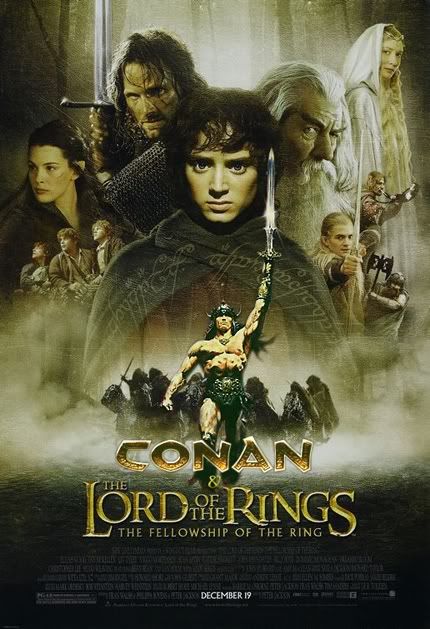
Frodo! What is best in life?


I ran into this somewhere online and of course, I saved it. Cause it makes me grin.

I can imagine Arnold's Conan hewing his way through orcs with lots of Schwarzeneggery vocal effects. "Nnngggraahhh! Awhhooghh! I kill you all! Get to the Choppah!" Maybe not the last one.

Truthfully though, I'd really like a fantasy movie with the scale and heroic theme of the LOTRs movies, and the gritty, joyous hack and slashery of the first Arnold Conan movie. Lets not talk about the second one.

I have a bad feeling about the oncoming Conan movie with Jason Momoa from Stargate Atlantis. I don't doubt Momoa is gonna give it his all, and from the pics of him I've seen in the role, he's looking the part, mostly.

It's just that the hollywood braintrust has done their usual hatchet job on Howard's work. Made up their own characters, pasted on the standard "seeks revenge" plot, and altered Conan to make the non-Howardian elements fit.

I just don't see why all of Howards Conan stories couldn't be treated in the same way they did Arthur Conan Doyle's Sherlock Holmes stories in that Jeremy Brett series. Or the Brother Cadfael stories, or the Hercule Poirot stories.

All most all the Conan work is short stories anyway. Why not a faithful run of one hour episodes?