Saturday, July 3, 2010

The Spontaneous Creation of Magic Items in Play.


I think of my Wyrd Greyhawk as a low magic campaign world, but in fact, it is awash in it. Magic is elemental, a fundamental natural force which permeates and penetrates all space and things in the game world, living and not. Wells and currents of magical energy dot the world, allowing for things and creatures that mundane physics would deny. Raw arcane force has properties and behaviors of it’s own, but these are not completely definable as they vary, shift, and change from time to time and place to place. The only reliable definition of magic is that, it is that which science is not.

The thing that is actually low in Wyrd Greyhawk is the PC’s ability to access and control magic, and employ it to do their bidding. Harnessing magic to create a magic item, or cast a spell is like building a water wheel in order to to use the power of a river to run a mill. Spell work or magic item creation require extensive knowledge, skills, and resources, as well as a proper location and the needed natural energy. Just as a water mill would require knowledge and skill in metallurgy, woodworking, stonemasonry, a basic understanding of physics, the necessary materials, and a strong flowing stream, so too does magic use have a great number of prerequisites.

These things are well beyond the scope of the vast majority of people in Wyrd Greyhawk. Creating a magic item requires knowledge of magic that would be on a level equal with the ability to build a wind turbine to generate electricity, from scratch, without formal schooling. Remember, there are no magic universities or schools in Wyrd Greyhawk, only individual archmages who may choose to take apprentices or not.

This makes the number of magic items and their availability to the PCs in The Game very low and infrequent, which is what the phrase “Low Magic” is commonly seen to mean in gaming terms. This allows me a game world steeped in eldritch glamour without having PC’s suffering Christmas Tree Syndrome and cheapening the weird and unsettling feeling I want magic to have. I actually employ parts of the 2E wild magic system under certain conditions to enhance the atmosphere and ensure that players never take magic for granted. But that’s a post for another day.

This post is about how the natural flow of background magic, combined with circumstance and motivating action on the part of PCs, as well as the good judgment of the DM, occasionally results in the spontaneous creation of magic items.

When a PC shows a particular liking for, and flare in the use of, a particular mundane item, I begin assigning that item Arcane Potential Points, (APPs). Each time that item is employed in a manner which is inventive, showy, changes the course of an encounter or adventure, increases that character’s stature or renown in some way, snatches victory from the jaws of defeat, or is above and beyond the ordinary in some way, I award the item 1 APP. Sometimes 2.

This is a measure of the natural magic of the game world being invested in and/or attracted to the item by the heroic or infamous actions of its wielder. Some events, desperate acts performed under duress or moments of incredible luck, cause ripples and reverberations in the arcane aether, drawing currents of magic towards objects and people. Such actions need not be good in nature, but must be of consequence. I don’t tell players this sort of thing, it’s above their paygrade.

Once an item has accumulated 10 APPs, it has a chance of spontaneously demonstrating magical abilities. This chance is equal to the weilder’s chance of Saving VS Magic. If the item fails the save, it will never become a spontaneous magic channel, end of story. If it succeeds, it has become a magic item.

The DM may proceed in several ways according to the goals of his particular play style from this point.

The magic may be rolled for randomly, using the magic item lists from whatever iteration of The Game you favor and adjusting the result to fit the item. This can be fun, but nonsensical. Which may or may not be a problem for you.

The magic may be dictated by the circumstances of the event which bestowed the final APP. A troll slaying may result in the sword bestowing regenerative abilities on its user. Knocking a thief off a wall with a staff might give the staff the power to cause vertigo or loss of balance on a hit, etc…. I tend to favor this approach myself; I like symmetry and sympathy in magic.

The magic may be related to the characters backstory if you run a story driven campaign. It could be that the character’s actions have activated some destined fate and the spontaneous magic item will in some way make possible a previously unknown or unreachable goal. You could easily retcon any number of plot points into the game in this manner.

The magic may be influenced by powers divine or infernal if such are present in some way at the moment of magical investiture. It may even be possible that the item could become cursed in some way if the final APP derives from an act of evil.

The magic may cause the item to become sentient in addition to whatever magical powers may be gained. In this case, the rules for dealing with intelligent swords come into play, with all that entails regarding power struggles between the PC and the item.

Weapons are the obvious items to become spontaneously magically charged, but any item which a character uses regularly in the requisite manner may possibly become magical. This especially applies to items which are intrinsic to the characters class. Items such as a thief’s favorite crowbar, a friar’s fighting gloves, a paladin’s spurs, or items like a frying pan, a banner, a blanket, etc… May begin to accumulate APPs, if through play they become a regular part of a character’s idiom.

This system allows for magic items to be inserted into a low magic campaign in a way that doesn’t lessen the weirdness of magic, and at a rate that is controllable by the DM. Magic items that come into being this way are very personal to the characters and are treated as having much more value than the generic sword +2 looted from orc hoard #47.

You may or may not wish to inform the players of the new magical power of their item. I find it entertaining to cause unexplained events and drop hints rather than outright announce these things. If the PCs get suspicious and drop some coin on sages and mages, they may find out what has happened, but probably not how, or why. The thing that makes magic, magic is its unpredictability and ultimate uncontrollability. Science is repeatable; magic may or may not be so.

The players don’t get to manipulate this system to create magic items as they wish. As a DM of the Old Guard, I don’t need proof of rules lawyery or bad faith manipulation to get all smitey, only suspicion of same.

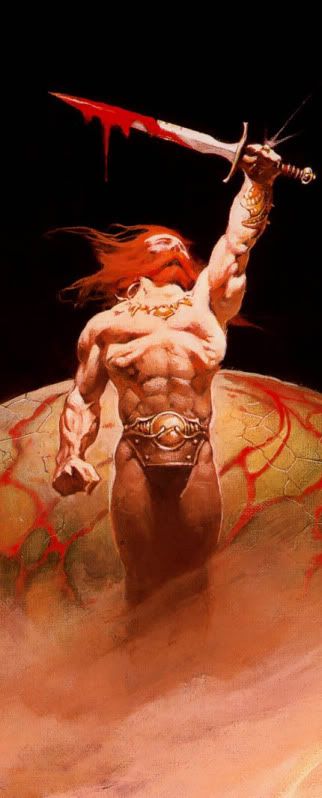
The pic is a clip from the center of a Frazetta painting for Karl Edward Wagner's Kane. I dig it. In my fantasy afterlife, Frazetta sits in on Gary's game in the sky and does the character portraits.

Thursday, June 3, 2010

Wyrd Greyhawk; "And the Goblins WILL get you, if you don't watch out!"


Fear stalks the land in many guises. There are few who know it not.

Great Lords sit their thrones with knotted brows, brooding upon the depredations of dragons, the glory to be won by victory, the ruin brought by defeat. Mighty wizards dwell upon the machinations of their rivals, and mull the limits of their own mastery of magic. Untrustworthy servant that it is, and quick to turn in the hand of he who overreaches. Even those who speak with the Gods themselves carry hidden fears, for with the gift of secret wisdom comes knowledge of the endless Infernal forces which threaten the very existence of all things.

The fears of the great and puissant are not, however, the fears of the common man. Dragons, devils, and malign magic are threats that most know, but vaguely. As fearsome tales told by fireside and distant fables from olden days.

When the plowman pauses in his work to gaze across the furrowed fields and into the shadows of the tulgey woods, it is not the appearance of a great and ravening scaled beast which he fears. When the washerwoman halts in her labor amongst the stones, and warily glances upstream towards the river bend, she does not watch for a warlock to arrive in a flash of reeking vapor. When the cooper wakes in the night and hearkens after sounds in the darkness, it’s not the lustful roar of demons that he listens for.

Such perils are the domain of warriors, wizards, and priests. The peasantry fear that which they know, that which they have suffered by all too often. What the rustics and villagers fear most is the furtive rustle amongst the dim-lit groves, the sudden spiteful black arrow, and the mad, cruel laughter of the Goblins.

The goblins of Wyrd Greyhawk are one race, but of two sorts, the High, and the Low. The Low Goblins retain the standard statistics of AD&D goblins with only a few changes.

Goblins prey upon all other races as the circumstances may allow. They are conscious-less creatures who see all other living things as toys to be tormented for their own amusement, and as food. Cruel mirth is the force which motivates them. Goblins exult in malignant jokes and tricks, usually lethal in nature, visited upon the unsuspecting and helpless. Outright murder is commonly engaged in, but given time to prepare, goblins will always prefer that the death be entertaining for them, and humiliating for the victims.

Low Goblins range between 3 and 5 feet in height, with gray-green warty skin, broad mouths filled with pointed teeth, and lambent yellow eyes. There is much variety amongst them as to general physical conformation. They may be stocky as dwarves, or thin as elves. Some have been told of as sporting horns, others as being as hairy as a ram. There are no reliable reports which can be used to discern the true aspects of their appearance. Those who are learned conjecture that so close is the goblin’s connection to primal chaos that their very forms are subject to change with each generation.

Goblins make very few things for themselves, instead dressing in the clothing of previous victims and employing the weapons of those who have died at their hands. Goblins of the Low sort are most often encountered in groups of 6-24. When more are encountered, they will always be lead by a High Goblin.

All goblins are Chaotic Evil and not Lawful Evil. They are, in fact, so resistant to any sort of order that Low Goblins must check moral every 6th round in any endeavor,(combat, a march, construction, etc..), for which they have no heart. Failure of the moral check does not indicate fear, for though the goblins live to bring terror to others, they themselves feel that emotion but little. Rather, their inner chaos is of such intensity that they are unable to remain dedicated to any task to which they are not driven.

This moral check may be dispensed with if the low goblins are captained, or otherwise commanded by a High Goblin. A High Goblin Lord they will obey with gleeful abandon, even to the point of taking obviously suicidal actions if so commanded.

High Goblins

Frequency: Very Rare
No. Appearing: 1-6
Armor Class: 4, or by armor type.
Move: 12”, (120’ per round)
Hit Dice: 6
% In-Lair: 40%
Treasure Type: Nx4, Q
No. of Attacks: 2
Damage/Attack: 1-6, or by weapon
Special Attacks: Seeming, Curse, see below
Special Defenses: Shadow Step
Magic Resistance: Standard
Intelligence: Highly Intelligent
Alignment: Chaotic Evil, exemplary so
Size: M
Psionic Ability: Nil

The High Goblins are beings of greater intelligence, subtlety, and sophistication than the jeering and cackling Low Goblins. Terribly, this makes their evil humor horrific in its depth and depravity. Those who find themselves within the power of the High Goblins may come to consider their captors witty and insightful. They may feel them to be wildly entertaining and fascinating hosts. This gives their eventual and certain betrayal and death much greater savor and delight from the twisted perspective of the goblins. Sauce for the goose, as it were.

High Goblins are rarely met in large groups. They prefer to live as individuals, Lording over clans of Low Goblins where their will is uncontested. Sometimes families or cabals of High Goblins orbit a particularly powerful, malign, or expansive individual whose force of personality allows him to influence others of his kind. Rarely does a High Goblin appear who can force sufficient numbers of his race to submit to his Lordship and claim the ephemeral title of Goblin King.

The High Goblins are tall and spare of build. They have sharper features than the Low Goblins, skin of a lighter grey, and red-gold eyes shining with sardonic joy from beneath lank, green-black hair. This, the true visage of the High Goblins is rarely seen by others for the “Noble Goblins” posses the inherent magical ability to create a Seeming. The Seeming is both a charm, and a disguise. Those who fail to Save VS Magic will see the High Goblin in whatever form it has chosen, and will perceive it as non-threatening, a friend or possible ally. High Goblins employ the Seeming to gain information, or to lead the trusting astray. They often choose to appear as rangers, elves, or hermits, beguiling travelers or those lost in the wilderness. Once a being has been taken in by the Seeming, it will remain in effect through multiple encounters with the same goblin until it has been lifted by a remove curse, or the goblin himself negates it by attacking the victim. A person may labor for years beneath the delusion of the seeming if it amuses the goblin to continue to string him along, or else it furthers some dark and intricate plot.

The goblins are as closely linked to evil as they are to chaos. Acts of evil, committed by those of non-evil alignment due to instigation by the goblins, temporarily enhance the inborn powers of the goblins.

As an example, goblins may travel by stepping into and out of shadow once per day. This ability allows them to cross distances of up to a mile instantly if shadows exist at both locations. This is the reason that dusk is called, “the Goblin hour”, by villagers and woodsmen. Normally, goblins lack the power to cross boundary lines or circumvent magical wards by stepping through shadow. Even a closed door, or scribed rune prevents entry by the goblins to the most humble cottage by stepping from the shadows.

If, however, through careful machinations the goblins have manipulated the occupants into evil action in some way, they gain sufficient power to enable them to overcome their normal limitations and gain access through the shadows. It must be an actual evil act on the part of the occupants, and not simply a thought or attitude in order for the goblins to gain entry, though even so small a thing as a blasphemous curse uttered in a moment of anger may prove fatal. At the DM’s discretion of course.

Any weapon, magical or not, acts as though Of Wounding in the hands of a High Goblin. Wounds inflicted will not heal naturally and will require magical or divine intervention. Lost hit points will not be regained until the damage has been dealt with by a cleric or magical healing.

A High Goblin may Curse a victim a single time, but if the curse is removed, may never curse that creature again. The curse will be minor, but difficult to deal with. As examples, lameness in one leg, cutting Movement rate in half, deafness, increasing the victim’s chance of being surprised, Confusion, the victim will shortly become lost if not always accompanied, etc… The DM is encouraged to be creative and fitting in inventing goblin curses, and the remedies thereof.

All goblins, both the Low, and the High, receive +1 to hit with the short bow. Their black shafted, spiral fletched arrows are often, (35% chance), smeared with concoctions which cause hallucinations or madness, (50% chance of either). Those struck must Save VS Poison to avoid the effects. Victims who suffer hallucinations will imagine attack by random monsters or catastrophic natural events, (floods, storms, earthquakes), and will act accordingly. Those struck by madness may rave and tear their own cloths, randomly attacking anyone near or hurting themselves. Hallucinations will last for 1d10 rounds, Madness for 2d10 rounds. There is a 10% chance of madness becoming permanent and requiring magical healing to correct.

Each High Goblin encountered has a 25% chance of magic-use with a spell-like form. Goblin magic requires no material components or spell books, though the effects of the wyrd-work are similar in outcome to wizard’s magic. Goblin spells are cast by a short, eerie chant or song which takes 1 round to complete. If a goblin is capable of magic, he may work spells of power roughly commensurate with up to the 4th level of magic use. A goblins ability to work magic is static; it does not increase in levels as does a human magic-user’s. Instead, a goblin may cast 7 spells per day of whatever power level.

As shown above concerning the goblin’s ability to step in and out of shadow, a High Goblin can for a time increase the power of his magic by tricking non-evil aligned creatures into acts of evil. If a High Goblin, through deceit, convinced one party member to unjustly betray another, the power of the next spell he chose to cast would be doubled. This is a complex situation and no set of rules can be written to address all of the possibilities which may arise, so the DM must proceed with all due diligence.

In creating goblin spells, the DM may choose in some random fashion from the magic-user spells of the first to the fourth level. The mechanics of the spells will remain the same, excepting for the single round casting time and the lack of a need for material components, but the visual and/or auditory effects of the spell will be altered to make them strange and unfamiliar to the Player Characters. Magic Missile will function in the game in the standard manner as written; however the glowing darts of magical energy are replaced by a number of large, iridescent hummingbirds which flash through the air emitting a grating whine and impale the target on their needle beaks before vanishing in a spurt of foul ectoplasm.
----------------------------------

The new job, putting in my garden, shop projects, etc, have eaten up most of my time this past month. I only got to work on the goblins in fits and starts. Honestly, I've also been so fascinated in watching the disintegration of civilization in real time that my attention was directed away from D&D. Ridiculous, I know. The march of events in the real world is predictable, unlike the randomness of The Game, but still, it's hard to look away from the train wreck even when you know how it's going to play out.

Heh...

The pic is Blix from Legend, the only Tom Cruise movie which refrained from sucking.

Sunday, May 2, 2010

I don't really go to game conventions because...

I prefer going to general sci-fi and fantasy conventions rather than actual gaming conventions. I’ve not gamed all that often with people I don’t already know well, though of course I’d be willing to make an exception for you. If you’re reading this blog, we’re probably simpatico, compadre.

The only tournament style game I ever played in was AD&D, of course, at the Emperor’s Birthday Convention, probably in 81 or 82. The Emperor’s Birthday was originally a wargaming con, but I hear it later amalgamated with Griffcon, and I think they’re both now defunct. It was here in Indiana, but I don’t remember where now. I’m sure one of you knows where it was and who put it on.

Anyway, my high school gaming circle at the time was probably 16 or so strong, with a core of 6 enthusiasts, including me. The others came and went, sometimes playing a lot for a while and then losing interest. We were self taught at playing The Game, we never had any older players to show us how it was done. I was the instigator, I started with the Holmes edition that Mom had found in a yard sale, and dragged all my buddies into it as fast as I could. We moved on to AD&D as soon as it came along. It was in big hardbacks man, how could it not be cooler? It said ADVANCED right on the cover!
So, somebody ran into a flyer for the Emperor’s Birthday con and we decided to register for the tournament. We were all excited to have a chance to play, “Real Big League D&D”, official and everything. I mean, you had to register and all that, that had to mean it was adult and serious and important, right?

We weren’t quite old enough to drive, so we all rode up to the con in a van driven by the father of one of the guys. We got situated at our table and waited for the DM. I don’t remember now if the game was an official TSR module, or something the DM wrote himself. I do remember that it sucked. Not the adventure itself, I never got the chance to read it, the actual play of the game sucked.

I love tension in the game. I like purple prose and lurid description. I want to smell the dank musty corridors, hear the rutch of nailed boots on stone and the ring of steel on bone. I came to D&D from literature and not wargaming, so in my mind, it's atmosphere and immersion that have precedence over calculation and tactics. Only by a little bit though, I do play to win and I won’t turn down a victory for characters sake.
EPs are EPs man, get em’ where you can.

The problem here was that at the Emperor’s Birthday game, our DM was Ben Stein. He had the most boring monotone presentation I’d ever encountered. Just imagine Stein’s voice saying, “You’ve come to a T in the passage. It proceeds both to the right and to the left. Which way do you go? Anybody…. Anybody…. Buehler?”

I’m not exaggerating much here, folks. We were all a bit dumfounded that it was even possible to suck all the excitement out of D&D. Some of our games ended in table flipping and fisticuffs, we even locked a player in his own car trunk one time. This guy was the most egregious example of, “You’re Doing It Wrong!” that I’ve ever encountered.

We might have stuck with it but for the second wrench in the works. When the DM arrived, he wasn’t alone. He brought along his son, probably about 11 years old, and announced he would be joining our party. We thought, “Uh, well, ok…” If the DM thought the kid was mature and experienced enough to game at a “Real Big League D&D Event”, surely everything would go fine.

Nope, the kid was ADHD before it was cool. He was a disaster, charging from one room to another without any party consultation, acting on his own, thieving from party members, recklessly attacking everything we encountered. we were horrified.
We knew this was a timed tournament, there were points to gather, goals to achieve, and we had a rabid badger as a party member. And he was the DM’s son, we were trapped.

Eventually though, a moment arrived when we could rid ourselves of the dungeon albatross and retain plausible deniability. The kid decided to don his ring of invisibility without consulting the party, and sneak across a rope bridge which spanned an underground chasm. There was a bugbear outpost on the other side, and he meant to get there first and steal the choicest treasure items before the rest of us could arrive.

At any other time, this would have been a laudable Old School maneuver. Something any of us might have done in game. But for ruining our first, “Real Big League D&D Event!”, it was the last straw.

As I was watching the bugbears, the DM mentioned to me that I saw the rope bridge begin to sway of its own accord. So of course I pointed and yelled, “Invisible Monster!”. The party opened up on the Rope Bridge, daggers, arrows, hand axes, and magic missiles went flying the length of it to transfix the “invisible monster!” The kid reappeared mid bridge, a pin cushion of adventuring hardware, and pitched over into the chasm. I think maybe the DM realized he was losing us and decided to sacrifice the kid to keep the game going. With great power comes great responsibility. Heh…

Even getting rid of the kid didn’t make the game much better though. The DM was a guy who probably should have stuck to Napoleonics. He just didn’t have the joie de vivre needed give the game life. After a bit, we started suiciding our characters in order to escape. There was a dealer’s room to check out and we were tired of the Underdark Death March. I deliberately set off an easily avoided poison needle trap and went hunting minis. After a couple stupid deaths, the DM caught on to what we were doing and started furiously fudging the dice in our favor so we wouldn’t be killed.

The guys got away with ridiculous maneuvers that would have gotten them stone dead if I was behind the screen. My buddy running a dwarf fighter managed to strangle a hill giant to death with his bare hands.

Now, I’ll still game with strangers if we seem to have some common ground. I had a pretty good game with a guy from work, his wife, and a friend of theirs a while back, but I’m not interested in schedualed convention games. That’s probably not fair from one crappy game so many years ago, but I’m ok with that.
Now, on the other hand, if I ever get to Garycon, I think I’d be pretty much assured that my fellow con-goers would be Old Guard compatible, and it would be an honor to die a messy death in their company.

Thursday, April 29, 2010

Sunuvabitch! Blogger just ate my friggen post!

Serves me right for not writing it out in Word first. Crap.

Sunday, April 25, 2010

Bent a cam on the Difference Engine.

I've been off the Aether-Net for a bit. One of the tertiary cams on my difference engine bent, metal fatigue most likely. Luckily my brother is and informational technologies electro-smith, and was able to combine the best components of mine old engine with those of a second.

The new and improved Old Guard difference engine is capable of far greater computational speed and power. The hammers just ring!

New posts will soon follow. Up the Irons!

Saturday, April 17, 2010

The Dwarfs of Folklore vs the Dwarves of The Game.


Along side the PC available Dwarves, I’m including the Dwarfs of folklore as monsters, (little m), cause I dig that black fairytale vibe. These are the venal, unpredictable and generally no good hairy little men who take advantage of lost travelers, trick the innocent into bad bargains, and steal young women and children who wander unprotected.

Dwarf of the Wild Wood.

Frequency: Very Rare
No. Appearing: 1-6, usually a single dwarf will be encountered
Armor Class: 4, or by armor type
Move: 12”, 120 feet in a round
Hit Dice: 4
% in lair: 40%
Treasure Type: F
No. of Attacks: 2
Damage/Attack: 1-4, or by weapon
Special Attacks: Misdirection
Special Defenses: Vanish
Magic Resistance: 15%
Intelligence: Very High
Alignment: Chaotic Neutral by default, but may be any non-good.
Size: S, variable, 2-4 feet tall on average.
Psionic Ability: nil

A lean and gnarled little man, with an avaricious leer and a sardonic glint in his eye, a dwarf of the wild wood is the last person an adventurer in a tight spot would hope to see. Cunning and venal tricksters, the dwarfs exult in taking advantage of those whom they chance to find in dire straits.

In fact, chance often has little to do with the encounter, as dwarfs lay traps and dig pits to capture the unwary or reckless traveler. It is the dwarfs practice to deny responsibility for the trap, and to offer aid to the unfortunate, but always at a great price.

They will require the victim’s word that he will not go back upon the bargain struck, and though the dwarfs have no sense of honor themselves, they are also bound by the literal words of the deal, and must also abide by it.

If an adventurer should manage to gain a position of advantage or at least of equality with a dwarf, he may be able to reach an agreement by which he may gain a great deal. The dwarfs are peerless crafters of metal and workers of inherent magic. Though not mighty spell casters, dwarfs are able to imbue great magical power in the work of their forges and furnaces. Jewelry, weapons and armor produced by dwarfs are often items of nearly artifact level puissance.

Dwarfs are also quite knowledgeable in areas of dark and hidden wisdom and may be consulted as though they were sages concerning subjects which a prudent adventurer may not wish to openly inquire after. Of course, a dwarf will drive a very hard bargain before providing such lore, and may leave out information which could prove deadly to the incautious. Let the buyer beware who chooses to do business with a dwarf.

A dwarf will rarely choose to engage in direct melee. Though dwarf made weapons can be fearsome, and the armor they craft formidable, they have little liking for putting themselves in danger. If seriously threatened, it is likely a dwarf will use his innate ability to Vanish. In a flash, or with a stamp of his foot, or by stepping into shadow, a dwarf may remove himself from a location of immanent danger once per day. This may function in a manner analogous to Dimension Door, Teleport, Passwall, Meld with Stone, or other standard spell as the DM sees fit.

A dwarf also possesses the power of Misdirection. A dwarf may divert the attention of those who fail to Save VS Spell by insinuation and inference once per day. In this manner a dwarf may cause others to change their plans or act in a way which advances the dwarf’s own agenda at the expense of their own original course.

As an example, Migrud, the dwarf who dwells near the wells of Ohlam, through Misdirection caused Sir Holgruh, Brulm of the Heavy Hand and Yeilasnia the Sharper to abandon their intention to seek the Wyrm’s Band, and instead confront the caravan of Mehulude at the Hoarnung ferry. This action allowed Migrud to steal the daughter of Mehulude in the confusion. Though the knavery was found out, to the shame of all involved, neither the dwarf, nor the girl were ever seen again.

Dwarfs are nearly always encountered as lone individuals as they are too paranoid and untrustworthy to often live in groups. If a group is encountered it is likely they are working a mine or managing some other source of wealth which requires at least some teamwork to acquire.

Encountered dwarfs are always male, it is uncertain that there even are female dwarfs and it is hinted darkly that this lack is the reason for the dwarf’s predilection towards woman theft.
Dwarfs vary in appearance and size, with skin often nut brown, sometimes black, and sometimes pale white. They have long and wild beards and unkempt hair. Dwarfs may dress in the height of fashion, or they may appear in filthy rags. In no case is it safe or wise to judge a dwarf’s prowess by his appearance.
Dwarfs tend to inhabit areas that are wild and uncharted, but near to a civilized land. They live in caves and mines, build huts or shacks in deep woods, or lurk close by waterfalls or riverbends.
Dwarfs are always aware of the passage of travelers through their land and watch avidly for the chance to gain by the misfortunes of others. If it is necessary to manufacture this misfortune then to a dwarf, so much sweeter is the gain.


Anything that becomes popular for any length of time tends to move further and further from its point of origin as the facets of it which attract the most attention are magnified by public perception and feedback on the original. Most things, art movements, political positions, musical styles, The Game, become self-referential at some point and move away from whatever originally attracted the majority of fans to them in the first place.
Getting at the root of The Game, and from that point considering and testing the directions in which it wasn’t explored is a big part of what the OSR is for, in my mind. Alongside with, and complementary to, building my personal iteration of Greyhawk , I’m revisiting the basic elements of the game to find their origins and see what happens when I look at them from a different direction. Just like the rest of you.

So, dwarfs. OD&D dwarves are largely Tolkien dwarves. The good professor humanized the dwarfs of folklore and fairytale and turned them into an organized and non-human, but relatable race. They have their own motivations and desires, but they reflect facets of human nature, stubbornness, greed, inflexibility, etc… the same as the orcs represent war on nature, militarism, destruction for its own sake.

As The Game has changed with new editions and materials, so have the portrayals of dwarves in The Game also changed. OD&D dwarves were, after the Tolkien version, non-magical, technologically oriented, stolid, hardworking, and unforgiving. There really wasn’t all that much written about the dwarves culture, but it was natural to default to Tolkien and to the cultures from which most of the original folktales he drew from, Scandinavian, Germanic,Celtic, English and so on.

Of course, that cultural feedback loop starts up quickly as a thing grows in popularity, and the most prominent features of what was written about dwarves were amalgamated with the same prominent features of the northern European cultures they had their roots in, and commonly perceived dwarf game culture began to rapidly expand.

Now, there is a sweet spot in the arc of development of whatever cultural fancy you want to talk about, where it is fully realized and detailed and distinct from its inspirational origin. After this point, caricature sets in, like gangrene, and the compounding stereotypes turn it into a joke. This shark-jumping occurs in every medium, and it’s pretty much unavoidable. It’s hard to pin point when it happened, but suddenly every dwarf was Foamy Tankard MacTankard, hard drinking, grim, stubborn, but loyal warrior/iron worker of the Stony Iron Hammer Shield Clan.

This is why there are renaissances. Of gaming, and otherwise.

I’m not about to throw out the Tolkienesque D&D dwarves as PC races, I’ll just scrape off the cultural cruft and try and restore them to original condition so I can add new cultural cruft that’s in keeping with my own sensibilities.


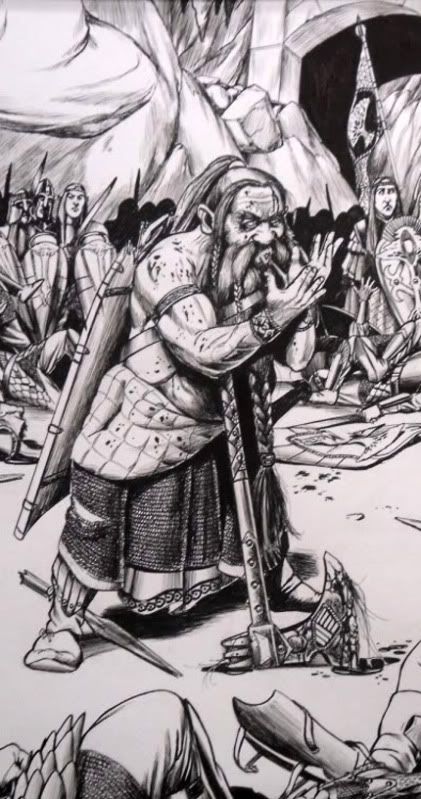
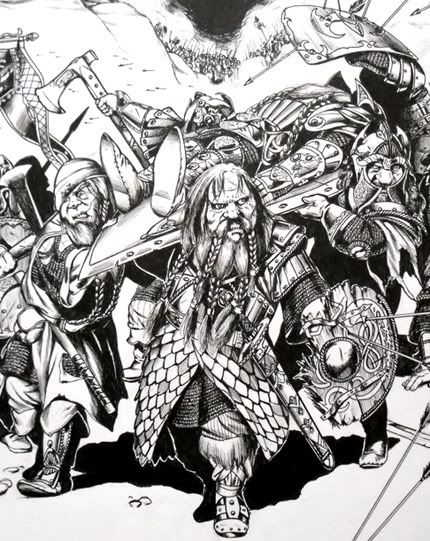
My favorite art depictions of pre shark jumping dwarves are always by Jim Holloway. This has a lot to do with the fact that Jim’s art has a sharp sense of fantastic realism and rough humor, as well as clean line work and good figure balance. The armor and weapons he depicts are just slightly fantasized versions of real world examples and believable to me and that’s important to my view of fantasy. Spikes, straps and ridiculous oversized weapons just kick me right out of suspension of disbelief.

This will be my starting point for redeveloping PC dwarves for Wyrd Greyhawk. If I decide it's needed. As with the paladin, the players don't care that much, so this is just for me. And you if it appeals to you.

These last two images are close ups that I've clipped out of larger pieces by Holloway. The originals you may find in the Holloway art thread at Dragonsfoot. These are new art, not previously appearing in published D&D material. Mr Holloway is planning a book of new illustrations, and I'll be glad to see it.

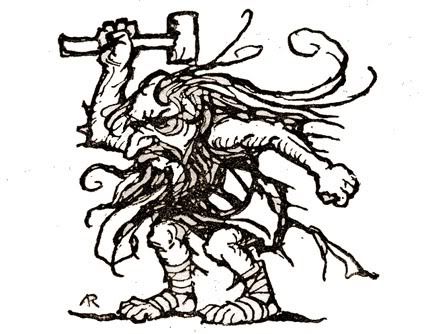
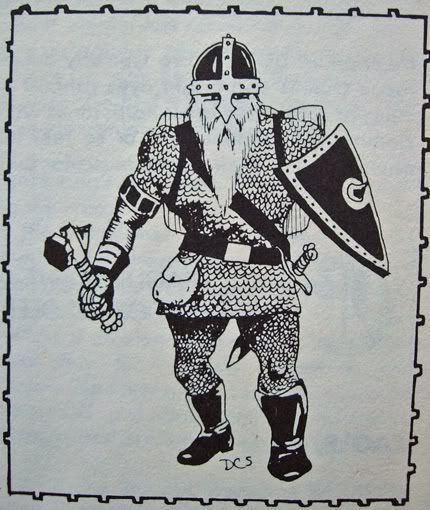
The top illustration is by Rackham, it's a small page decoration for The Rhinegold. The second image is a pic of Sutherland's illustration for the dwarf entry in the 1e Monster Manual.

Saturday, April 10, 2010

Musical Inspiration.

This is what I was listening to when I wrote the Wyrd-Paladin post.

Dead Can Dance- The Chant of the Paladin.


http://www.youtube.com/watch?v=MrOjTMWf5eM